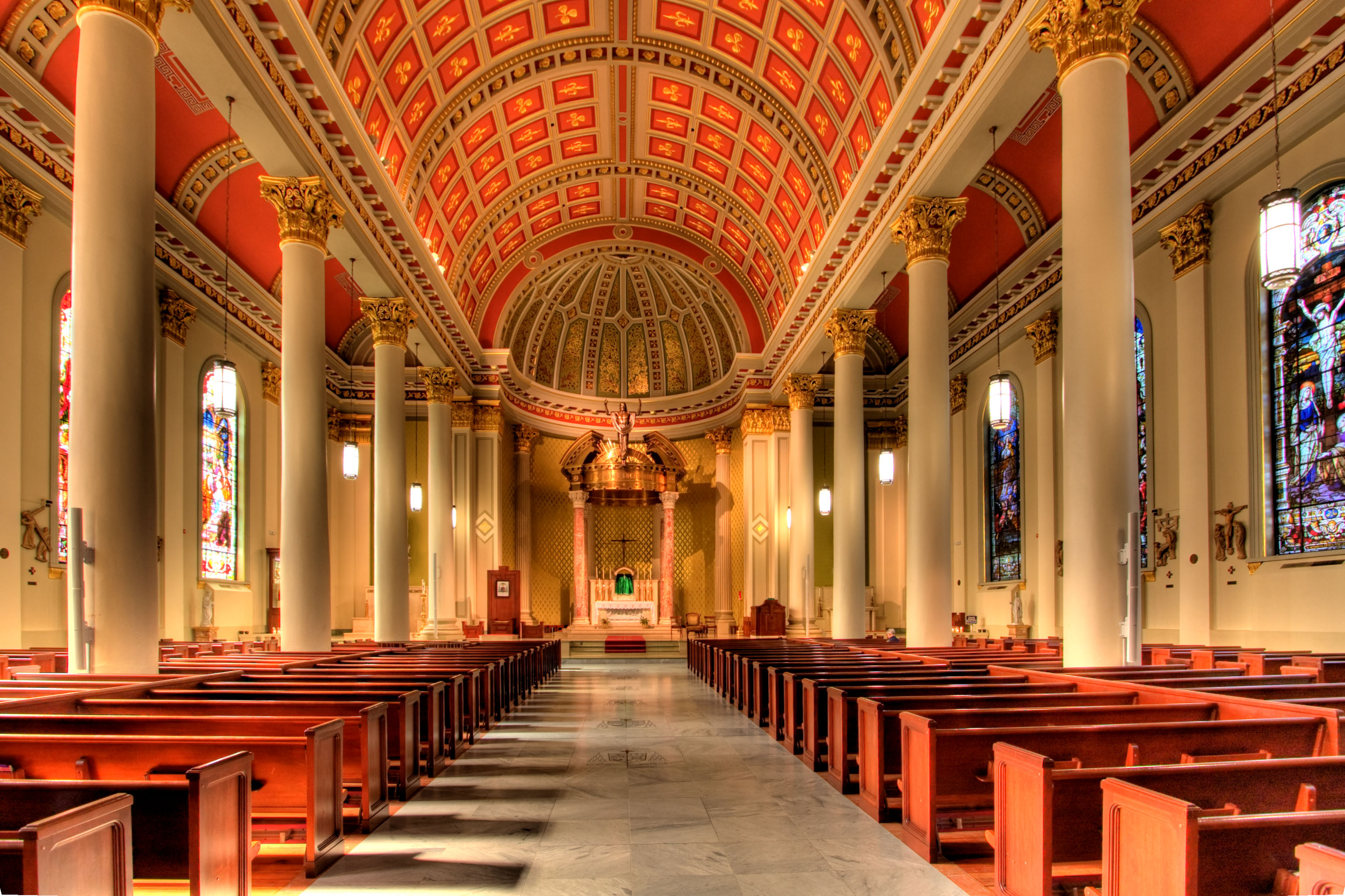
Cathedral Basilica of the Immaculate Conception
The parish is older than the city that surrounds it. On July 20, 1703 -- a full year after Mobile's founding and seventy-three years before the Declaration of Independence -- the Bishop of Quebec established a Catholic congregation at the French citadel of Fort Louis de la Louisiane. It was the first parish on the entire Gulf Coast. More than three centuries later, the Cathedral Basilica of the Immaculate Conception still anchors downtown Mobile, its twin towers and classical portico rising above the city as testimony to a congregation that has outlasted French colonial rule, Spanish occupation, financial panics, a catastrophic explosion, a plane crash, and fire.
Three Flags, One Parish
The parish has served under three national flags. Father Roulleaux de La Vente became its first pastor in the French settlement, where the church was known as Notre Dame de la Mobile -- Our Lady of Mobile. When the settlement relocated to its present site in 1711, a new church was built under the same name. Then came the Spanish. In 1781, during Spain's occupation of Mobile, the parish took its current name: Immaculate Conception. When Pope Pius VIII erected the Diocese of Mobile in 1829, he appointed Bishop Michael Portier as its first bishop. Portier's initial cathedral was a modest wooden structure sitting on the Old Spanish Burying Ground -- the very site where the present cathedral stands today. He soon resolved to build something more permanent.
A Cathedral Born in Crisis
In 1833, Portier hired Claude Beroujon, a former seminarian turned architect, to design a Roman basilica for the new cathedral. Portier laid the cornerstone in 1835, but the Panic of 1837 -- one of the worst financial crises in American history -- brought construction to a grinding halt. It took thirteen more years before Portier could finally consecrate the building in 1850, and even then the cathedral lacked its portico and towers. Money was simply too scarce. Bishop John Quinlan added the classical portico in the 1870s, with eight massive Doric columns across the front, and Bishop Jeremiah O'Sullivan completed the twin towers in 1884. The cathedral had taken half a century to finish.
Blast, Crash, and Fire
The cathedral has endured catastrophes that would have destroyed lesser buildings. On May 25, 1865, just weeks after the Civil War ended, roughly 30 tons of gunpowder ignited inside a Union Army ammunition depot at Marshall's Warehouse in Mobile. The blast killed some 300 people and devastated much of the town. The windows and sashes on the cathedral's north side were blown in by the explosion. Then in 1946, a U.S. Navy aviator clipped one of the crosses atop the south tower before crashing to his death. In 1954, a fire that started in the church basement caused severe damage to the interior. Each time, the congregation rebuilt. The stained glass windows that had been destroyed by the 1954 fire were remade by the same German studio that created the originals.
Windows from Munich
The cathedral's stained glass windows are among its finest treasures. Made in Munich, Germany, by Franz Mayer & Co., they were installed between 1890 and 1910. Twelve main windows -- six on the south wall, six on the north -- each depict an event involving Mary in the life of Jesus, from the Annunciation to the Coronation of Mary as Queen of Heaven. Portico windows beneath each tower show the Baptism of Jesus and St. Cecilia, patron saint of musicians. Eight foyer doors carry smaller windows depicting saints including Augustine of Hippo, St. Patrick, and Louis IX of France. After the 1954 fire damaged several of the windows, Franz Mayer & Co. remade them, maintaining the artistic continuity that spans more than a century.
Still Standing After Three Centuries
In 1962, Pope John XXIII elevated the cathedral to the rank of minor basilica, recognizing both its historical significance and its architectural beauty. The building sits on an east-west axis, its barrel vault ceiling and rows of interior columns reflecting Beroujon's original Roman basilica design. The Greek Revival exterior, with its eight Doric columns and twin towers, was photographed by the Historic American Buildings Survey in 1936, preserving a visual record of the structure during its first century. Today the Cathedral Basilica of the Immaculate Conception serves as the seat of the Archbishop of the Roman Catholic Archdiocese of Mobile -- the spiritual anchor of a parish that has been in continuous operation for more than 320 years.
From the Air
Located at 30.690°N, 88.046°W in downtown Mobile, Alabama. The cathedral's twin towers and classical portico are visible from moderate altitude against the surrounding low-rise downtown. The building is oriented east-west. Best viewed from 1,500-2,500 feet AGL. Look for the large white columned facade facing east, roughly 3 blocks north of the Mobile River waterfront. Nearby airports: KBFM (Mobile Downtown Airport, 2 nm southwest), KMOB (Mobile Regional Airport, 8 nm west). The Boyington Oak at Church Street Graveyard is approximately 0.5 nm to the northwest.