Cathedral of Chihuahua
One real per mark of silver. That was the price of faith in colonial Chihuahua. For nearly seven decades, from 1725 to 1792, every ingot of silver pulled from the mines of the province contributed to the rising walls of what would become northern Mexico's most magnificent cathedral. The Metropolitan Cathedral Church of the Holy Cross, Our Lady of Regla, and St Francis of Assisi stands today on the Plaza de Armas, its Spanish Baroque facade a testament to the wealth that flowed through these mountains and the devotion of those who extracted it. Mine owners from Chihuahua and nearby Santa Eulalia joined local merchants in funding the construction, transforming raw mineral wealth into carved stone and gilded altars.
Columns That Spiral Toward Heaven
The cathedral's facade announces its ambitions immediately. Solomonic columns - those twisted, spiraling pillars that seem to rotate as they rise - were still rare in New Spain when builders incorporated them here. The effect is dynamic, almost alive, drawing the eye upward through a collection of monuments celebrating the twelve apostles to a clock crowned by an angel sculpture. That angel was a nineteenth-century addition; below it once hung the royal Spanish coat of arms, removed in 1874 by architect Jose Felix Maceira during Mexico's post-independence transformation. The clock he installed, acquired in London, now marks time where empire once proclaimed dominion. An octagonal window shipped from Germany catches the light, its panes considered a fine specimen of the glassmaker's art even centuries later.
Master Builders and Mortal Remains
Construction began on June 21, 1725, when the Bishop of Nueva Vizcaya placed the first stone. Sergeant-Major Juan Antonio Trasvina y Retes had donated the land, but it would take generations of builders to realize the vision. Pedro Coronado served as the first superintendent, followed by Miguel de la Sierra, and then Master Architect Jose de la Cruz, who finalized the plans and earned the honor of burial within the church upon his death in 1734. The bells were cast in 1730, waiting half a century in storage before Architect Bernardo del Carpio completed the towers in 1780 and Superintendent Melchor Guaspe directed their installation. Each name represents years of labor, vision passed from hand to hand like the stones themselves.
Sacred Spaces Within
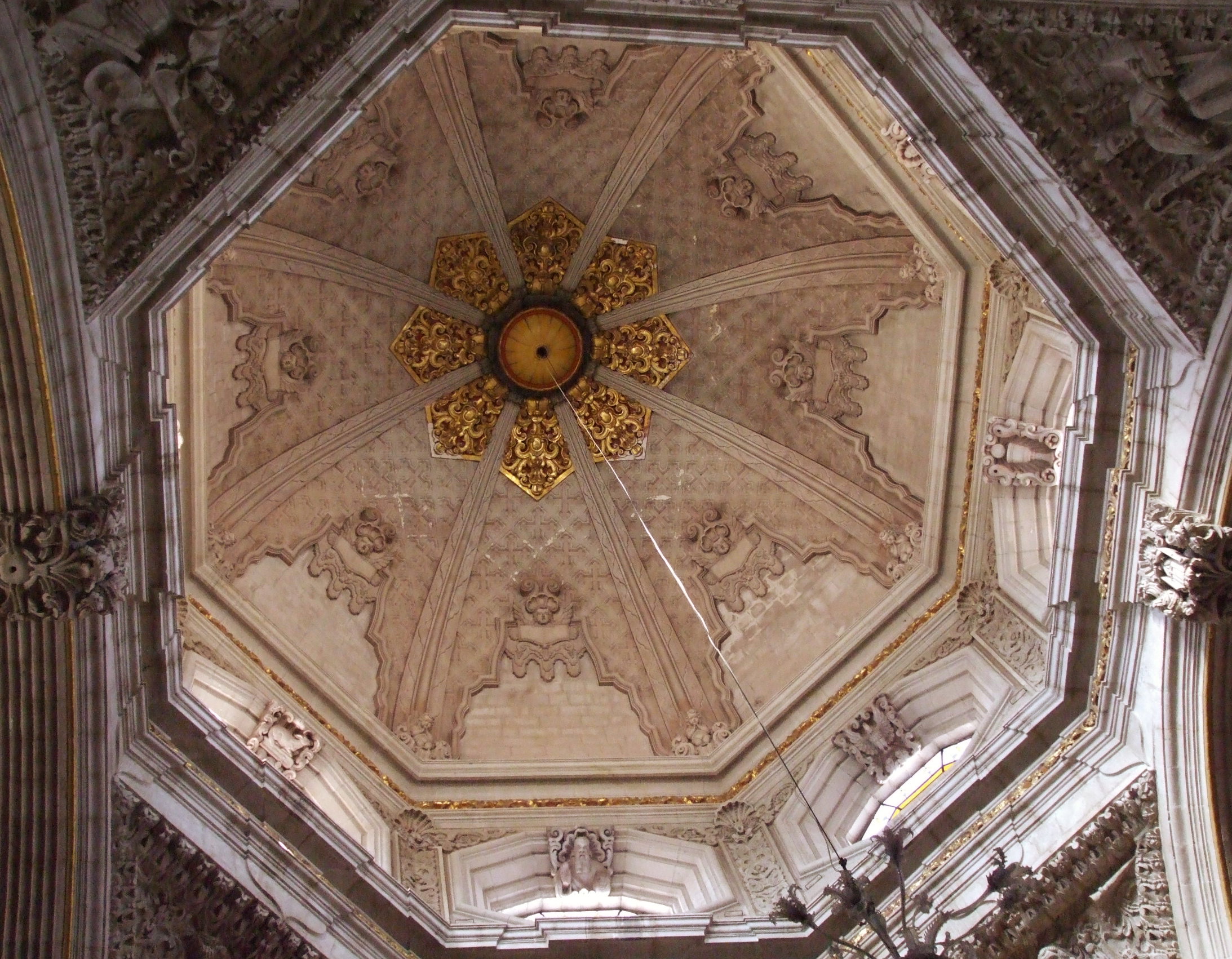
The interior unfolds as a series of discoveries. Just inside the entrance, a fine baptistry chapel occupies the north side, while directly opposite lies the Chapel of Christ of Mapimi with its remarkable eighteenth-century retablo blending Primitive and Baroque elements. Here rests St Peter of Jesus Maldonado, a priest ordained in El Paso, Texas, who became a martyr during the Cristero War and was canonized by Pope John Paul II in 2000. The chancel contains an unusual double altar - a smaller piece of Carrara marble nestled within a larger one of local quarry stone, added after the original construction. In the east gallery, an organ built by Hook and Hastings in 1885, later rebuilt and expanded by E.F. Walcker in 1960, fills the nave with sound where earlier instruments by George Jardine once played.
The Crypt and Its Treasures
Below the main floor, the Sacred Art Museum occupies the cathedral's crypt, adjacent to the tombs of past archbishops. Colonial-era masters are represented here: Miguel Cabrera, Jose de Alcibar, Jose de Paez, and Antonio de Torres, their canvases preserved in the cool darkness. The throne Pope John Paul II used during his 1990 Mass in Chihuahua stands on display, along with the ornate former archbishop's cathedra and canopy. Life-sized statues of saints, some two centuries old, watch over the collection. It is a space where the sacred and the artistic intertwine, where devotion found expression in pigment and gold leaf.
Light in the Desert Night
The cathedral was designated as such in 1891, when Chihuahua was elevated from its status as part of the Diocese of Durango. In 1958, it became the metropolitan archdiocese for five suffragan dioceses across the state. But for many visitors, the cathedral's most memorable transformation comes after dark. In 1910, to celebrate the centenary of Mexican independence, the facade blazed with electric lights - then fell dark for nearly a century. In 2005, permanent illumination returned, and in October 2008, the city celebrated its approaching tricentenary with a spectacular light show across the Baroque facade. The solomonic columns, the apostles, the angel with its sword - all now glow against the desert night, silver and stone made luminous.
From the Air
The Cathedral of Chihuahua sits at 28.64N, 106.08W on the Plaza de Armas in the heart of Chihuahua City. The distinctive Baroque facade and twin towers are visible from altitude among the urban grid. Roberto Fierro Villalobos International Airport (MMCU/CUU) lies approximately 12 miles to the southeast. The city sits in a high desert valley at roughly 4,700 feet elevation, surrounded by three prominent hills visible in the city's coat of arms. Approach from any direction for views of the cathedral against the mountain backdrop. Clear skies predominate except during summer monsoon season.