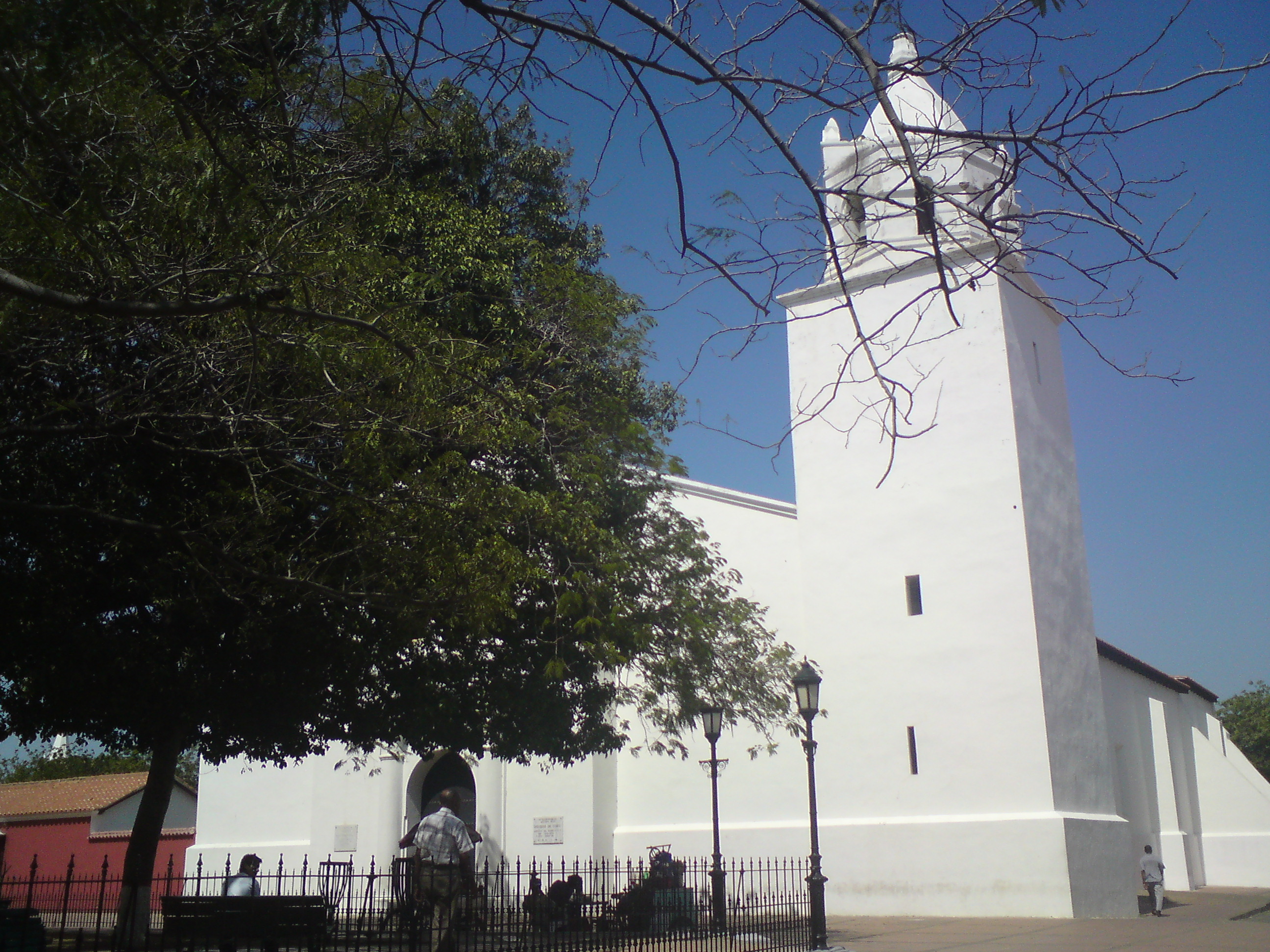
Cathedral of Coro
Gun slits in a church tower tell you something about the neighborhood. The Cathedral Basilica of St. Anne in Coro, Venezuela's oldest surviving church, was built not just for worship but for defense - its tower walls punctuated with narrow openings designed to repel pirate attacks from the Caribbean. Construction began in 1583 and dragged on for roughly half a century, an eternity that reflected both the ambition of the project and the realities of building at the edge of a colonial empire. When the work was finally completed around 1634, the result was a structure that would influence the architectural character of every church built in Venezuela for the next century.
A Diocese Before a Cathedral
The story of the cathedral begins not with stone but with a papal decree. In 1531, Pope Clement VII created the Diocese of Coro, establishing the first bishopric on the South American continent. Coro itself had been founded just four years earlier, in 1527, by Juan de Ampies - and almost immediately handed over to the German Welser banking family, who governed the province as Klein-Venedig from 1528 to 1546. The city served as the capital of the Captaincy General of Venezuela until 1578. By the time cathedral construction began in 1583, Coro was already a place of layered authority: Spanish crown, German financiers, Catholic diocese, indigenous communities. The cathedral would embody all of those tensions in stone.
Fifty Years of Raising Walls
No record survives of who designed the cathedral's floor plan - a nave flanked by two aisles, described in Spanish architectural terminology as three naves. What is documented is the painstaking pace of construction. Between 1608 and 1615, Francisco Ramirez oversaw the building of the dome and two lateral vaults, essential structural work that gave the interior its volume and light. When Ramirez's role ended, Nevada Bartolome took over in 1615, and his continuity proved critical to bringing the project to completion. The tower rose after 1620, and the entire structure is believed to have been finished around 1634 - nearly fifty years after the first stone was laid. Among all buildings constructed in Venezuela before 1713, the cathedral was the most architecturally significant, establishing precedents in form and proportion that shaped church construction across the country for generations.
Remodeled, Restored, Endangered
The cathedral's history did not freeze when construction ended. In 1928, it underwent an extensive remodeling that altered its colonial character. But recognition of its historical importance caught up: in 1957, the cathedral was declared a national monument, and subsequent restoration work brought it back toward its original appearance. When UNESCO designated Coro and the nearby port town of La Vela de Coro as a World Heritage Site in 1993 - Venezuela's first - the cathedral was included in the site's buffer zone rather than its core area. Then the rains came. In 2005, heavy storms damaged Coro's earthen colonial buildings so severely that UNESCO placed the entire site on its List of World Heritage in Danger. The cathedral, built of sturdier material than the surrounding mud-brick houses, survived better than its neighbors, but the threat underscored how fragile even centuries-old architecture remains in a changing climate.
Stone Memory at the Edge of Empire
Coro sits on the dry, windswept isthmus connecting the Paraguana Peninsula to the Venezuelan mainland, far from the country's modern centers of power. The cathedral stands in the city's historic core, surrounded by streets where colonial Spanish architecture blends with Mudejar influences carried from Moorish Spain and Dutch building traditions imported from nearby Curacao and Aruba. It is a cruciform structure, one of the few examples of cross-plan colonial architecture in Venezuela. Walking through its nave, you move through nearly five centuries of continuous worship in a building that has outlasted the empire that commissioned it, the pirate raids it was designed to resist, and the political upheavals that repeatedly reshaped the nation around it. The gun slits in the tower are sealed now. The pirates are long gone. But the cathedral still watches over Coro, the oldest surviving witness to Venezuela's colonial founding.
From the Air
The Cathedral of Coro is located at approximately 11.41N, 69.68W in the historic center of Coro, Falcon state, Venezuela. From the air, the city sits on the narrow isthmus connecting the Paraguana Peninsula to the mainland, making it a distinctive geographic landmark. The nearest airport is SVJC (Josefa Camejo International Airport, also known as Coro Airport) just south of the city. La Vela de Coro, the associated port town, is visible on the coast approximately 12 km to the northeast. The Medanos de Coro sand dunes, a national park, lie between the two towns and are highly visible from altitude.