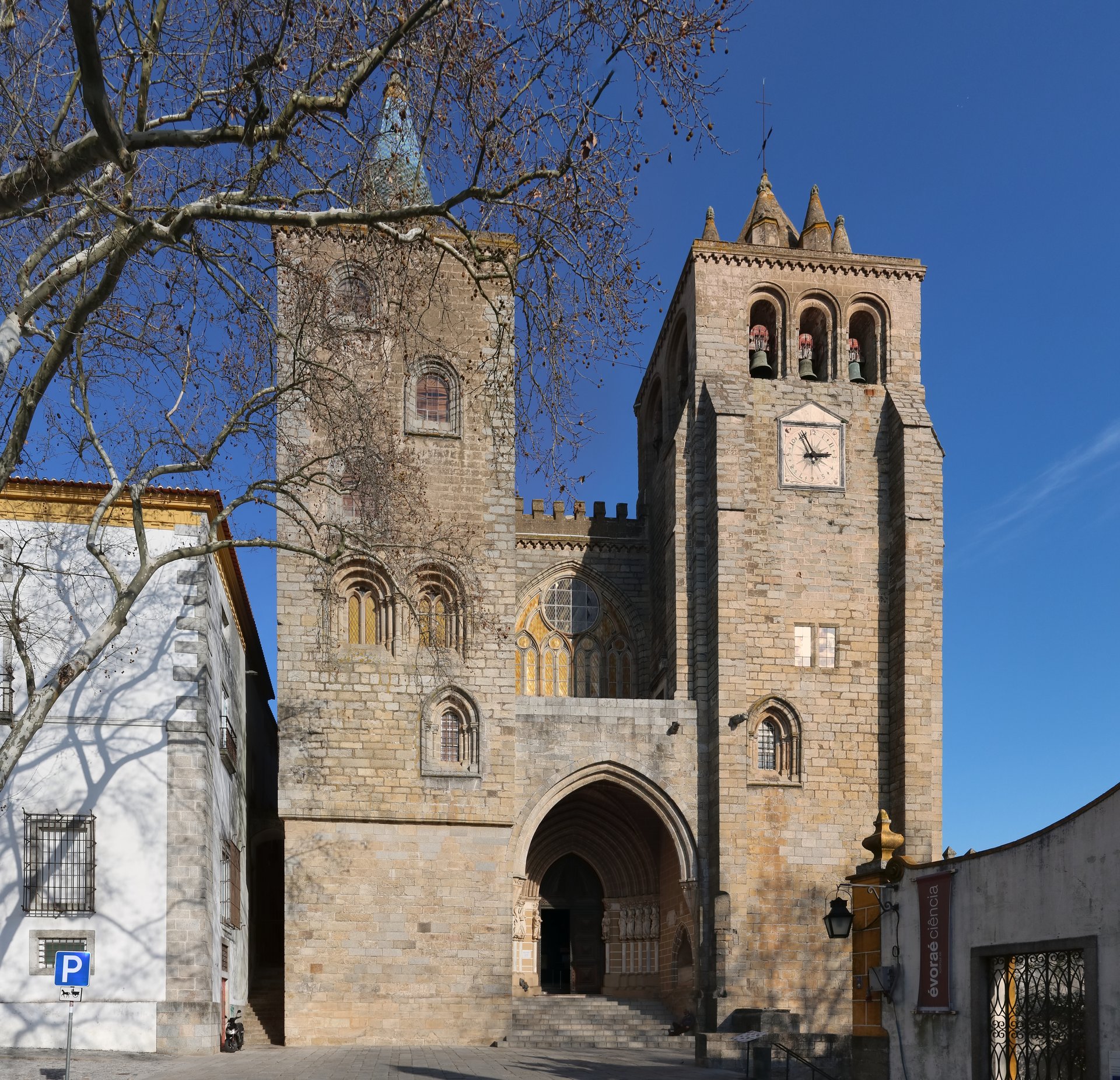
Cathedral of Evora
In 1497, before Vasco da Gama's fleet set sail for the Orient on the voyage that would reshape global trade, the expedition's flags were blessed in the presbytery of the Cathedral of Evora. The cathedral had already been standing for nearly three centuries by then, built on the highest point in the city shortly after Geraldo Sem Pavor -- Gerald the Fearless -- wrested Evora from Arab control in 1166. It is the largest medieval cathedral in Portugal, a fortress-church of rose granite whose battlemented walls and lantern tower recall a time when cathedrals were built to defend as well as to worship.
Apostles at the Door
The main portal is a masterpiece of Portuguese Gothic sculpture. Huge marble statues of the twelve Apostles occupy the columns flanking the entrance, carved in the 1330s, likely by sculptors known as Master Pero and Telo Garcia. Free-standing Gothic sculptures of this kind are rare in Portugal; they are more commonly associated with funerary monuments than with church doorways. Above the Apostles, the pointed ogival arch frames the entrance in the style that defines the entire building. The facade, built with the same rose granite that gives Evora's old city its warm, pinkish cast, is flanked by two massive towers completed in the 16th century, each topped with a different conical spire -- one clad in medieval colored tiles, the other bare stone.
A Cardinal Who Became King
The most important historical figure associated with the cathedral is Cardinal-King Henrique, who served as archbishop and cardinal of Evora before an extraordinary turn of fate forced him onto the Portuguese throne. Henrique was the brother of King John III, and when the young King Sebastian died at the Battle of Alcacer-Quibir in 1578, there was no direct heir. Henrique, already elderly, ruled for just two years, from 1578 to 1580. His brief reign ended Portugal's independence, as the Spanish crown absorbed the kingdom after his death. But his legacy at the cathedral endures: his scepter, a 16th-century goldsmith work in Manueline style, is among the treasures of the cathedral museum.
Sound and Stone
In the 16th and 17th centuries, the cathedral became the center of the School of Evora, a tradition of polyphonic music that rivaled the finest in Europe. Composers Mateus de Aranda and Manuel Mendes taught here, and Mendes trained pupils who became famous in their own right -- Duarte Lobo and Filipe de Magalhaes among them. The music they created was shaped by the building's acoustics: a large nave with a pointed barrel vault, white mortar on bare high walls amplifying and diffusing sound. Near the entrance stands Portugal's oldest functioning organ, dated to around 1544 and built by Heitor Lobo. The choir stalls, carved from oak by sculptors from Antwerp in 1562, are decorated with mythological scenes and images of courtly life, hunting parties, and farm work -- secular subjects carved into sacred furniture.
The Virgin Who Opens
The cathedral museum houses one of Portugal's most remarkable objects: a 13th-century French ivory statue of the Virgin Mary, just twelve inches tall, whose midsection opens like a triptych to reveal nine miniature scenes from her life carved inside. The head is a 16th-century replacement, but the body and its hidden narrative are original -- a puzzle box of devotion, portable and intimate. Nearby sits the reliquary of the Santo Lenho, or Holy Wood, a 17th-century vessel of gilded silver and polychromed enamel encrusted with 1,426 gems: 840 diamonds, 402 rubies, 180 emeralds, two sapphires, one hyacinth, and one cameo. The main chapel, rebuilt between 1718 and 1746 by the German architect Joao Frederico Ludovice for King John V, introduces Roman baroque polychrome marble into the medieval granite interior -- green from Italy, white from Montes Claros, red and black from Sintra.
From the Air
Located at 38.57N, 7.91W on the highest point in the historic center of Evora, Portugal. The cathedral's lantern tower and twin spires are the most prominent features of the old city skyline. The Roman Temple of Evora stands immediately adjacent. Nearest airports: Evora (military, LPEV); Lisbon-Humberto Delgado (LPPT), approximately 130 km northwest. Best viewed at 1,500-3,000 ft AGL. The entire historic center is a UNESCO World Heritage Site.