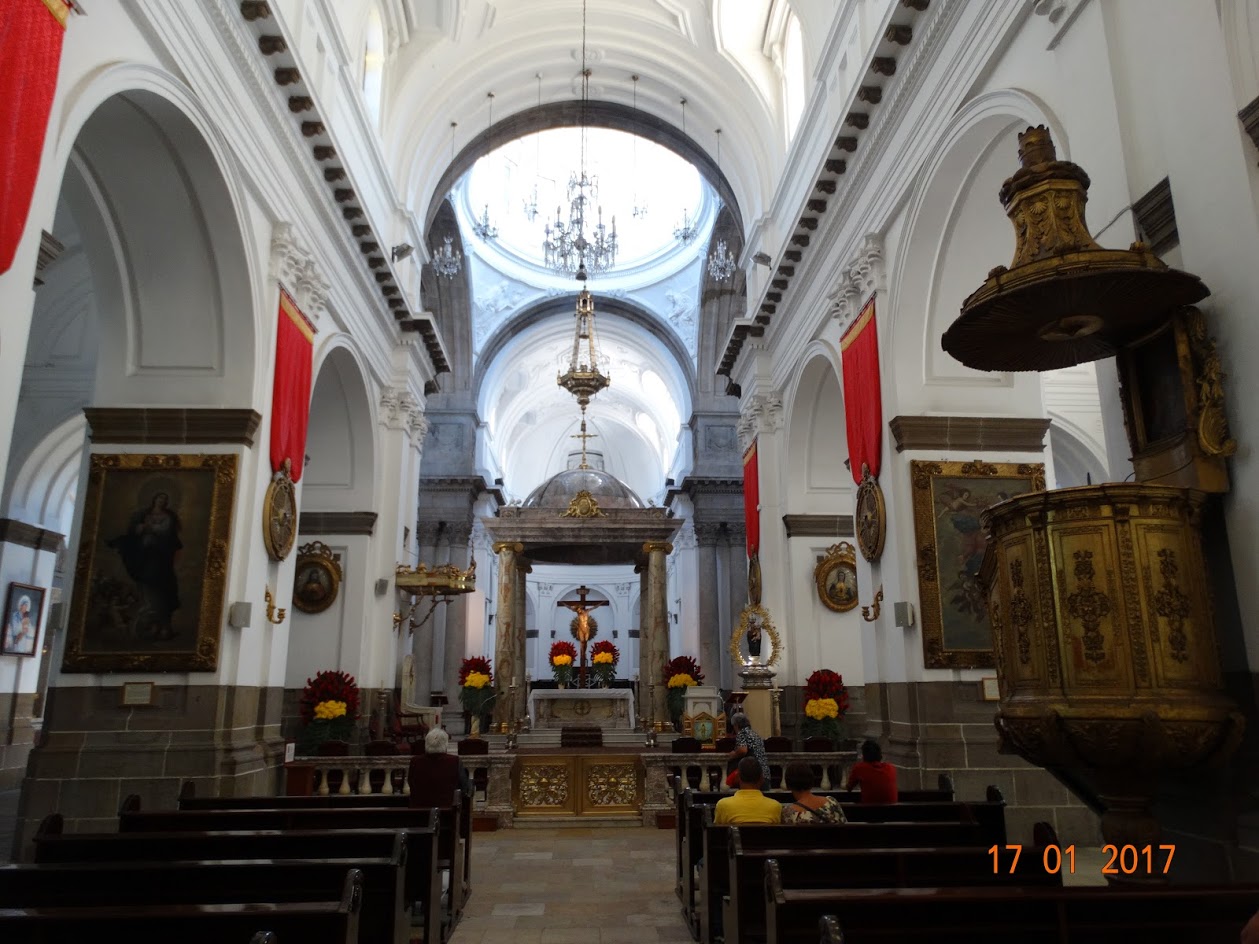
Cathedral of Guatemala City
Twelve pillars stand in front of Guatemala City's Metropolitan Cathedral. They are not structural columns holding up the building. They are memorials, inscribed with the names of thousands of people who were forcibly disappeared or murdered during Guatemala's internal armed conflict — a war that began in 1960 and did not end until the final peace accord was signed in 1996. Behind the pillars rises a massive structure blending baroque and classical elements, its walls thick enough to absorb the worst that Central American geology has thrown at it over two centuries. The cathedral is the main church of both Guatemala City and the Archdiocese of Guatemala, but its meaning extends far beyond liturgy. It is a building that has been relocated, rebuilt, shaken apart, and put back together — a physical record of the forces that have shaped this country.
Born from Earthquake Ruins
The cathedral's origins trace to destruction. In 1773, the Santa Marta earthquakes devastated Santiago de los Caballeros de Guatemala — modern-day Antigua Guatemala — and triggered a bitter fight over whether to rebuild in place or relocate the capital entirely. Archbishop Pedro Cortes y Larraz opposed the move, fearing the church would lose its power and influence if it had to start from scratch. Captain General Martin de Mayorga overruled him, and the capital shifted to the Ermita Valley. The cathedral followed reluctantly, arriving at its provisional location in a small chapel on November 22, 1779. When that chapel deteriorated, services moved to the Santa Rosa Chapel in 1786. The ornaments from the old cathedral in Antigua — whatever had survived the earthquake — were salvaged and stored in the old Universidad de San Carlos Borromeo building. The church spent 36 years in temporary quarters before reaching its permanent home.
Thirty-Three Years of Stone
Construction began officially on August 13, 1783, after architect Marco Ibanez, artist Antonio Bernasconi, and engineer Joaquin de Isasi spent two years drafting blueprints that were approved by Royal Decree on November 6, 1779. Archbishop Cayetano Francos y Monroy — who had replaced the resistant Cortes y Larraz — laid the first stone in 1782. Work ground forward for three decades. By 1815, the main section was complete enough to receive the sculpture of Our Lady of Perpetual Help in a formal procession from Santa Rosa, and the church opened with a Te Deum. In 1816, gold from the old altars was melted and recast for the new ones. The east towers went up starting in 1821. On July 23, 1860, a new altar of Carrara marble replaced the original wooden one. The towers were finished in 1867, and the main bell — cast from the bronze of cannons from San Jose Fort — was blessed during the First Vatican Council in 1871. Guatemalans gave the bell a nickname: "La Chepona."
Shaken Twice, Standing Still
The earthquakes came in cycles. In late 1917, tremors began destroying towns near Amatitlan. Then, on December 25 and 29, 1917, and January 3 and 4, 1918, powerful earthquakes devastated Guatemala City itself. The cathedral was badly damaged. Under President Manuel Estrada Cabrera, the government response was slow and widely criticized — the semi-official newspaper Diario de Centro America published updates twice daily and openly attacked the administration's incompetence. More than half a century later, at 3:01 in the morning on February 4, 1976, a magnitude 7.5 earthquake struck near Los Amates, 160 kilometers northeast of the capital. Approximately 23,000 people died across Guatemala, 76,000 were wounded, and more than a million were displaced. The cathedral collapsed again. This time, President Kjell Eugenio Laugerud Garcia organized an efficient recovery, and the cathedral was completely repaired within five years. The building's survival is not a matter of luck. Its massive walls and structural redundancy were designed for a seismically active region — not invulnerable, but rebuildable.
Memory Carved in Stone
The cathedral's interior is relatively sparse for a building of its stature, but that restraint only amplifies the weight of what it holds. The altars are ornate, the space vast, and the structural thickness of the walls creates a silence that feels earned rather than designed. In 2003, Pope John Paul II authorized the canonical coronation of the Immaculate Conception enshrined within the cathedral, a ceremony that took place on December 5, 2004. But for many Guatemalans, the building's most powerful feature is outside: those twelve pillars bearing the names of the disappeared. Guatemala's civil war lasted 36 years and killed an estimated 200,000 people, the vast majority of them indigenous Maya. The pillars do not explain. They do not argue. They simply list names, and in that listing insist that each name belonged to a person who lived and was taken. The cathedral stands behind them as it has stood behind everything — war, earthquake, revolution — absorbing damage and refusing to fall.
From the Air
The Metropolitan Cathedral sits at 14.642°N, 90.512°W on the Parque Central in the heart of Guatemala City. From 3,000–5,000 feet AGL, the Parque Central is identifiable as a large open square in the dense urban core, with the cathedral's twin towers and massive footprint visible on its north side. La Aurora International Airport (MGGT) lies approximately 4 km south-southwest. Guatemala City occupies a highland valley at roughly 4,900 feet elevation. Volcanic peaks — Agua, Fuego, and Acatenango — are visible to the west and southwest on clear days. Expect afternoon thermals and occasional low visibility from volcanic haze.