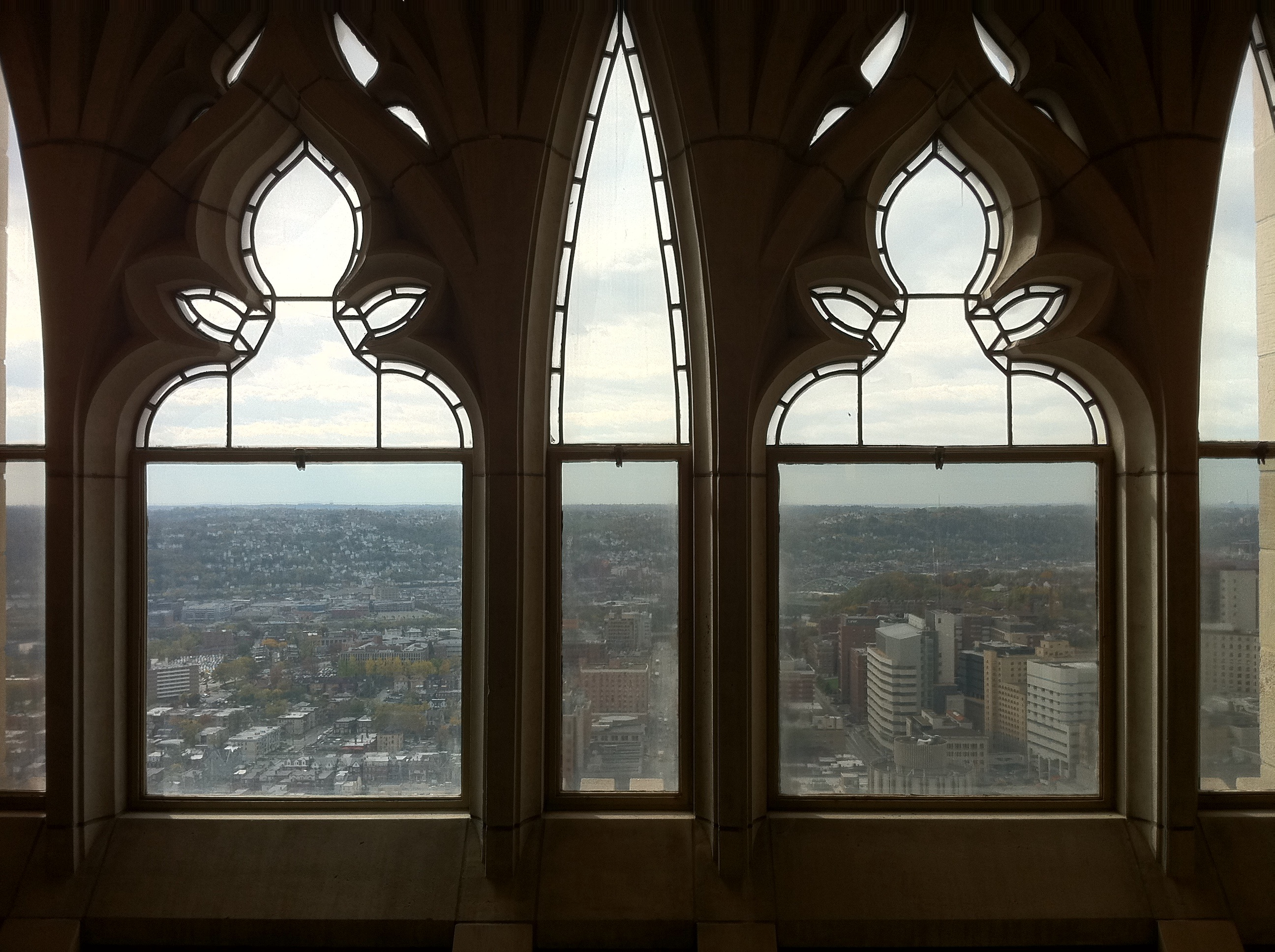
Cathedral of Learning
Ninety-seven thousand children each sent a dime and a letter explaining how they earned it. In exchange, each received a certificate for one brick in a Gothic tower that was rising over Pittsburgh's Oakland neighborhood in the late 1920s. The campaign was called "Buy a Brick for Pitt," and it helped fund one of the most audacious buildings in American higher education: the Cathedral of Learning, a 42-story Late Gothic Revival skyscraper that remains the tallest educational building in the Western Hemisphere. Students call it "Cathy." They also call it the "drunken compass" - because no matter how lost you get in Oakland, you can always see it, and it will point you home.
A Tall Vision in a Smoky City
In 1921, John Gabbert Bowman became the University of Pittsburgh's tenth chancellor and inherited a campus of scattered buildings and World War I-era temporary wooden structures. He envisioned a single, dramatic tower that would symbolize education's importance to the city and solve the university's chronic overcrowding. Bowman secured a plot called Frick Acres - a $2.5 million donation aided by the Mellon family - and hired Philadelphia Gothic architect Charles Klauder to design the building. The plan fused a modern skyscraper with Gothic architectural tradition, and it met fierce resistance. Community members and university officials argued it was too tall for Pittsburgh. Ground was broken in 1926. When the first class was held in the building in 1931, the exterior was still unfinished. It was completed in October 1934 and formally dedicated in June 1937.
The Commons Room: Half an Acre of Gothic Silence
Step inside the Cathedral's first floor and the city vanishes. The Commons Room is a half-acre, four-story-high English perpendicular Gothic hall that architect Klauder considered his greatest achievement. It was a gift from Andrew Mellon. The arches are true arches - no steel supports hold them up. Each base weighs five tons and is placed so firmly it could support a large truck. The room's secret weapon is overhead: Guastavino acoustical tiles set between the vaulting ribs absorb sound, keeping the cavernous space remarkably quiet despite constant use as a study hall. The corridors surrounding the Commons Room hold calligraphy hand-cut in slate by Edward Catich and stained glass windows by Charles Connick. On the first floor, the Croghan-Schenley Ballroom conceals Greek Revival rooms dating to 1835, transplanted from a demolished Pittsburgh mansion - along with stories of a ghost, possibly Mary Schenley herself, who rearranges furniture after the doors are locked each night.
Thirty-One Nations Under One Roof
The Cathedral houses 31 Nationality Rooms on the first and third floors, each designed to celebrate a culture that shaped Pittsburgh's growth. The program began in 1926 when Bowman invited each nationality with a significant presence in Pittsburgh to design their own room. The university provided only the space and ongoing maintenance; each ethnic community was responsible for all fundraising, design, and materials. Foreign governments sometimes contributed, and the rooms contain authentic artifacts from their respective countries. Twenty-nine of the rooms function as working classrooms. Each room depicts an era before 1787 - the year of the university's founding and the signing of the U.S. Constitution - with one exception: the French Classroom depicts the period just after. A typical first-floor room took three to ten years to complete and cost the equivalent of $300,000 in 2006 dollars. More recent rooms have cost $750,000 and up, and six additional rooms are in various stages of planning.
Falcons, Victory Lights, and a Wartime Barracks
The Cathedral's 40th floor balcony is home to a nesting pair of peregrine falcons. Golden "victory lights" ring the building's highest floors and glow amber after Pitt football wins. During World War II, the building served as a barracks: roughly 1,000 Army Air Corps personnel were housed, fed, and instructed inside, with at least 12 floors dedicated to military use from 1943 to 1945. A bomb threat on July 26, 1940, prompted extra guards and raised fears of wartime sabotage. The building contains more than 2,000 rooms and windows, and its steel frame is clad in Indiana limestone. After decades of accumulated soot, the university approved nearly $5 million for cleaning and restoration in 2007, restoring the exterior to its original pale appearance - though some Oakland residents had argued the grime should stay as an homage to Pittsburgh's industrial past.
Built from the Top Down (Almost)
A persistent legend claims that Chancellor Bowman ordered construction to start at the top floor and work downward, making the project impossible to cancel. The truth is more practical. The Cathedral's exterior walls are not load-bearing - the building hangs from an interior steel frame. Similar structures typically began exterior stonework at the third or fourth floor to allow easy movement of materials. In the Cathedral's case, the quarry supplying stone for the lower floors was not ready on schedule, so masons started higher up. The myth took root from a 1943 military tabloid that stated "the masonry was started from the top downward." Construction photos prove otherwise. The steel-frame structure overlaid with limestone stands 42 stories tall, second among the world's gothic-styled buildings only to the Woolworth Building in Manhattan, and second among university buildings only to the main building of Moscow State University.
From the Air
Located at 40.444°N, 79.953°W in the Oakland neighborhood of Pittsburgh, Pennsylvania. The Cathedral of Learning is the tallest structure in the Oakland area and is clearly visible from altitude as a distinctive Gothic tower rising above the surrounding university campus. Look for the pale limestone structure amid the green of Schenley Park to the south and east. The golden victory lights may be visible at night. Pittsburgh International Airport (KPIT) is approximately 18 miles west. Allegheny County Airport (KAGC) is approximately 7 miles south. Downtown Pittsburgh's skyline is visible 3 miles to the northwest at the confluence of the three rivers. The University of Pittsburgh campus, including the adjacent Heinz Memorial Chapel and Schenley Plaza, surrounds the building.