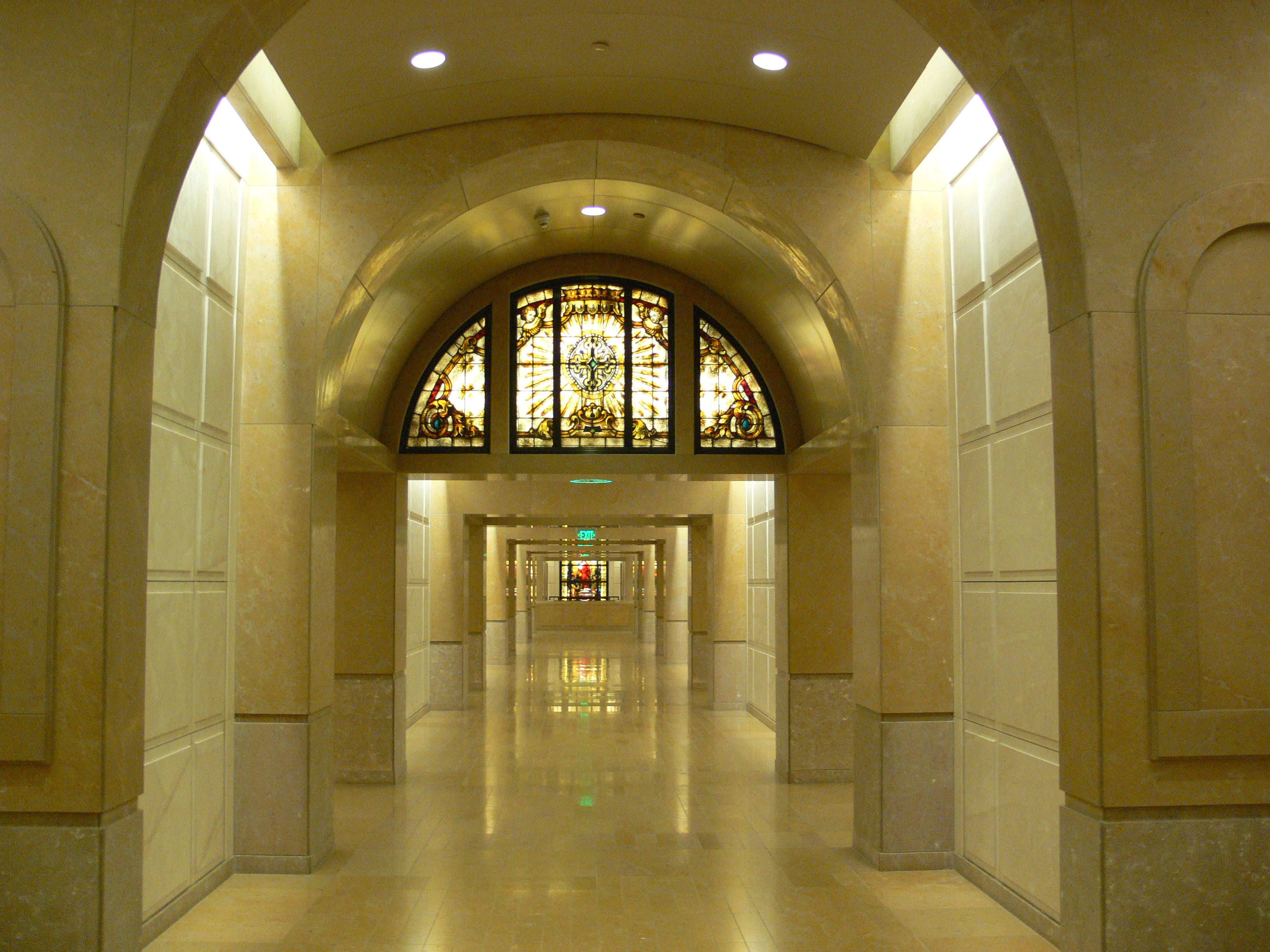
Cathedral of Our Lady of the Angels
The Cathedral of Our Lady of the Angels sits at the top of a long processional staircase on Temple Street, its travertine-clad walls angled away from the street in a gesture that is simultaneously welcoming and opaque. When it opened on September 2, 2002, Los Angeles finally had a Catholic cathedral commensurate with the size of its archdiocese—one of the largest in the world—and it promptly divided everyone who saw it.
After the Earthquake
The Cathedral of Saint Vibiana had served the Archdiocese of Los Angeles since 1876—a modest Baroque building on Main Street that carried considerable historical weight for the city's Catholic community. The 1994 Northridge earthquake left it structurally compromised. The archdiocese faced a choice: repair Saint Vibiana or build anew.
They chose to build. The relics of Saint Vibiana herself were transferred to the new cathedral, along with a piece of the tilma of Our Lady of Guadalupe—physical continuities with a past that the architecture would not otherwise preserve. Spanish architect Rafael Moneo, fresh from receiving the Pritzker Prize in 1996, won the commission.
A Building Without a Front
Moneo's design is deliberately disorienting. The cathedral has no traditional west-facing facade, no rose window, no soaring Gothic verticals. Instead, alabaster panels—translucent sheets of stone—admit diffused light into the nave in a way that approximates stained glass without imitating it. The walls slope inward at subtle angles. The building cost $189.7 million, making it one of the most expensive religious structures ever built in the United States, a fact that generated significant criticism at the time.
The interior is enormous: the nave seats 3,000 people, with standing room for thousands more. Tapestries designed by John Nava line the ambulatories, depicting communion saints from across the centuries rendered with a photorealistic intensity that makes them feel contemporary rather than devotional. Critics found the whole effect chilly; admirers called it austere and meditative.
Below the Floor
The cathedral's crypt mausoleum extends beneath the main level, providing burial space for clergy and laypeople alike. Among those interred here are actor Gregory Peck and inventor Ron Popeil, an ecumenism of fame that would have puzzled an earlier generation of church planners.
The 105-rank Dobson pipe organ—the instrument's Opus 75—anchors the acoustic life of the space. At full volume it can be felt as much as heard.
The Cathedral in the City
The site on Temple Street places the cathedral at the edge of downtown, just uphill from the Hollywood Freeway. Moneo oriented the building so that its grand entrance faces away from the freeway noise and toward a plaza with a reflecting pool and a campanile. The bell tower holds a carillon of 35 bells.
Two decades on, the cathedral has settled into the city's fabric—less controversial now than when it opened, visited by tourists and worshippers in roughly equal measure. Whether it achieved what its commissioners hoped—a building that would speak to Los Angeles rather than to European tradition—remains a matter of perspective. What it undeniably achieved is presence. On the hill above the freeway, it is impossible to miss.
From the Air
The Cathedral of Our Lady of the Angels is visible on the ridgeline just north of downtown Los Angeles, between Grand Avenue and the Hollywood Freeway (US-101). Flying in from the west on approach to KLAX, the complex appears as a large pale travertine structure above the downtown freeway interchange. The campanile is the most readily identifiable element from altitude. Downtown's skyscraper corridor lies just to the south; the 110 and 101 freeways form an X-pattern below. Nearest airports: KLAX (Los Angeles International) to the southwest, KBUR (Burbank) to the north.