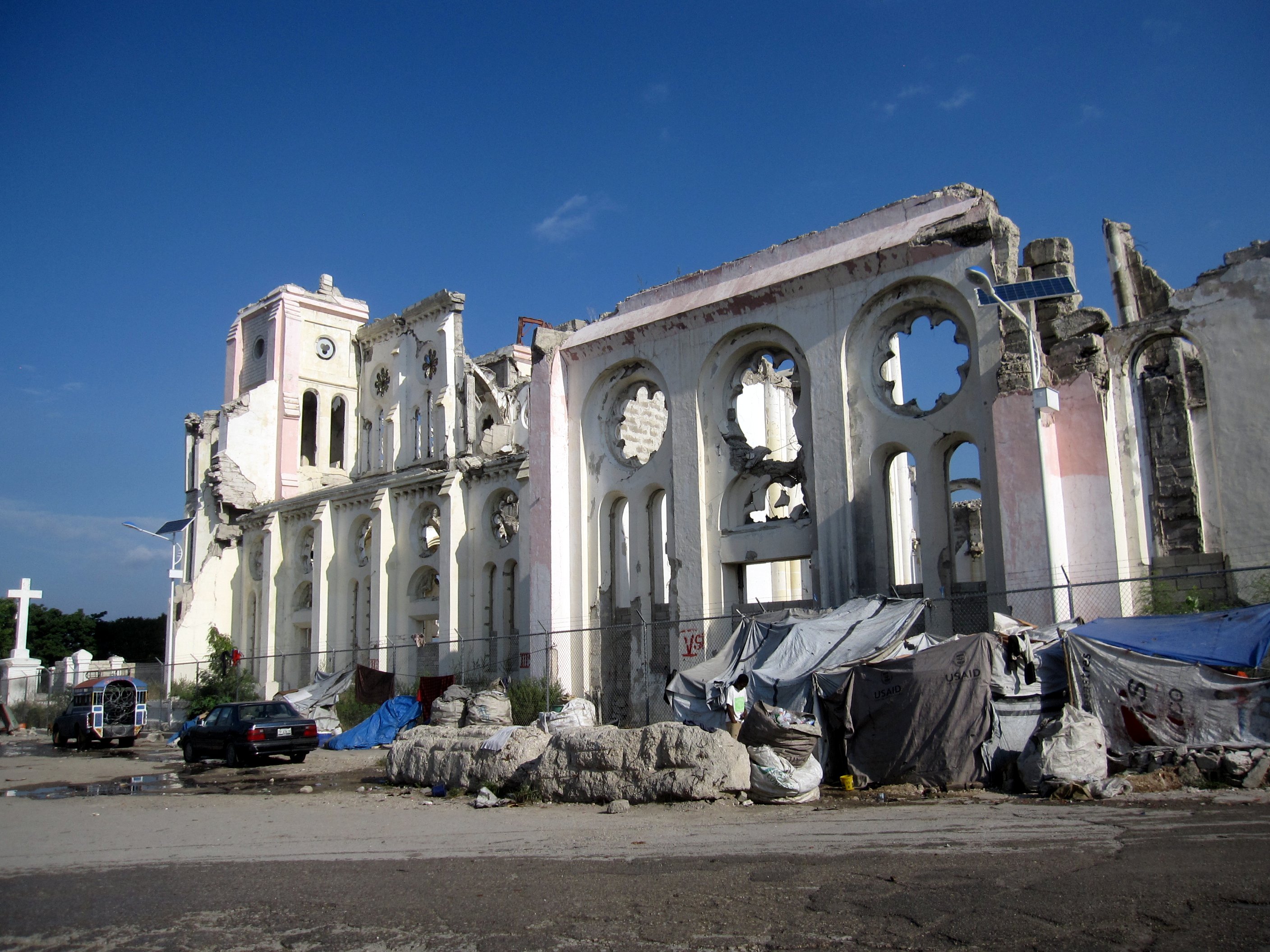
Cathedral of Our Lady of the Assumption, Port-au-Prince
For nearly a century, the cupola of the north tower did double duty. By day it crowned the Cathedral of Our Lady of the Assumption, the seat of Roman Catholic faith in Port-au-Prince. By night it served as the front light of a pair guiding mariners into the harbor - a cathedral that was also a lighthouse, sacred architecture pressed into practical service on an island where nothing has ever been allowed just one purpose. Construction began in 1884 and took thirty years, the cathedral finally opening in 1914 and receiving its formal dedication in 1928. It stood for ninety-six years after that. Then, at 4:53 p.m. on January 12, 2010, a magnitude-7.0 earthquake collapsed the roof, brought both towers crashing down, and killed the archbishop inside. The lower walls survived. Everything else - the nave, the cupola, the guiding light for ships - fell into rubble that, as of the mid-2020s, has still not been cleared for reconstruction.
A Light for Ships, a Seat for Faith
The cathedral occupied a central position in Port-au-Prince both geographically and spiritually. As the cathedral church of the Roman Catholic Archdiocese of Port-au-Prince, it anchored the religious life of a nation where Catholicism runs deep - brought by French colonizers, retained through revolution, blended with Vodou traditions in ways the Vatican has never quite reconciled. But the building also served the harbor. Its north tower cupola functioned as a leading light, paired with a second marker to create an alignment that guided ships safely into port. Sailors approaching from the Caribbean Sea would line up the two lights and follow them in. It was an arrangement typical of Haiti's resourcefulness: why build a separate lighthouse when the tallest structure in the city already had a tower facing the water?
Fifty-Three Seconds
The earthquake struck on a Tuesday afternoon. The 7.0-magnitude shock, centered about 25 kilometers west of Port-au-Prince, lasted less than a minute but destroyed much of the capital. The cathedral's roof caved inward. The twin towers that flanked the main entrance broke apart and fell. Inside the rubble lay Archbishop Joseph Serge Miot, killed instantly. Vicar General Charles Benoit was pulled from the debris but died later. The nunciature and archdiocesan offices were destroyed alongside the cathedral. Aerial photographs taken two days later show the building's footprint clearly - the walls standing to half their height, the interior choked with concrete and dust, the cupola gone entirely. What had taken thirty years to construct vanished in less than a minute. Across the city, an estimated 220,000 people died. The cathedral's loss was one ruin among thousands, but its symbolic weight was enormous: the spiritual heart of the nation, shattered.
A Competition Without a Cathedral
In March 2012, the Archdiocese launched an international design competition in collaboration with Faith & Form magazine and ISPAN, Haiti's Institute for the Safeguarding of National Heritage. Puerto Rican architect Segundo Cardona won. His design was ambitious and thoughtful: the surviving facade of the old cathedral would be framed by two new concrete towers, preserving the memory of what stood before. The original nave, whose pillars had partially survived, would become a covered courtyard. Religious services would take place beneath a new dome at the level of the old transept, with the altar below. The Miami Herald called it "a modern interpretation of the traditional architecture of a cathedral." Capacity would reach 1,200, expandable to 1,800 using the courtyard. Critically, the interior would rely on natural light rather than electric - an acknowledgment that electricity in Port-au-Prince remains intermittent and expensive.
Ruins That Remain
Cardona's design won the competition in 2012. More than a decade later, the cathedral remains in ruins. Despite millions of dollars allocated for reconstruction - from international donors, from the Catholic Church, from the Haitian government - the project has not broken ground. A Pulitzer Center investigation asked the question directly: where did the money go? The answers involve institutional dysfunction, competing priorities, political instability, and the grinding difficulty of rebuilding anything in a country that has endured coup after coup, hurricane after hurricane, and a second devastating earthquake in 2021. In 2014, the archdiocese consecrated a smaller, transitional cathedral behind the ruins. The congregation worships there now, in the shadow of the building they lost. The original walls still stand to partial height, open to the sky, slowly weathering. They are not a monument - no one intended them to be preserved this way. They are simply what is left when reconstruction stalls and time keeps moving. The cupola that once guided ships into harbor is gone. The harbor remains.
From the Air
Located at 18.549N, 72.339W in the heart of downtown Port-au-Prince, Haiti. The cathedral site sits approximately 400 meters from the waterfront, visible from altitude as a partially ruined structure in the dense urban grid of the capital. Toussaint Louverture International Airport (MTPP/PAP) is approximately 10km to the north. From the air, the cathedral ruins are identifiable by the open-roofed rectangular footprint amid the surrounding buildings - the walls still standing to partial height with no roof structure. The harbor it once served as a lighthouse is immediately to the west, a crescent-shaped bay clearly visible on approach. The smaller transitional cathedral behind the ruins may be visible as a newer structure. Best viewed from 2,000-4,000 feet on approach to or departure from PAP. The dense urban fabric of Port-au-Prince spreads across hillsides in all directions, with earthquake damage from 2010 still evident in gaps and rebuilt structures throughout the city.