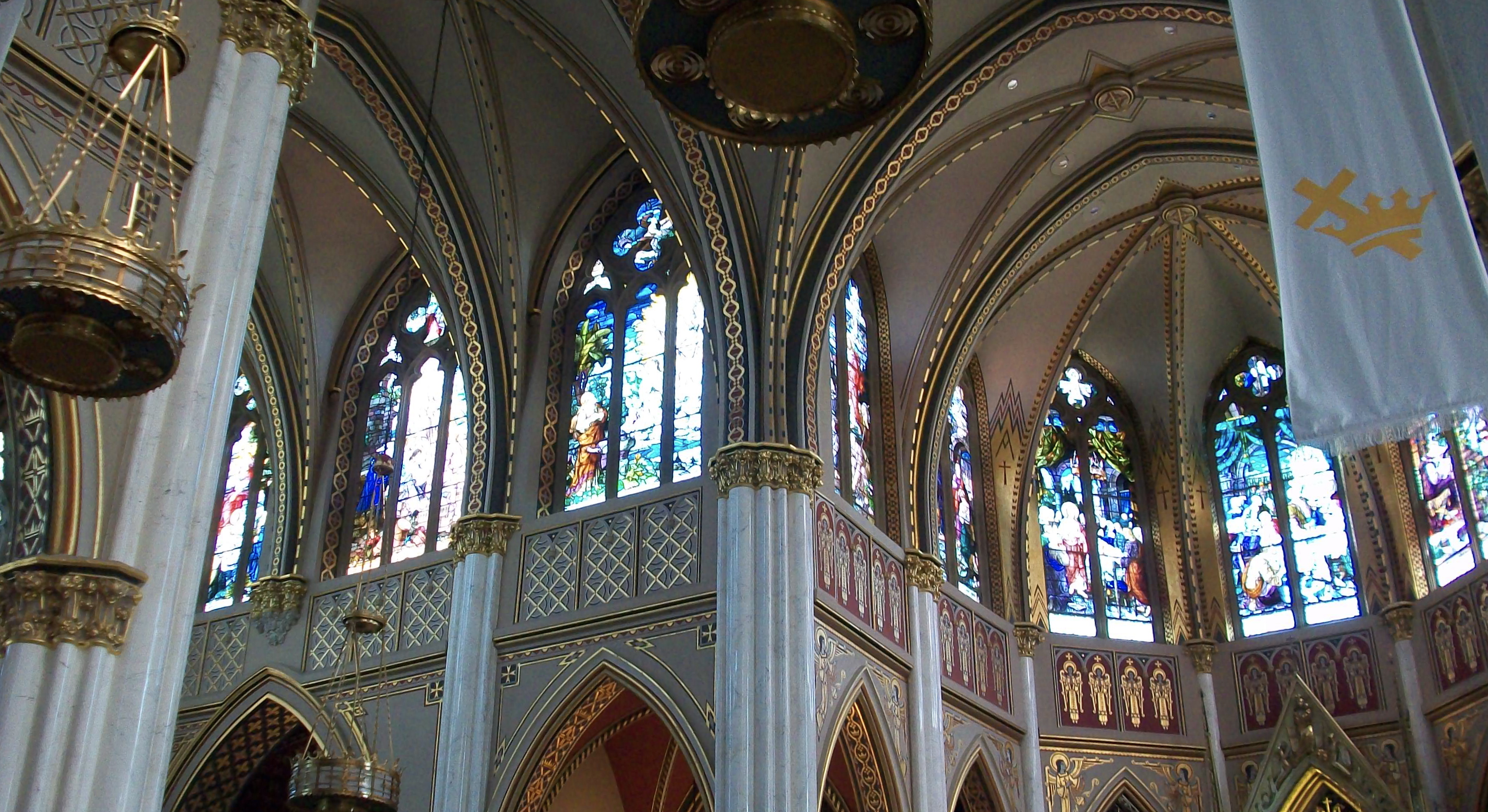
Cathedral of Saint Helena
Thomas Cruse made his fortune in Montana gold. In 1905, he gave $25,000 to purchase a site for a new cathedral in Helena. Nine years later, on December 26, 1914, Cruse became the first person to have his funeral held in the building his donation made possible. The Cathedral of Saint Helena, modeled after Vienna's Votivkirche, took sixteen years to complete at a cost of $645,000. Its 230-foot twin spires, topped with twelve-foot gold-leafed crosses, now define the skyline of Montana's capital, a slice of European Gothic architecture transplanted to the American West.
Vienna on the Plains
Architect A.O. Von Herbulis of Washington, D.C., had studied at university in Vienna and knew the Votivkirche intimately. When Helena's Building Committee chose between Romanesque and Gothic designs for their new cathedral, they selected Gothic unanimously, and Von Herbulis drew directly from his Viennese inspiration. The Columbia Construction Company of New York City laid the cornerstone on October 4, 1908. The Catholic community of Helena celebrated their first Mass in the new building on November 8, 1914, though construction continued for another decade. The cathedral was finally consecrated in June 1924. Bishop John Patrick Carroll drove the project, raising funds and overseeing every aspect of construction throughout those sixteen years.
Windows from Munich
The F.X. Zettler Firm of Munich, Germany, created the cathedral's stained glass, and by the time of dedication, 46 of the planned 59 windows had been installed. The Zettler Firm made an extraordinary claim about the 37-window set depicting the Christian story from the fall of Adam and Eve through the early twentieth-century Church: these windows surpassed anything the firm had produced in its first fifty years of existence. The remaining windows in the clerestory level came from another master, Charles J. Connick of Boston, installed by 1926. Today, the cathedral contains nearly 12,000 square feet of stained glass telling stories from both the Old and New Testaments across all 59 windows.
Shaken but Standing
In fall 1935, a series of earthquakes struck Montana. The cathedral's south tower was almost completely destroyed. Reconstruction and reinforcement work continued until 1938, designed to prevent future catastrophe. But the building would face another unexpected threat decades later. In February 1989, a Montana Rail Link train wreck sent shockwaves through Helena. The cathedral's interior columns sustained damage, requiring repairs that were not completed until 1999-2000. Through earthquake and industrial accident, the Gothic structure has endured, each restoration reinforcing its bones while preserving its historic character.
Bells and Bronze
Fifteen hand-cast bells hang in the cathedral's north tower, each representing one of the fifteen mysteries of the Rosary. The limestone exterior features 29 statues of saints and biblical figures gazing down on the streets of Helena. Inside, the interior remained largely unchanged from dedication until the mid-1950s, when Bishop Joseph M. Gilmore oversaw the installation of the bronze altar canopy, the grillwork behind the altar, and the gilding that now catches the light streaming through Zettler's glass. This restoration was completed in April 1959 for the cathedral's golden jubilee and the 75th anniversary of the Diocese of Helena.
Living Stone
The cathedral continues to evolve while honoring its past. Renovation in 1982-1983 under Bishop Elden F. Curtiss addressed liturgical changes from the Second Vatican Council, including extensive restoration of the stained glass windows. The most recent renovation, begun in 2002, transformed both upper and lower levels. The lower level, now named for Helena's first bishop, John B. Brondel, houses two social halls and a complete kitchen. Upstairs, the sanctuary, Saint Joseph's Chapel, and a new baptistry received careful attention. A new elevator in the north transept provides access between levels. The pipe organ has been renovated and enhanced, the chime system restored, and the exterior stained glass given new protective coverings. The National Register of Historic Places added the cathedral in 1980, formal recognition of what Helena's residents have always known: this building belongs to both heaven and history.
From the Air
Located at 46.59°N, 112.03°W in downtown Helena, Montana. The cathedral's distinctive twin 230-foot Gothic spires with gold-leafed crosses are visible landmarks when approaching the capital city. Helena Regional Airport (KHLN) lies approximately 2 miles northeast. The cathedral sits in the valley between the Rocky Mountain Front and the Big Belt Mountains. Clear weather provides excellent visibility of the structure from pattern altitude. The building is on the National Register of Historic Places.