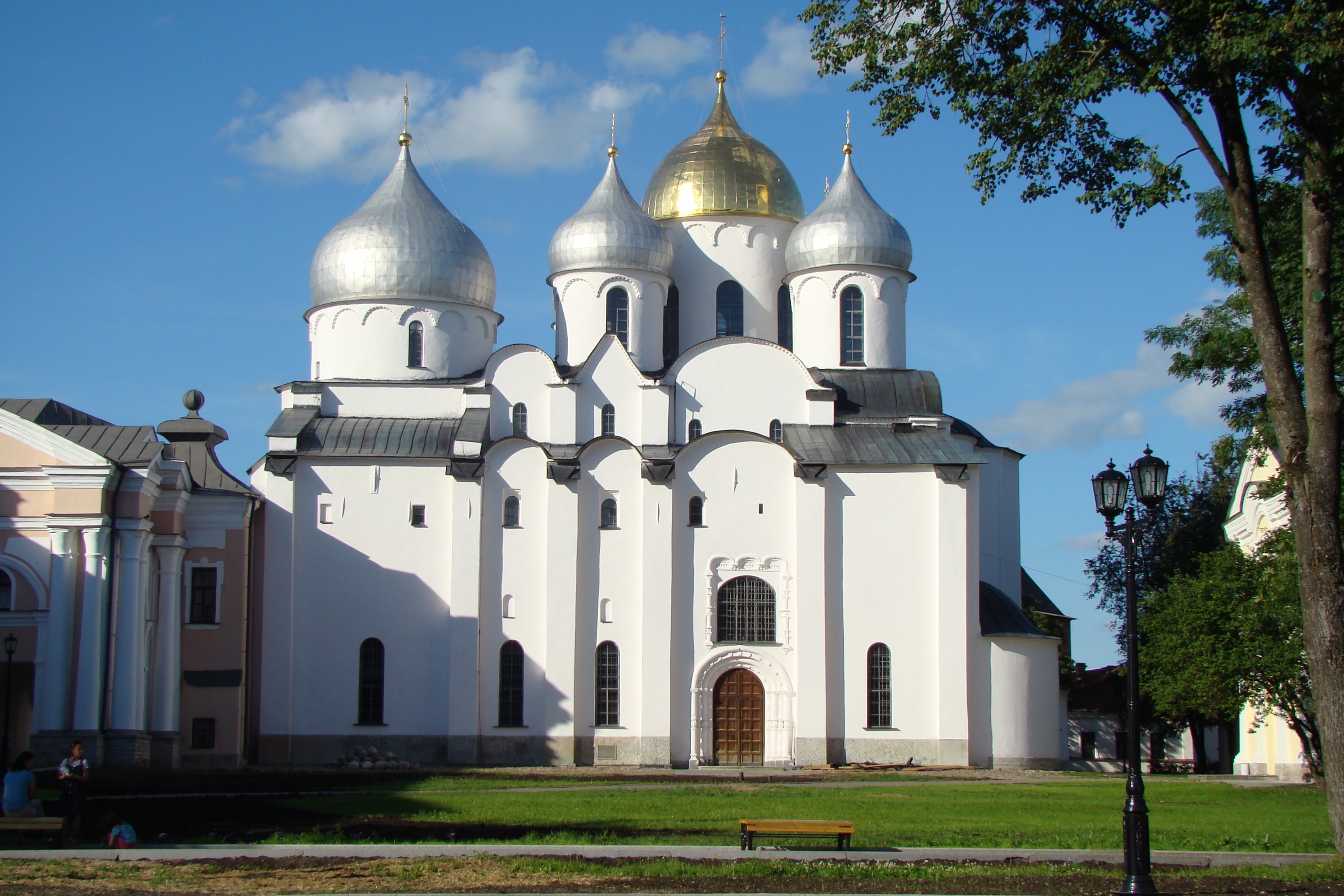
Cathedral of Saint Sophia, Novgorod
"Where Holy Wisdom is, there is Novgorod." The medieval citizens of this trading republic said it plainly, and they meant it as a constitutional principle. When their princes overstepped, the Novgorodians answered: we have no prince, only God, the Truth, and Holy Wisdom. The five-domed limestone cathedral on the west bank of the Volkhov River was the city itself made stone. Vladimir of Novgorod, son of Yaroslav the Wise, laid the walls in 1045. By 1050 or 1052 the work was done, and a thousand years later the building is still standing, still consecrated, still receiving pilgrims who come up the riverbank to see the oldest building in Russia still in use.
A Warrior, Not a Bride
An art historian once compared Novgorod's St. Sophia to its sister cathedral in Kyiv, built at almost the same moment by Vladimir's father Yaroslav. The Kyiv cathedral, he said, is a bride. The Novgorod cathedral is a warrior. The difference is immediate. Where Kyiv's St. Sophia spreads horizontally with bright mosaics and Greek finesse, Novgorod's stands taller, narrower, austere. The walls are thick. The windows are slits. The five domes are clustered tight, with a sixth larger one rising over a stair tower to the upper galleries. The minimal decoration and the vertical massing feel almost Romanesque, closer to a Norman keep in Normandy than to anything in Constantinople. This was the first Slavic church to break openly with the Byzantine pattern, and the masters who built it set the template for everything Novgorod would build afterward.
The Library in the Tower
Climb into the upper galleries and you climb into the brain of medieval Novgorod. The treasury was kept here. The library, said to have been started by Yaroslav the Wise himself, lived here too. When it was finally moved to the St. Petersburg Spiritual Academy in 1859, it numbered more than 1,500 volumes, some dating to the thirteenth century. The current archbishop, Lev, has rebuilt the library in the same galleries. By 2004 it held about 5,000 volumes again. A Sunday school meets in the gallery now. The House of Holy Wisdom, the cathedral's administrative arm, was once one of the largest landowners in all of Novgorod's territory. In the seventeenth century it owned forty-one monasteries with their lands and peasants, and its bishop kept his own court in Moscow. The cathedral was not just a church. It was a state.
The Doors That Came From Somewhere Else
The bronze doors at the western entrance are perhaps the most traveled artifact in any Russian cathedral. They were almost certainly cast in Magdeburg around 1152, sculpted in high relief by German masters, and intended for the cathedral in Plock, Poland, where they served as a doorway for around two hundred and fifty years. Nobody is certain how they made their way to Novgorod. The most popular theory points to Archbishop Evfimii II in the fifteenth century, a known lover of Western art who also brought Gothic touches into the Palace of Facets. Another theory credits Simeon Lingwen, a Lithuanian prince and brother to the Polish king. Wilder accounts claim Novgorodian raiders looted them from the Swedish town of Sigtuna in 1187, which is almost certainly wrong, though the doors are still sometimes called the Sigtuna Gates. They open only twice a year. Since 1982 a copy of them hangs in Plock, a return gift from Novgorod.
The Pigeon on the Cross
On the main golden cupola sits a small bronze pigeon, the symbol of the Holy Spirit. Local legend tells that a real pigeon once perched on this dome and froze in terror as it watched Ivan the Terrible's troops slaughter the people of Novgorod in 1570. Ivan looted the cathedral itself. Archbishop Leonid spent the next few years restoring what could be saved. Three centuries later, during the Nazi occupation in the Second World War, the dome and the pigeon figure were destroyed. The Soviet government turned the cathedral into a museum, kept the structure standing, and after the war commissioned a replica of the pigeon. The original was carried back to Spain by soldiers of the Blue Division, the Spanish volunteers who had fought alongside the Wehrmacht around Novgorod. In 2005 they returned it. The cathedral was given back to the Russian Orthodox Church in 1991. Bishop Lev and Patriarch Alexius II rededicated it. The inscription on the north wall of the west entrance still attests to that day.
What Survives
Inside, beneath the floor of the Martirievskaia Porch on the south side, lie generations of bishops, princes, and posadniks, forty-seven prominent Novgorodians in all. Prince Vladimir was the first burial in 1052. Metropolitan Gurii was the last in 1912. The Icon of Our Lady of the Sign hangs to the right of the Golden Doors. Legend credits it with saving the city in 1170 when the Suzdalians attacked and Archbishop Ilya carried it out onto the city walls. The icon spent the Soviet years in the Novgorod Museum nearby, along with the bones of Bishop Nikita, which were reportedly stored in a paper bag until 1957. Both the icon and the bones are home now. The cathedral itself appears on the five-ruble bill, beside the Millennium of Russia monument that stands just outside its walls. To stand inside St. Sophia is to stand inside the longest continuous interior space in the country, used and reused and saved across a thousand years of war, looting, occupation, and quiet faith.
From the Air
Cathedral of Saint Sophia stands on the west bank of the Volkhov River inside the Novgorod Detinets (kremlin) at 58.522°N, 31.277°E. The five-domed silhouette with its dominant golden cupola is recognizable from low altitude in clear weather. Nearest airport is Veliky Novgorod (ULLN), about 6 km south. Pulkovo (ULLI) at St. Petersburg lies roughly 175 km northwest. Recommended viewing altitude 2,000 to 4,000 ft AGL with the sun behind you to catch the gilding.