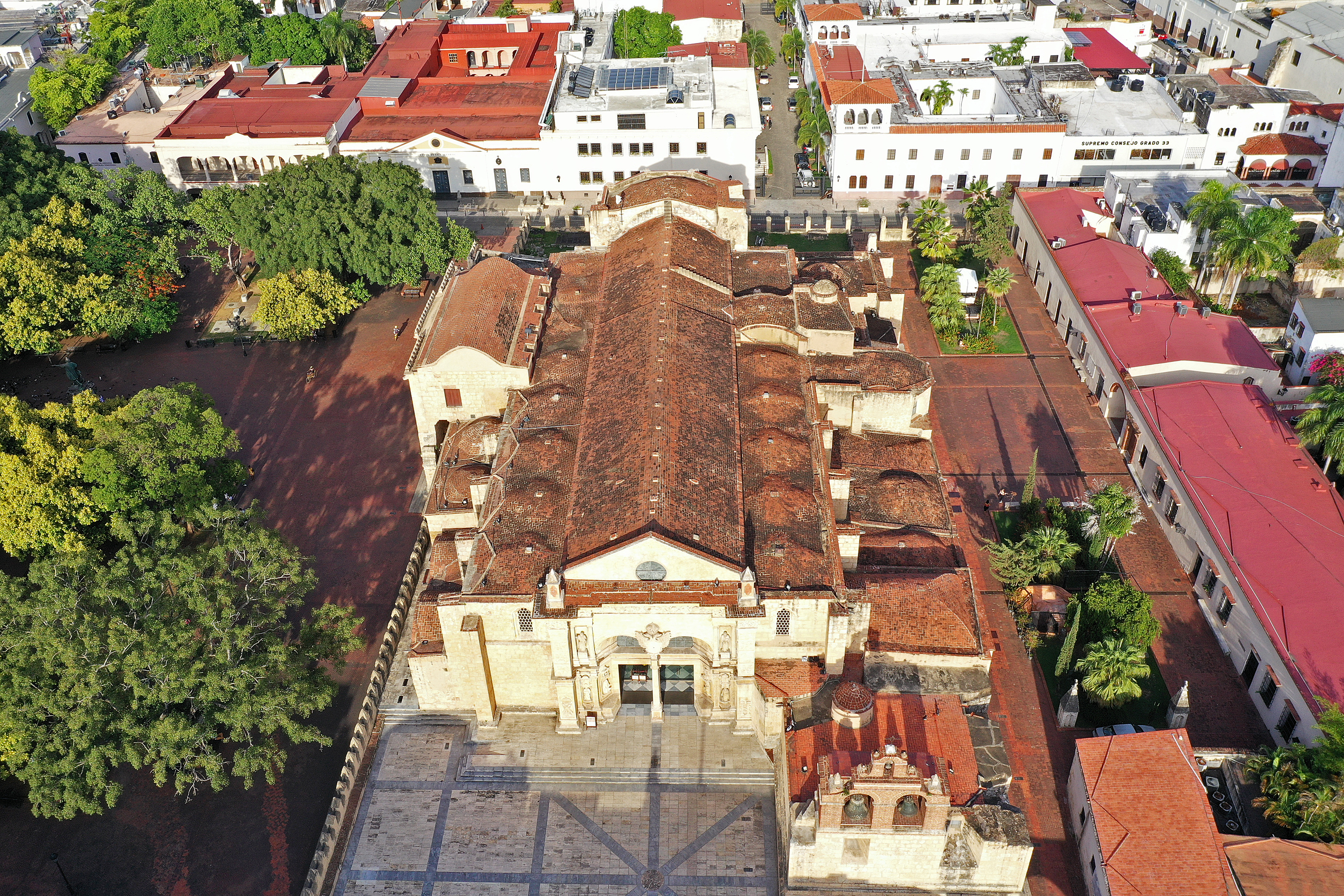
Cathedral of Santo Domingo
Pope Julius II ordered it built in 1504, before Michelangelo had finished the Sistine Chapel ceiling, before Martin Luther had nailed anything to any door. The Cathedral of Santa Maria la Menor in Santo Domingo holds a distinction no other church in the Western Hemisphere can claim: it is the oldest cathedral in the Americas, and it has been standing since the generation that first crossed the Atlantic. Its walls are calcareous stone quarried from the island itself, its vaults ribbed in the Gothic tradition, its main portal carved in the Plateresque style that was fashionable in Spain when this island was still the center of a new world. Five centuries of hurricanes, invasions, earthquakes, and political upheaval have passed through Santo Domingo, and this cathedral has outlasted them all.
Built by Many Hands
No single architect can claim this cathedral. Alonso de Rodriguez drew the first plans in 1512, commissioned under the pastoral authority of Friar Garcia Padilla, the first bishop of Santo Domingo - a man who never set foot on the island. When work stalled, Luis de Moya and Rodrigo de Liendo picked up in 1522 with a new design, urged forward by Bishop Alessandro Geraldini. It was Alonso de Fuenmayor who finally pushed the project to consecration on August 31, 1541, nearly four decades after the papal decree. The architect Alonso Gonzalez, inspired by Seville Cathedral, partially completed the structure by 1550. But the bell tower was never finished. In 1547, authorities halted its construction because the tower had grown taller than the Homage Tower at Fortaleza Ozama, disturbing the sentinels who needed clear sightlines to watch for approaching ships. A cathedral that threatened military readiness - only in the New World's first city would such a conflict arise.
The Pirate, the Admiral, and the Bones
Sir Francis Drake sacked the cathedral in 1586, using the sacred space as headquarters for his troops during his invasion of Santo Domingo. The marks of that occupation linger in the building's history like a scar. But Drake's violation was temporary. A more enduring drama involved the remains of Christopher Columbus himself. For centuries, the cathedral housed the Admiral's bones in a marble monument, attended by the ornate Plateresque archiepiscopal throne that dates from 1540. When Spain ceded the colony in 1795, the remains were transferred to the Cathedral of Havana. A century later, after the Spanish-American War, they moved again to the Cathedral of Seville, where DNA testing in 2006 confirmed at least some of the bones were authentic. The cathedral in Santo Domingo lost the physical relics, but the marble monument and the memory of what it held remain - a reminder that this building was once the most important church between Lisbon and the Pacific.
Fourteen Chapels and Five Centuries
The cathedral began with no side chapels at all. By 1740, it had nine. Today there are fourteen, each added as wealth and devotion accumulated over the centuries. The Chapel of Geraldini honors the bishop who revived construction. The Chapel of Diego Caballero reflects the wealth of colonial merchants. The crypt of the Archbishops holds generations of the Dominican church's leadership. In the Baptismal chapel, light filters through stone that has witnessed half a millennium of christenings. Among the cathedral's treasures is a panel painting of the Virgin of la Altagracia dated 1523, making it one of the oldest devotional paintings in the Americas. Altarpieces, funerary monuments, ancient woodcarvings, and silver fill the treasury. Four former presidents of the Dominican Republic are buried here, including Buenaventura Baez, who served five nonconsecutive terms. A building that began as a house of worship became a repository of national memory.
Stone, Space, and Light
The numbers tell part of the story: 54 meters long, 23 meters across the three naves, 16 meters from floor to the highest vault, more than 3,000 square meters of built area. But numbers cannot capture what the space feels like. The central nave rises under a pitched roof while the side naves are covered by ribbed vaults that bulge outward like hemispherical domes, an unusual arrangement that gives the interior an almost organic quality. Three doors pierce the facade - two Gothic, one Gothic-Plateresque - and the main entrance opens through a battlemented atrium that functions as an antechamber, separating the sacred from the secular. To the north lies the Plaza de Armas. To the south, the Plazoleta de los Curas leads to the cloister built in the late 1500s, where canons once lived in cells arranged around a courtyard. A narrow passage called the Callejon de Curas connects the cloister's annexes, a reminder that this was not just a church but a small city within a city.
Primada de America
In 1546, Pope Paul III granted the cathedral a title it still carries: Metropolitan Cathedral and Primate of America, bestowed at the request of Holy Roman Emperor Charles V. In 1920, Pope Benedict XV elevated it further to Minor Basilica of the Virgin of the Annunciation. These titles are not mere honorifics. They place this building at the apex of Catholic authority in the Western Hemisphere's history, the mother church from which all others descended. Today, the cathedral serves as headquarters of the Archdiocese of Santo Domingo, still functioning as a place of worship rather than merely a museum. Mass is celebrated under the same ribbed vaults that Drake's soldiers once defiled, in front of altarpieces that predate the Pilgrims by a century. The oldest cathedral in the Americas is not preserved in amber. It is alive, doing in the 21st century exactly what Pope Julius II intended it to do in 1504.
From the Air
Located at 18.473°N, 69.884°W in the heart of Santo Domingo's Ciudad Colonial, on the west bank of the Ozama River. The cathedral sits adjacent to Columbus Park (Parque Colon) and is identifiable from altitude by its prominent stone structure within the dense colonial grid. Best viewed at 2,000-3,000 feet AGL. Nearest major airport is Las Americas International Airport (MDSD/SDQ), approximately 25 km east. Santo Domingo's La Isabela International Airport (MDJB/JBQ) is closer at roughly 15 km north. The colonial district is bounded by the Ozama River to the east and the old city walls. Tropical maritime climate with afternoon convective activity common year-round.