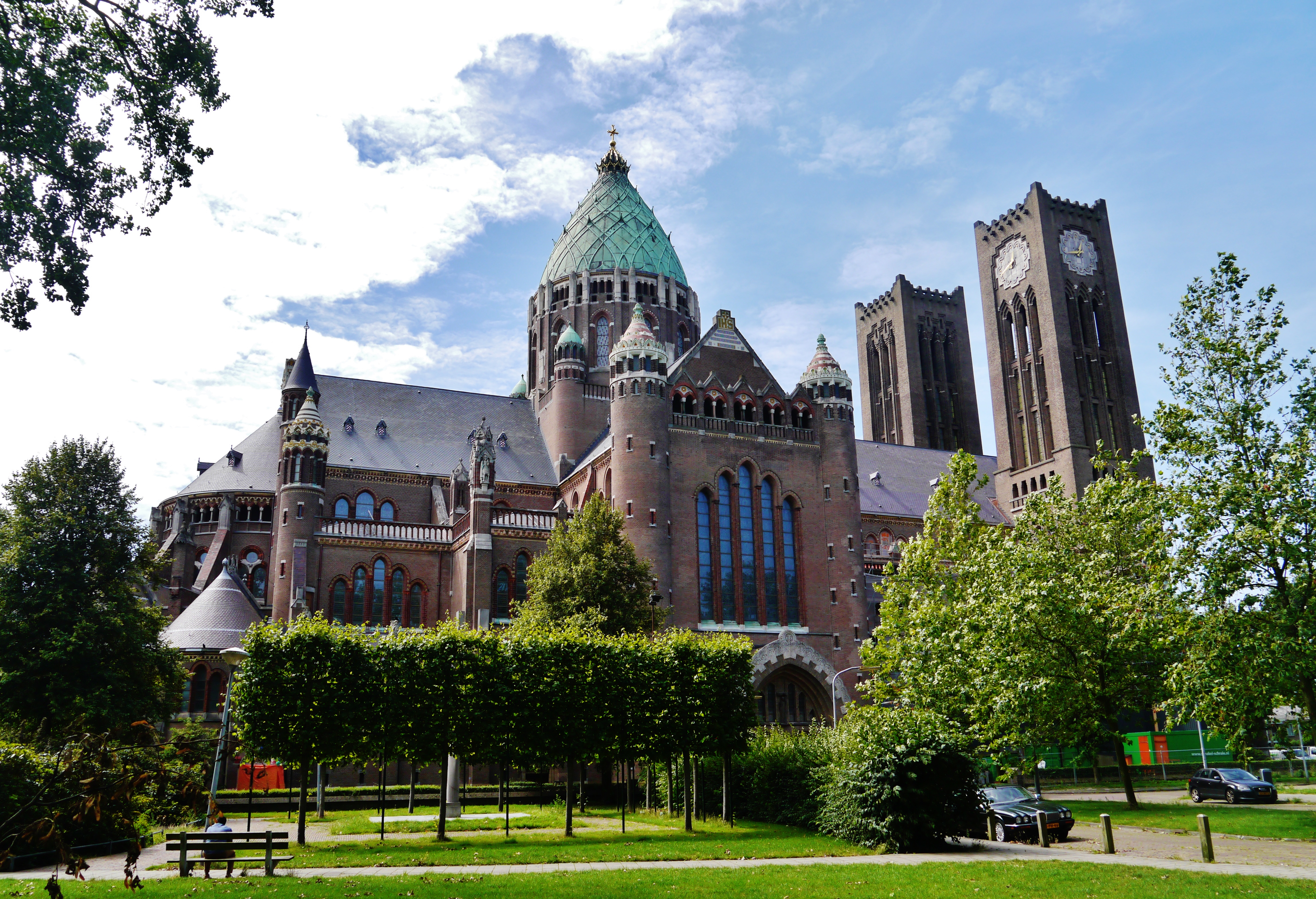
Cathedral of St Bavo, Haarlem
Two cathedrals named Saint Bavo stand in Haarlem, and that is not a mistake. One is the gothic Grote Kerk on the central market square, the Sint-Bavokerk that has been Protestant since 1578. The other is the Kathedrale Basiliek Sint Bavo on Leidsevaart at the western edge of town — neo-romanesque, dome-crowned, built by Joseph Cuypers between 1895 and 1930. The two churches exist because in the late sixteenth century a Catholic cathedral became a Protestant church and the Catholic community of Haarlem went underground for three hundred years. When they finally got their own building back, they put it where the Protestants could not take it from them again, and they built it large enough to make the point.
The First Cathedral, Lost
Haarlem has had a Christian parish church since the ninth century, originally a wooden chapel that was a filial church of Velsen, itself founded in 695 by the Anglo-Saxon missionary Willibrord. The stone Sint-Bavokerk that replaced the wooden building on the Grote Markt became formally a cathedral in 1559, when Nicolaas van Nieuwland was appointed Haarlem's first bishop. The arrangement lasted nineteen years. In 1578, after the Siege of Haarlem, the church was confiscated and converted to Protestantism as part of the Reformation. Most of the art and silver was seized; what survived is now in the Frans Hals Museum collection. The Haarlem Catholics took what they could carry, walked out of their cathedral, and disappeared into the back rooms of private houses to keep saying mass.
Three Centuries Underground
What the Catholics did next is one of the quiet remarkable stories of Dutch religious history. The Netherlands officially became Protestant, but the Dutch authorities tolerated Catholic worship in private — as long as it stayed invisible from the street. The underground Catholic places of worship were not called churches. They were staties, mission stations, treated administratively as outposts of a faith no longer at home in its own country. Town records show that by the eighteenth century the Haarlem council was taxing the staties — making them legal in fact, if not in name. At least seven Haarlem staties drew more than three hundred worshippers to mass. One of them, the St. Josephs statie, met in a converted private house on the Goudsmitsplein until a Waterstaatskerk — a state-funded church in the early-nineteenth-century neoclassical style — finally gave them a proper building on Jansstraat in 1853, behind the Grote Kerk that had once been theirs.
The Bishop's Cathedral Problem
By the late nineteenth century the St. Joseph kerk on Jansstraat was the most popular Catholic church in Haarlem, and since 1853 it had served as a cathedral. It was also obviously too small almost from the day it opened, despite enlargements. In 1893 Bishop Gaspard Bottemanne began planning a new cathedral that would be both a bishop's seat and a working parish church. The first choice for architect was Pierre Cuypers, the man who designed Amsterdam Centraal and the Rijksmuseum and most of the great Catholic-revival buildings of nineteenth-century Holland. Cuypers may have made an initial sketch, but he was already in his seventies. The commission went to his son Joseph Cuypers instead.
Cuypers the Son, Cuypers the Style
Joseph Cuypers grew up in his father's office and inherited his father's commissions; this cathedral was the largest project of his career. His first design was neo-gothic in the elder Cuypers's manner, but Joseph kept changing it. After numerous revisions, he settled on neo-romanesque instead — round arches, massive walls, a central dome — with influences pulled in from Byzantine architecture and from the jugendstil, the German and Austrian art-nouveau movement just then reshaping European decoration. The result does not look like anything else his father built. Construction began in 1895 with the choir and its radiating chapels. The building was consecrated on April 1, 1898. The transept and nave followed in 1902-1906. Money ran out before the towers, which had to wait until 1927 — Joseph by then working with his own son, Pierre Cuypers Jr., a third generation of Cuypers architects on the same project.
The Treasury
The former sacristy now holds the schatkamer, a small treasury museum displaying objects from Haarlem's Catholic past — pieces that survived the 1578 seizures, things rescued from the staties, items from other closed Catholic collections. There is a seventeenth-century painting of Saint Bavo, the patron saint himself. There is silver from the chapel of Louis Napoleon Bonaparte, who made Villa Welgelegen in Haarlem his residence during his reign as King of Holland from 1806 to 1810. There are chasubles, dalmatics, and surplices — the embroidered vestments of the Haarlem clergy — with the earliest pieces Flemish in origin and dating to the early sixteenth century. They are older than the building that holds them. They predate the Reformation that sent the Haarlem Catholics underground. Hanging them here, in a cathedral the Catholics finally got to build for themselves, closes a loop that took three hundred and twenty years to complete.
From the Air
Located at 52.3764 N, 4.6222 E in western Haarlem, about 20 km west of Amsterdam. Nearest airport: Amsterdam Schiphol (EHAM/AMS), 9 km southeast. The cathedral's twin towers and central dome make it a clear visual landmark on any approach to Haarlem; it sits about 1 km southwest of the Grote Markt and the older Protestant Sint-Bavokerk. Pilots approaching Schiphol from the northwest will pass directly over Haarlem with both St. Bavos visible.