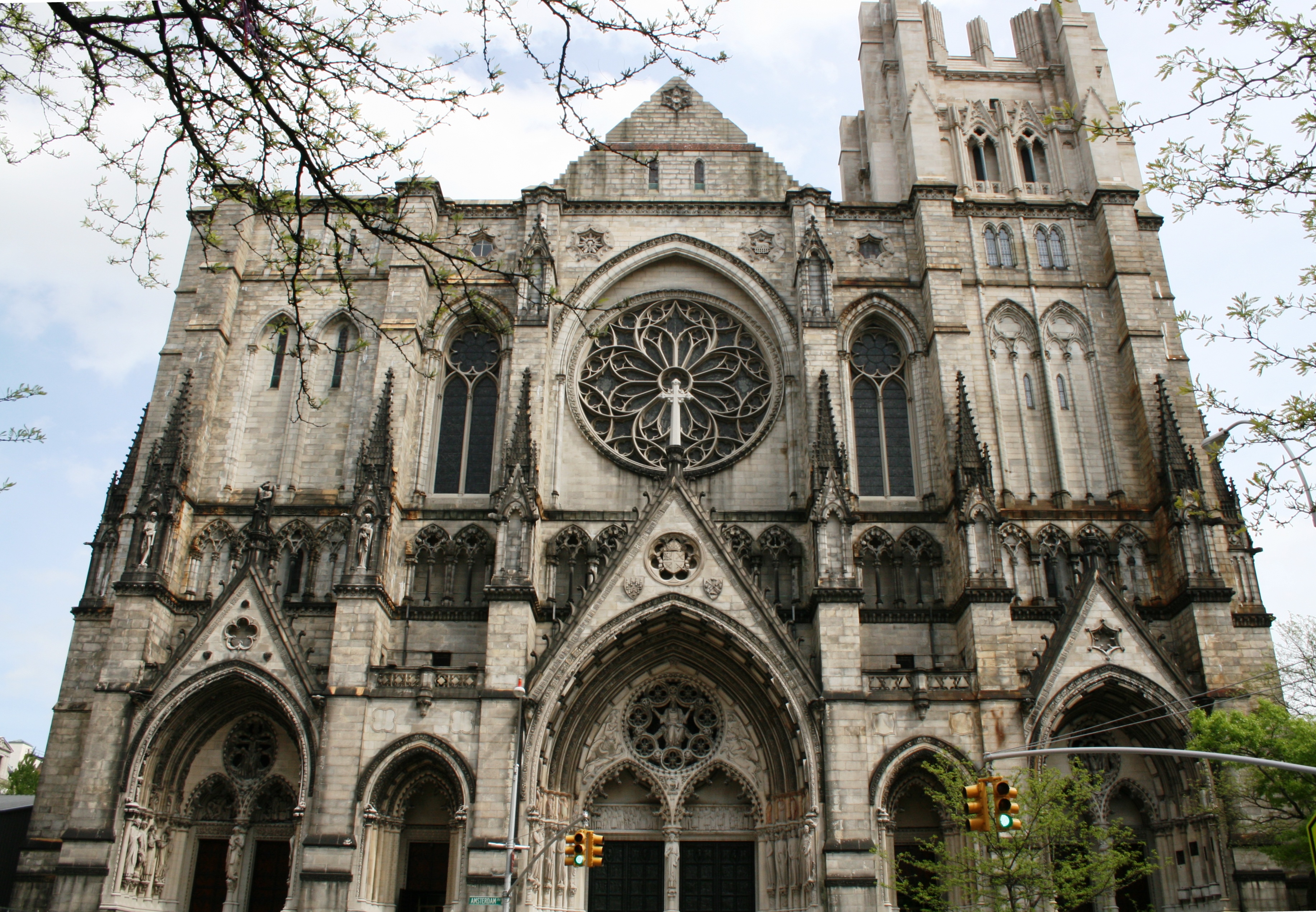
Cathedral of St. John the Divine
They started building it in 1892, and they have never stopped. The Cathedral of St. John the Divine rises from Morningside Heights in upper Manhattan like a stone argument against impatience, its nave stretching 601 feet long, its ridge soaring 177 feet above the floor. By some measures it is the largest cathedral in the world. By every measure, it is incomplete. The south transept remains unbuilt. The crossing lacks its planned 445-foot tower. And yet this is precisely what makes St. John's extraordinary -- it is a living construction site, a medieval ambition carried forward into the modern age, proof that some things worth building take more than a century.
Two Architects, Two Visions
Bishop Henry Codman Potter launched the campaign for a great Episcopal cathedral in 1887, and the cornerstone was laid on December 27, 1892. The original architects, George Heins and Christopher Grant LaFarge, designed a Romanesque-Byzantine structure anchored by massive granite arches at the crossing. After Heins died in 1907, the trustees hired Ralph Adams Cram, who reimagined the unfinished building in a soaring Gothic style. The result is a cathedral that changes architectural language as you walk through it -- Byzantine apse giving way to Gothic nave, Romanesque columns standing beside pointed arches. Rather than a flaw, this collision of styles records the building's own history in stone.
Stone, Bronze, and Glass
Eight granite columns support the choir roof, each standing 54 feet tall with a diameter of 6 feet and a weight of 130 tons. Their foundations descend as far as 130 feet into the Manhattan bedrock. The great west doors, the last of four bronze commissions, measure roughly 18 feet across. Inside, the choir stalls feature carvings completed as recently as 2001 -- Martin Luther King Jr., Albert Einstein, Susan B. Anthony, and Mohandas Gandhi, added by stonecarver Christopher Pellettieri. Below the crossing, the crypt stores artifacts including pieces of the demolished Pennsylvania Station and fragments from the World Trade Center. In the ambulatory, seven Chapels of the Tongues honor different national traditions, one of which contains a bronze altar with gold-leaf decoration designed by Keith Haring shortly before his death.
A Cathedral of Funerals and Concerts
The cathedral's memorial services read like a roll call of American culture: Duke Ellington in 1974, James Baldwin in 1987, Jim Henson in 1990, Toni Morrison in 2019. Nikola Tesla's funeral was held here in 1943; Eleanor Roosevelt's memorial in 1962. The living have filled the space with equal force. Duke Ellington premiered his Second Sacred Concert here in 1968. In 1990, Diamanda Galas performed Plague Mass, covering her body in cattle blood as a protest against societal indifference to the AIDS epidemic. Philippe Petit, the man who walked a wire between the Twin Towers, served as artist-in-residence starting in 1982. Paul Winter and his Consort still perform an annual Winter Solstice concert that fills the nave with sound.
Fire, Recovery, and the Unfinished Work
On December 18, 2001, a fire swept through the north transept, destroying the gift shop and coating the interior in soot. The restoration took years and cost $41 million. The great organ, silenced by the blaze, did not return to service until 2008 after an extensive rebuilding. Through it all, the cathedral's fundamental condition remained unchanged: unfinished. The south transept exists only in blueprints. The great tower over the crossing has never been built. In the Poets' Corner -- inspired by Westminster Abbey and dedicated in 1985 with Emily Dickinson, Washington Irving, and Walt Whitman -- new names are still being added. St. John the Unfinished keeps building, as it always has, one stone and one century at a time.
From the Air
Located at 40.80N, 73.96W on Morningside Heights in upper Manhattan, between 110th and 113th Streets along Amsterdam Avenue. The massive cruciform structure with its copper roof is visible from the air, dwarfing surrounding buildings. Columbia University campus lies immediately to the north. Nearby airports: LaGuardia (KLGA) approximately 7 nm east, Teterboro (KTEB) approximately 10 nm northwest. Best viewed at 2,000-3,000 ft AGL.