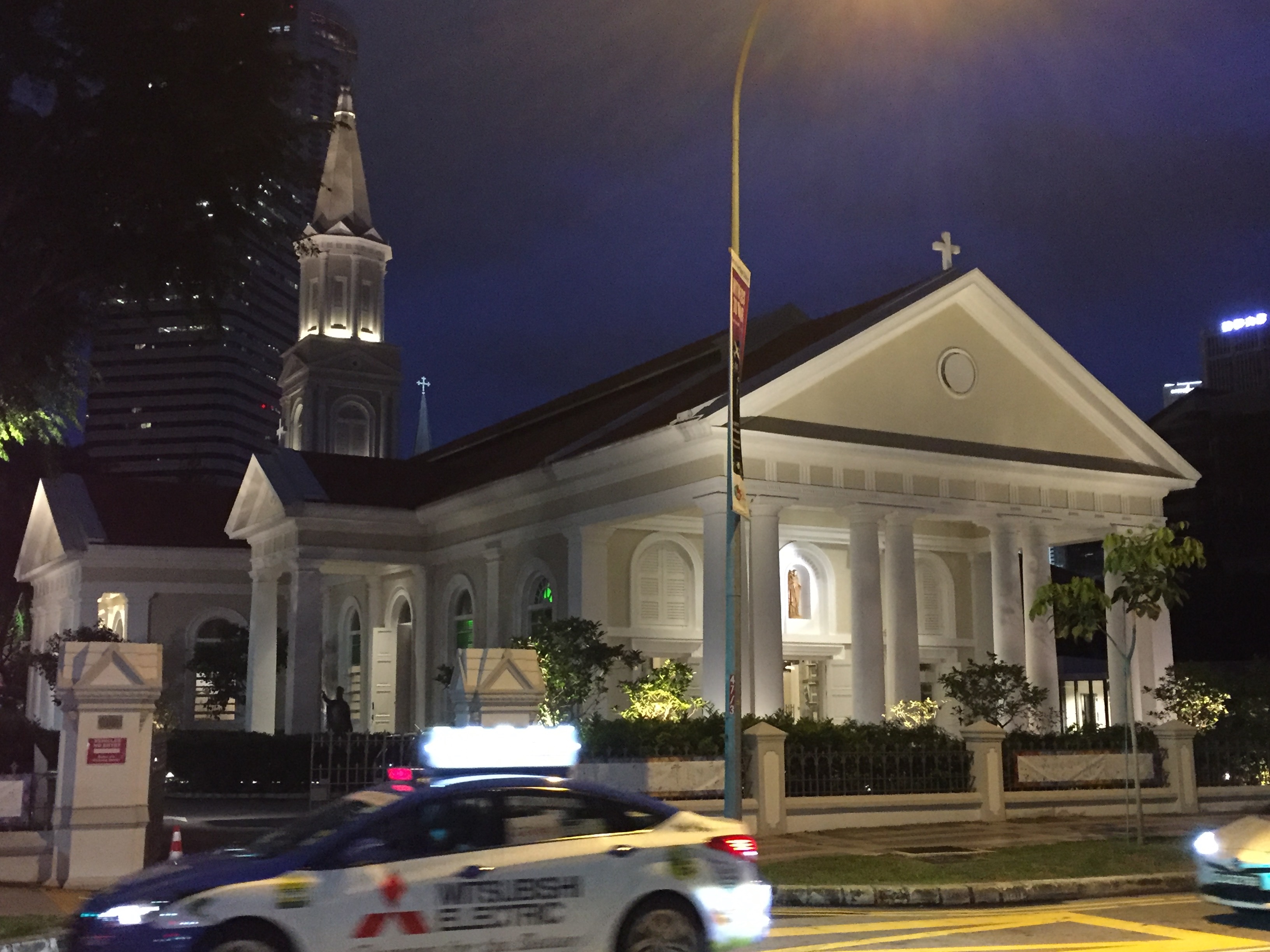
Cathedral of the Good Shepherd
In desperate circumstances, the good shepherd lays down his life for his sheep. Bishop Laurent-Marie-Joseph Imbert wrote those words to his fellow missionaries in Korea, urging them to surrender to authorities so their congregations would be spared. All three were beheaded on 21 September 1839. When news of their martyrdom reached Singapore just as a name was being chosen for a new Catholic church, the choice became obvious. The Cathedral of the Good Shepherd has carried that story in its name since 1847 -- a building born from sacrifice half a world away.
From Attap to Stone
Catholicism in early Singapore was a house affair. The faithful gathered for Mass at the home of Denis Lesley McSwiney before anyone thought to build a proper chapel. In 1832, construction began on the first permanent Catholic house of worship -- a modest wood and attap structure measuring 60 feet by 30 feet, costing about 700 Spanish dollars, with neither tower nor spire. It stood on what is now the site of the Singapore Art Museum, in an area Sir Stamford Raffles had designated for Europeans, Eurasians, and wealthy Asians. But the community outgrew the chapel quickly. By 1840, a subscription drive attracted funds from Queen Marie-Amelie Therese of France and the Archbishop of Manila. The government surveyor John Turnbull Thomson drew up the first design, which proved too expensive. McSwiney himself provided the accepted plan, reportedly influenced by George Drumgoole Coleman's original Saint Andrew's Church. The cornerstone was laid on 18 June 1843, and by 1847 the church was blessed and opened, its total cost amounting to 18,355.22 Spanish dollars.
A Cathedral Earns Its Name
For its first four decades, the Church of the Good Shepherd was simply a parish church. Elevation came in 1888 when the Diocese of Malacca was revived, and the building became the seat of its bishop. But there was a catch: a cathedral could not be formally consecrated while it still carried debt. The extension of the nave in 1888 had left the parish in arrears, and the consecration ceremony had to wait until 14 February 1897 -- nine years after the elevation -- when the books were finally balanced. Improvements followed steadily: ornamental cast iron gates in 1908, a Gallery Organ in 1912, electric lighting in 1913, electric fans in 1914. During the Japanese invasion in World War II, the cathedral served as an emergency hospital. It was gazetted as a national monument on 28 June 1973, securing its architectural and historical significance against the relentless redevelopment that defines Singapore's urban landscape.
Renaissance in the Tropics
The cathedral's architecture speaks a restrained Renaissance dialect. Its porticos follow the Palladian manner established in Singapore by George Drumgoole Coleman, and its floor plan traces the form of a Latin cross, oriented east in the traditional manner. The steeple rises in two sections: a square base marked by Ionic engaged columns and arched windows, topped by an octagon with Tuscan columns and narrow rectangular windows. Inside, the nave is a simple hall without aisles -- the two transepts screened off by pairs of Doric columns. Eighteen timber ceiling panels, each centered with a ceiling rose, form a concave surface overhead. Much of the cathedral's character lies in its details: six entrances with heavily moulded pediments, a statue of the Good Shepherd in a niche over the center door, and twelve consecration crosses on marble slabs placed during the 1897 consecration. These crosses can never be removed -- they stand as permanent proof, in the absence of documents, that a church has been formally consecrated.
The Oldest Pipe Organ Still Playing
The cathedral houses a 30-stop Bevington & Sons organ, the oldest working pipe organ in Singapore and the only pipe organ in the Catholic Church on the island. Dedicated in 1912 by Bishop Emile Barillon, the instrument has lived several lives. By the 1960s it had grown so dilapidated that it fell silent for nearly two decades. Hugo Loos, a Belgian engineer living in Singapore, volunteered as both organist and repairman, managing minor repairs before organ builder Robert Navaratnam -- trained in Germany -- took over in the 1980s, spending decades expanding the instrument with salvaged pipe ranks. The organ now incorporates pipework from defunct instruments around Singapore, including a Bombarde 16-foot stop from the former St. Clair Organ that once stood in Victoria Concert Hall. During the cathedral's 2013-2016 restoration, Diego Cera of the Philippines rebuilt it entirely with a new tracker action and symmetrical facade, replacing the distinctive asymmetric look Navaratnam had created.
Buried Time and Enduring Faith
In early 2016, beneath the cathedral's foundation stone, workers discovered a shoebox-sized time capsule from 18 June 1843 -- the day the cornerstone was laid. Inside were a prayer booklet, newspapers, and international coins, sealed 173 years earlier and forgotten. The discovery came during a major structural restoration necessitated by damage from nearby construction, a $42 million Singapore dollar project that addressed the tension between preservation and a city that never stops building. From the air, the cathedral occupies a gentle island of shaded grounds bounded by Queen Street, Victoria Street, and Bras Basah Road, at 1.2964 degrees north, 103.8528 degrees east. Its white-painted steeple and cross rise modestly beside the glass towers of the Civic District. Singapore Changi Airport (WSSS) lies 16 kilometers east. The cathedral does not compete for attention against the skyline -- it simply persists, which after 179 years may be the more impressive achievement.
From the Air
Located at 1.2964°N, 103.8528°E in Singapore's Civic District, bounded by Queen Street, Victoria Street, and Bras Basah Road. Singapore Changi Airport (WSSS) is approximately 16 km to the east. Seletar Airport (WSSL) lies to the north. The cathedral's white steeple and cross are visible amid the shaded grounds, contrasting with surrounding modern high-rises. Best viewed at 2,000-3,000 ft AGL. The Civic District is identifiable by the cluster of colonial-era buildings near Fort Canning Hill and the Singapore River.