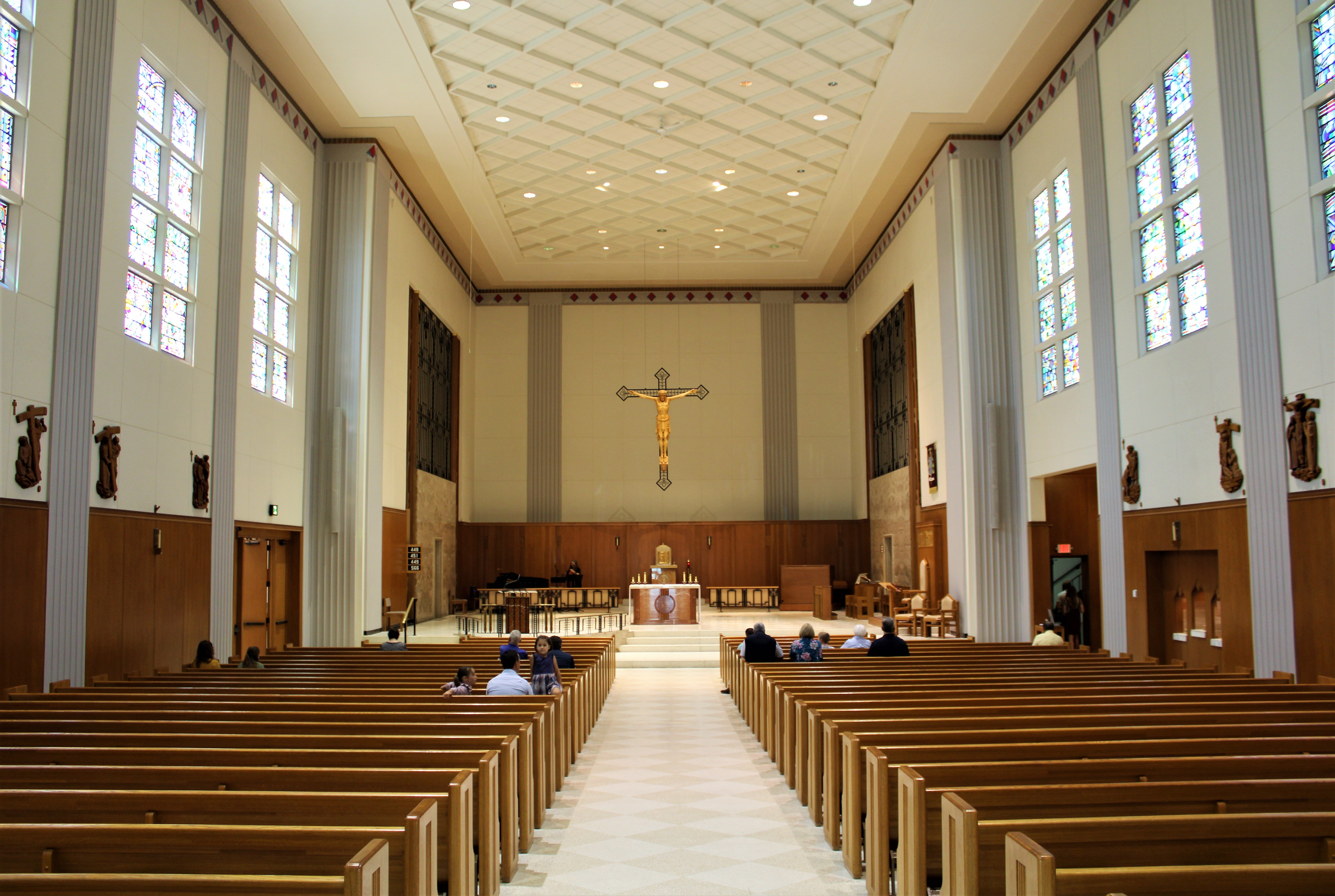
Cathedral of the Holy Spirit (Bismarck, North Dakota)
It took twenty-four years from purchase to pews. In 1917, the first Bishop of Bismarck, Vincent Wehrle - a Benedictine monk with a lifelong devotion to the Holy Spirit - bought a parcel of land in North Dakota's capital with a singular vision: a cathedral that would double as a shrine. He hired Milwaukee architect Anton Dohman in 1921, who drew up two designs. Then the Great Depression arrived and froze the project for two decades. When the cathedral finally rose from its foundations in 1941, it emerged not as the Romanesque church Dohman had first imagined, but as something startlingly modern - a tower of white monolithic concrete in the Art Deco style, believed to be the only Art Deco cathedral in the United States.
A Bishop's Stubborn Dream
Vincent Wehrle came to the northern Great Plains as a Benedictine missionary, eventually becoming the first bishop of the newly created Diocese of Bismarck. His devotion to the Holy Spirit was not casual theology - he wanted a building that would physically embody that devotion, a shrine where the faithful could contemplate the third person of the Trinity. The property he purchased in 1917 sat in what would become Bismarck's cathedral neighborhood. Dohman's first design echoed the church at Assumption Abbey in Richardton, North Dakota, a familiar Romanesque style common to Catholic churches across the Great Plains. His second design pushed toward something more contemporary. But before either could be built, the Depression strangled North Dakota's agricultural economy. Wheat prices collapsed, farms failed, and a cathedral was a luxury a prairie diocese could not afford. Wehrle waited. The dream outlasted the Depression, though not the bishop's tenure in the form he imagined.
Kurke's Concrete Vision
Bismarck's second bishop, Vincent Ryan, inherited the project and hired Fargo architect William F. Kurke to bring it to life. Kurke was no ordinary prairie architect - he had helped design the North Dakota Capitol building, one of the state's most prominent structures. For the cathedral, Kurke drew on Dohman's second, more modern concept but pushed it further into the Art Deco idiom. The result was a building of monolithic poured concrete, its surfaces smooth and white, its lines clean and vertical. The tall bell tower became an immediate landmark on Bismarck's low skyline, visible for miles across the Missouri River valley. Ground was broken in September 1941. The church opened in August 1945, just as World War II was ending - a building conceived in one era of hardship and completed at the close of another.
A Campus on the Prairie
Kurke designed more than just the cathedral. The nearby Bishop's Residence, a two-story concrete structure in matching Art Deco style, went up at the same time. A grade school followed in 1951, its facade defined by precast concrete panels and two horizontal window bands running two-thirds of the building's width. A school building connecting the cathedral and residence was part of Kurke's original plan, though the finished structure took a more contemporary turn than he envisioned. A two-story brick convent arrived in 1965, followed by a rectory in 1969. The convent now serves as the Center for Pastoral Ministry for the Diocese of Bismarck. Together, these buildings form a cohesive campus - a cluster of institutional architecture that tells the story of a small diocese growing through the mid-twentieth century, each addition reflecting the architectural sensibility of its particular decade.
Art Deco Sacred
The Art Deco style reached its peak in the 1920s and 1930s, celebrated in skyscrapers, movie palaces, and train stations. But cathedrals were almost always built in Gothic Revival or Romanesque styles, drawing on centuries of ecclesiastical tradition. Bismarck's Cathedral of the Holy Spirit defied that convention. Its geometric lines, smooth concrete surfaces, and emphasis on verticality through the bell tower place it firmly in the Art Deco vocabulary - yet the interior still functions as a traditional Catholic worship space, with a long nave leading to the chancel, stained glass windows filtering colored light, and the proportions that guide the eye upward. Since 1980, the cathedral and the Bishop's Residence have been contributing properties in the Bismarck Cathedral Area Historic District, listed on the National Register of Historic Places. The recognition acknowledges what Bismarck residents already knew: this is one of the most distinctive religious buildings on the northern Great Plains.
From the Air
Located at 46.81N, 100.80W in Bismarck, North Dakota's state capital on the east bank of the Missouri River. The cathedral's white concrete bell tower is a local landmark visible from the air against Bismarck's low-rise skyline. Bismarck Municipal Airport (KBIS) is approximately 3 miles southeast of downtown. The cathedral sits in a residential neighborhood northwest of the state capitol building, another Kurke-designed landmark. Approach from the west over the Missouri River for the best view of both the cathedral tower and the capitol. Visibility typically excellent on the northern Great Plains.