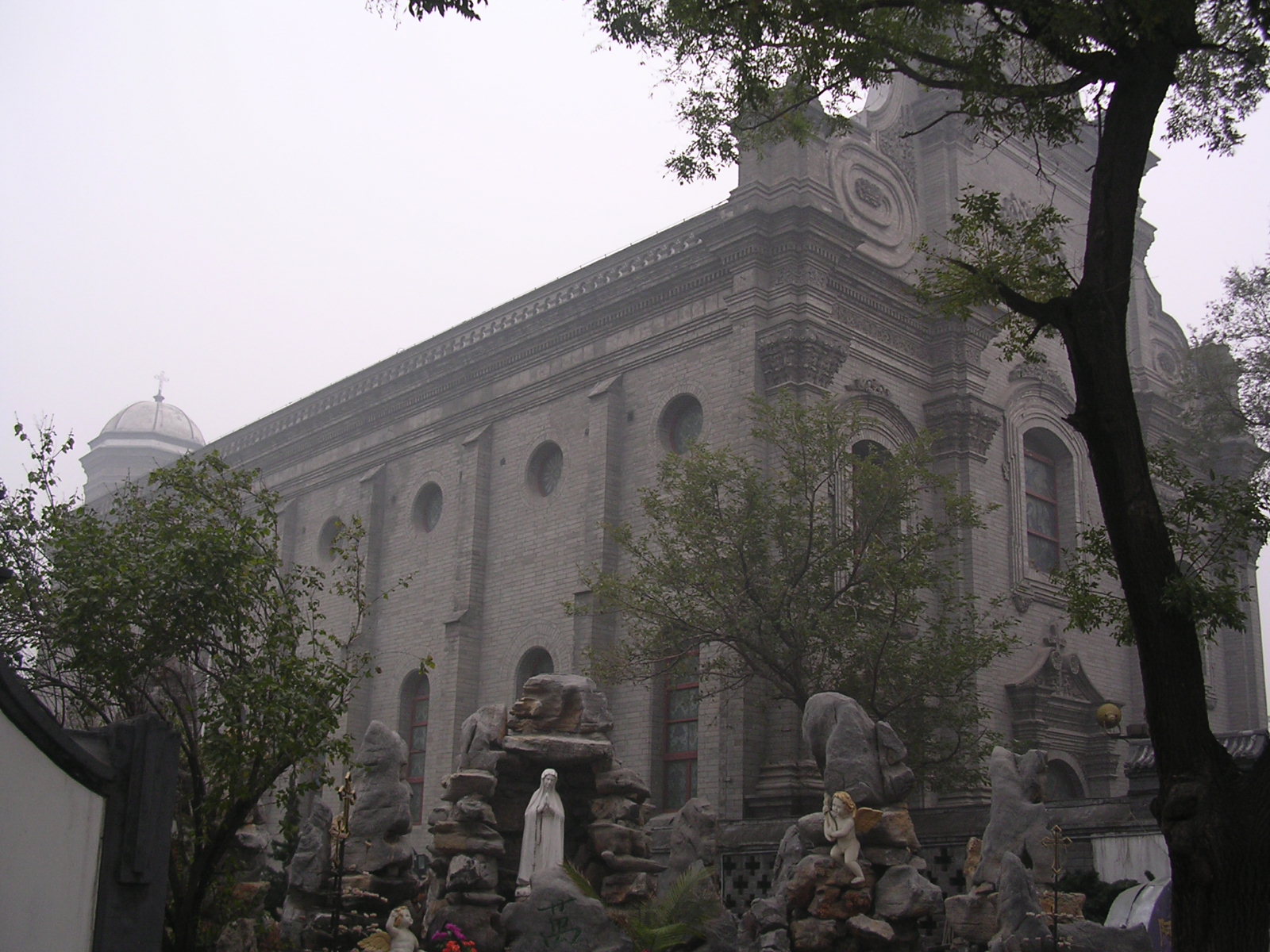
Cathedral of the Immaculate Conception, Beijing
Four churches have stood on this spot in central Beijing. The first was barely a church at all, just a small chapel attached to the residence that the Wanli Emperor granted to the Italian Jesuit Matteo Ricci in 1605, built in Chinese style with only a cross above the entrance to mark its purpose. The building that stands today, a Baroque edifice completed in 1904, bears the coat of arms of Pope Pius X on its facade and hosts masses in Mandarin, English, Latin, Italian, and Spanish. Between these two structures lie four centuries of earthquakes, fires, imperial confiscation, and wholesale destruction by the Boxer Rebellion.
An Emperor's Tolerance
Ricci arrived in Beijing after years of working his way through Chinese society, learning the language and customs, winning respect as a scholar and mathematician rather than demanding it as a missionary. The Wanli Emperor's gift of a residence near Xuanwumen was an extraordinary gesture of acceptance. The small chapel that Ricci attached to it was discreet by design, indistinguishable from surrounding architecture except for the cross. It was known as the Xuanwumen Chapel. In 1650, during the early Qing dynasty, the German Jesuit Johann Adam Schall von Bell replaced the chapel with a proper church. The Shunzhi Emperor, who visited the church twenty-four times, bestowed a stone stela inscribed with the characters meaning 'built by Imperial Order.'
Earthquakes and Imperial Silver
The second church was enlarged in 1703 under the Kangxi Emperor, becoming the second European-style building in Beijing. An earthquake destroyed it in 1720. The replacement, a cruciform Baroque structure measuring 86 meters long and 45 meters wide, was severely damaged by another earthquake in 1730. The Yongzheng Emperor donated a thousand taels of silver for repairs. In 1775, fire struck again, and the Qianlong Emperor contributed ten thousand taels of silver along with a calligraphed board in his own hand reading 'The True Origin of All Things.' Each imperial donation reinforced a remarkable pattern: Chinese emperors supporting the physical infrastructure of a foreign religion, even as political tensions between the Catholic Church and the Qing state grew.
Confiscation and Destruction
That patronage had its limits. In 1838, the Daoguang Emperor confiscated the cathedral as part of a broader crackdown on Catholic activity in China. The building sat empty until the end of the Second Opium War in 1860, when Bishop Joseph Martial Mouly reopened it under the terms imposed by the victorious Western powers. The respite lasted forty years. On June 14, 1900, during the Boxer Rebellion, the cathedral was razed to the ground along with most other churches in Beijing. The destruction was total, motivated by a nationalist fury directed at foreign religious and diplomatic presence in the capital.
The Fourth Church
The building that stands today was completed in 1904, the fourth church on the site. Its Baroque facade carries the coat of arms of Pope Pius X and is crowned by a cross and the letter M, representing Christ and the Virgin Mary. On December 21, 1979, Bishop Michael Fu Tieshan was consecrated in the cathedral, the first major Catholic ceremony in China after the Cultural Revolution. The cathedral became arguably the best-known Catholic church in China among foreigners, hosting English-language masses that drew the diplomatic and expatriate community. Known locally as Nantang, the South Church, it stands near Beijing's Financial Street, a European religious monument surrounded by the glass towers of Chinese finance. It has been closed for repairs since December 2018, with services relocated to the North Church.
From the Air
Located at 39.90°N, 116.37°E in central Beijing's Xicheng District, near Beijing Financial Street. The Baroque church building dates from 1904 and is not individually visible from cruising altitude, but the area is identifiable by the Financial Street towers. Nearest airport: Beijing Capital International (ZBAA), approximately 25 km northeast.