Cathedral of the Immaculate Conception (Saint John, New Brunswick)
Three thousand people packed into an unfinished building on Christmas Day 1855 to hear the first mass. The walls had gone up in a single year, the roof completed by November 1853, but the Cathedral of the Immaculate Conception would not be truly finished for another three decades. That urgency -- build now, perfect later -- reflected the desperation of the community it served. Between 1845 and 1847, approximately 30,000 Irish Catholics had arrived in Saint John, more than doubling the city's population. They came fleeing famine, and they found a city that had no room for them, in any sense of the phrase.
A Bishop's Announcement
Bishop Thomas-Louis Connolly arrived in Saint John in 1852 to find a Catholic population that had outgrown every available place of worship. The Irish who had flooded into the city during the famine years had been marginalized for decades -- politically, economically, and socially. Connolly understood that a cathedral was more than a building; it was a declaration that this community intended to stay and to matter. On November 14, 1852, he announced to his congregation that construction would begin immediately. Plans were drawn up in New York City over the winter of 1852-53. By May 1853, the foundation stone was in the ground. The pace was extraordinary: walls rose through the summer, and the roof was on before the first snow. Connolly was building something his people needed to see standing before doubt could settle in.
Stone by Stone, Spire by Spire
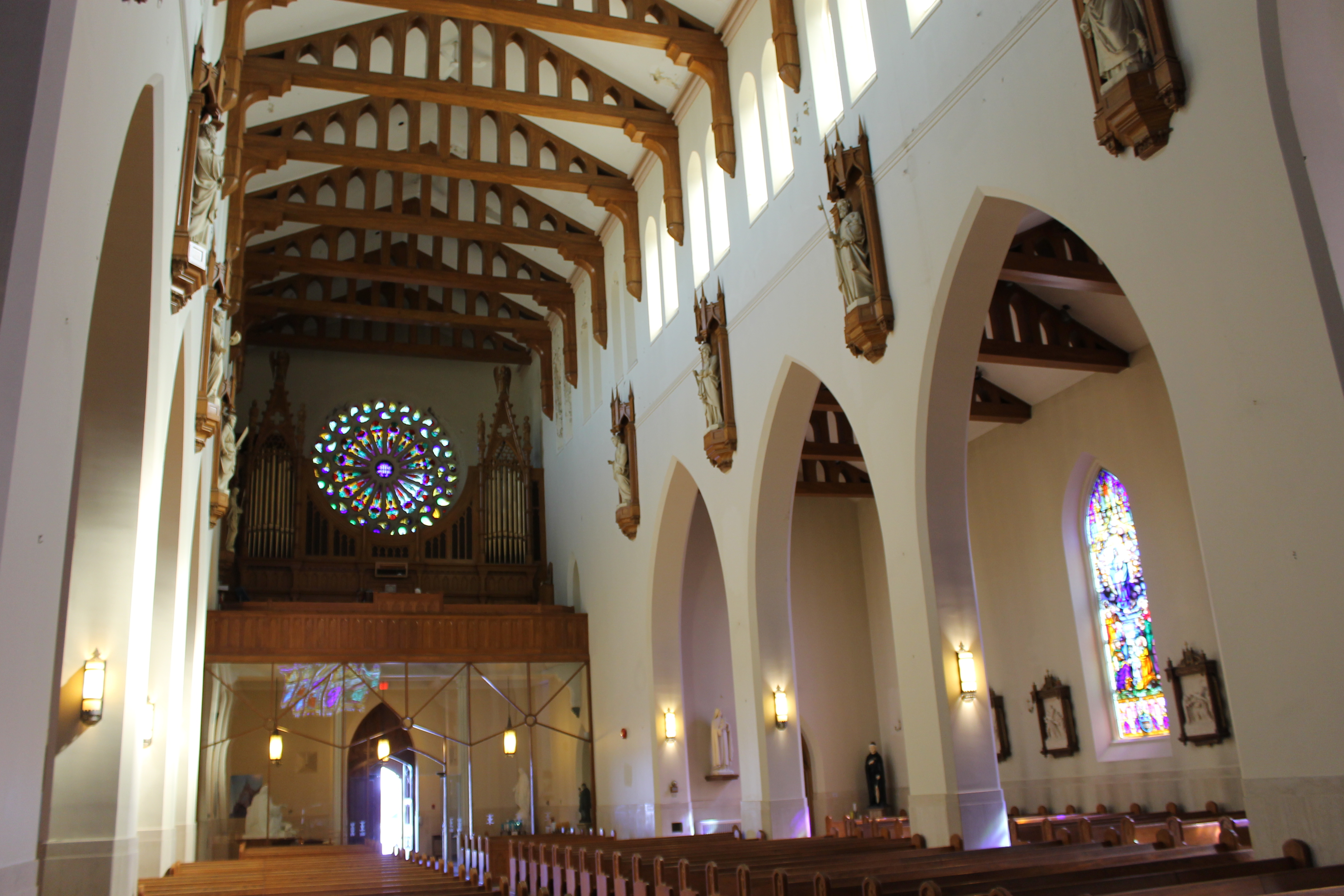
Completing the cathedral fell to Bishop John Sweeney, who was consecrated in 1860. Sweeney finished the chapel, chancel, and entrances by 1861, the same year the adjacent Bishop's Palace was built. The spire went up in 1871, reaching 230 feet to the top of its cross -- roughly 300 feet above sea level, making it one of the highest points in the city. Designed by architect Matthew Stead in the Gothic Revival style, the finished structure stretched 200 feet in length, with the transepts spanning 116 feet and the nave 80 feet wide. The detailed stonework and stained glass windows were typical of the style, but the scale was deliberate. This was not a parish church tucked into a side street. It was a cathedral on Waterloo Street, in the heart of the city, impossible to overlook. When the completed building was finally consecrated in 1885, with great fanfare, it had taken 32 years from announcement to full completion.
The Weight of Waterloo Street
The cathedral's designation as a heritage site recognizes not just its architecture but its meaning to Saint John's Irish Catholic community. The building and its adjacent Bishop's Palace are designated for their historical and religious associations with a population that had been systematically marginalized. The Irish who arrived during the famine years came with nothing and were received with suspicion. Anti-Irish and anti-Catholic sentiment was real and sometimes violent in mid-nineteenth-century New Brunswick. Against that backdrop, the cathedral was an act of collective self-assertion. Every stone laid, every dollar raised, every year of patient construction represented a community refusing to be temporary. The building still functions as the mother church of the Roman Catholic Diocese of Saint John, an active place of worship in a city that has changed enormously since those famine ships arrived.
A Spire Above the Harbour
Saint John is a city of hills and water, and the cathedral's spire has served as a landmark for approaching vessels since the 1870s. From the harbour, it rises above the rooftops like a compass needle. From inside, the Gothic arches draw the eye upward into the kind of vertical space that makes even a crowded room feel vast. The building has weathered 170 years of Maritime winters, the salt air off the Bay of Fundy, and the shifting fortunes of the city itself. Saint John has burned, rebuilt, boomed, and contracted multiple times since Bishop Connolly made his announcement. Through it all, the cathedral has stood on Waterloo Street -- not the oldest building in the city, but perhaps the one that best captures a particular chapter of its story: what a community can build when it has nothing left to lose.
From the Air
Located at 45.2783N, 66.0564W on Waterloo Street in central Saint John. The 230-foot Gothic Revival spire is a prominent landmark visible from considerable distance, particularly when approaching from the harbour side. Nearest airport: Saint John Airport (CYSJ), approximately 15 km east. The spire stands near the highest elevation in the city, roughly 300 feet above sea level, making it one of the most recognizable features of the Saint John skyline.