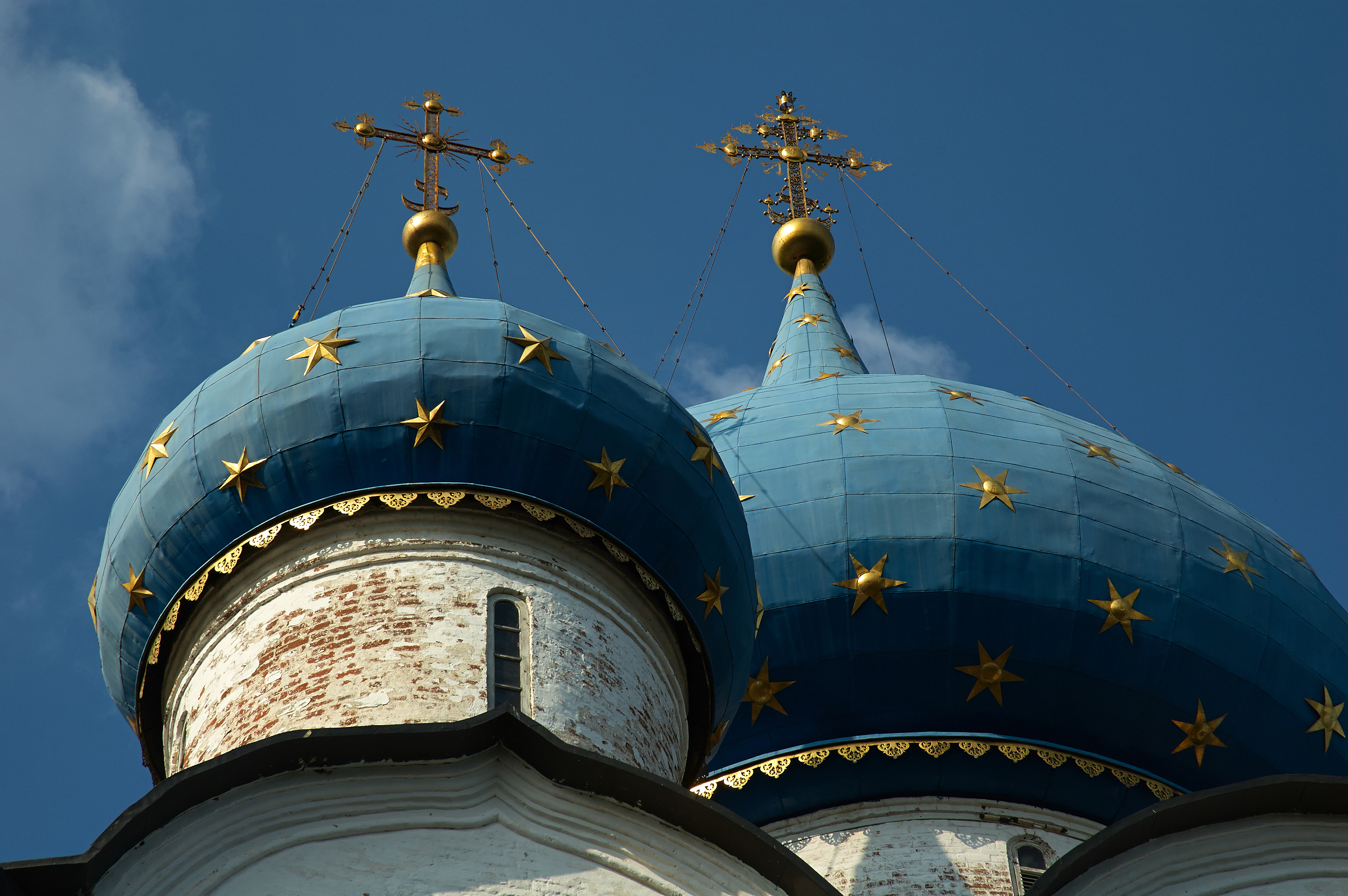
Cathedral of the Nativity of the Theotokos, Suzdal
Three cathedrals have stood on this site. The first rose during the reign of Vladimir Monomakh around 1102. The second, ordered by Yuri II of Vladimir in 1222, was built of white tufa stone and decorated with carved limestone. The third, rebuilt by Vasili III between 1528 and 1530, is what stands today -- a cathedral whose lower walls preserve twelfth-century masonry beneath sixteenth-century brickwork, a building that carries its own history in visible geological layers. The Cathedral of the Nativity of the Theotokos in Suzdal is a monument that has refused to disappear.
The First Cathedral on the Bend
Suzdal's kremlin occupies an oxbow of the Kamenka River, encircled by a ring of earthen walls that date to the town's earliest fortification. It was here, around 1102, that the first cathedral was built during the reign of Vladimir II Monomakh. What made this church unusual for its era was its purpose: it was the first city cathedral in the region not constructed for the exclusive use of a prince or his family. The building served the broader community of Suzdal, a distinction that reflected the town's growing importance as a center of political and spiritual life in northeastern Rus. Though nothing of this original structure survives above ground, its footprint established the sacred geography that has anchored Suzdal's identity for nine centuries.
White Stone and Mongol Fire
By the early thirteenth century, the original cathedral had deteriorated beyond repair. In 1222, Grand Prince Yuri II of Vladimir ordered it demolished and replaced with a new edifice of white tufa stone, decorated with carved limestone in the Vladimir-Suzdal tradition. This was the era of the great white-stone churches, when the principality's builders were creating an architectural language that would define medieval Russian culture. The new cathedral stood for just sixteen years before the Mongol invasion of 1238. When the forces of Batu Khan sacked Suzdal, the cathedral's interior was destroyed, though the structure itself survived. It endured through more than two centuries of Tatar-Mongol domination, battered but standing, until fire brought it down in 1445 -- the same year that the Battle of Suzdal was fought just outside the town walls.
A Cathedral in Layers
The rebuilding came under Vasili III Ivanovich between 1528 and 1530. Rather than starting from scratch, the builders worked with what remained. They lowered the surviving old walls to the arcade level and continued upward in brick laid in the Muscovite style, replacing the upper portions of white stone with the darker material. The result is a cathedral that reads like a cross-section of Russian architectural history: the lower portion still shows the carved white tufa of the 1220s, while the upper walls and the five blue domes studded with gold stars belong to the sixteenth century and later restorations. Inside, the cathedral contains the remains of a son of Yuri Dolgoruki, as well as princes of the Shuisky family, making the floor itself a compressed record of the dynasties that shaped this region.
Among the White Monuments
Today the Cathedral of the Nativity of the Theotokos is one of eight structures inscribed as the White Monuments of Vladimir and Suzdal, a UNESCO World Heritage Site recognized as a masterwork of medieval Russian architecture. The cathedral stands as perhaps the most complex monument in the group, not for architectural sophistication but for the sheer density of history compressed into one building. Despite several fires and centuries of alteration, the structure survives as a defining monument of medieval Russian culture. The earthen ramparts that encircle the kremlin remain, and the Kamenka River still curves around this elevated promontory as it did when the first cathedral was consecrated. Few buildings anywhere carry nine centuries of continuous sacred use across so many catastrophes -- Mongol invasion, fire, structural collapse, dynastic upheaval -- and remain standing.
From the Air
Located at 56.42N, 40.44E in the town of Suzdal, Vladimir Oblast, Russia. The cathedral sits within the Suzdal kremlin on an elevated bend of the Kamenka River. From the air, the kremlin's earthen ramparts and the cathedral's distinctive blue domes with gold stars are visible against the green river valley. Suzdal has no major airport; nearest is Vladimir, approximately 35 km to the south, or Ivanovo-Yuzhny (UUBI), approximately 70 km to the northeast. Best viewed at 2,000-4,000 feet. The Kamenka River's oxbow around the kremlin is the primary visual landmark.