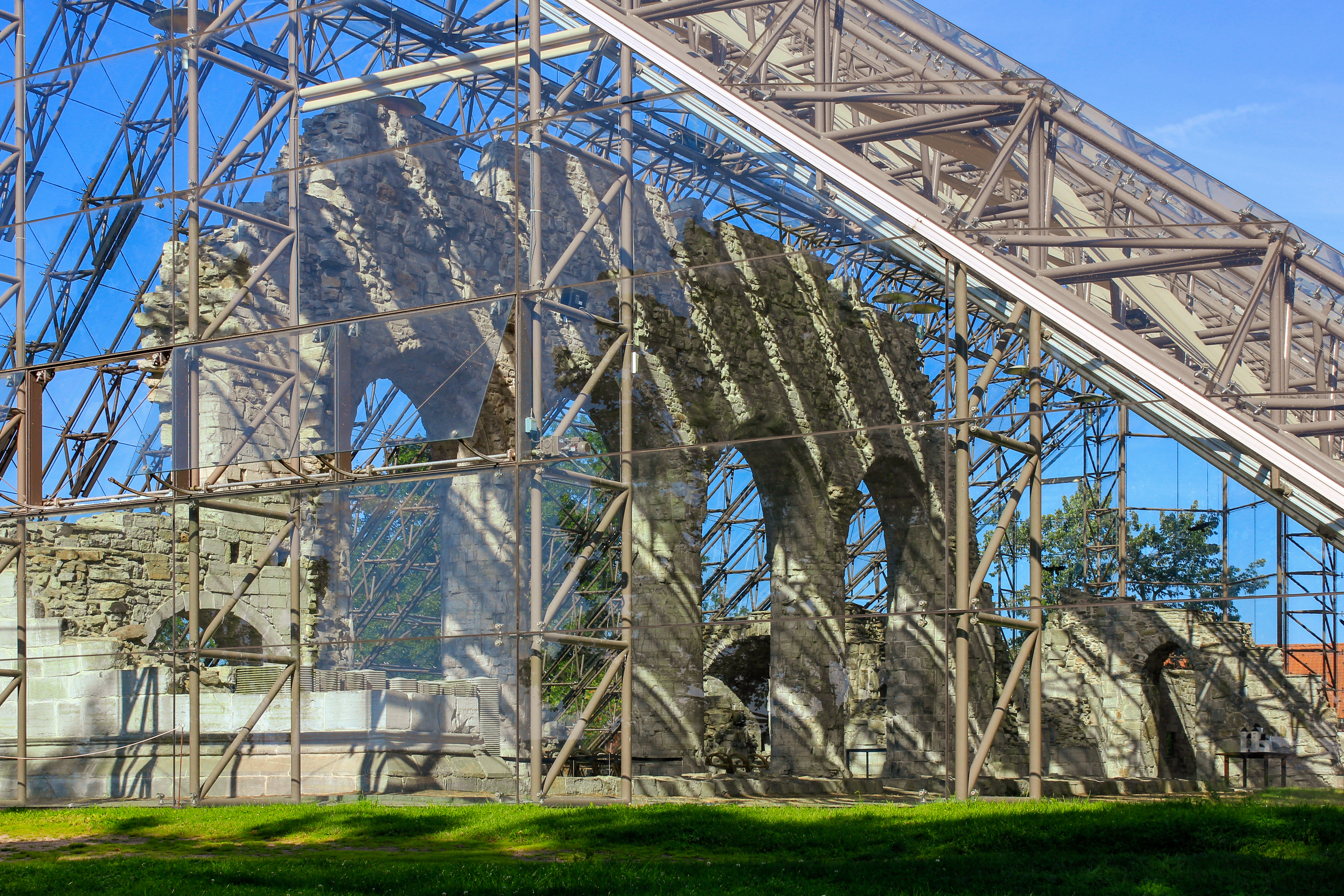
Cathedral Ruins in Hamar
The arches still stand, eight centuries after the first stones were laid, though they hold up nothing now but sky -- or rather, the glass canopy that replaced it. Hamar's cathedral ruins are what happens when a country refuses to let its oldest wounds disappear. The original cathedral took a century to build and three days to destroy, and the protective structure that shelters what remains took eleven years of its own. Together, ruin and shield form one of Norway's most striking architectural juxtapositions.
A Bishop from Greenland
Construction began under Bishop Arnaldur, who was appointed the first Bishop of Hamar in 1150 upon his return from Gardar, Greenland. That a man who had served at the edge of the known medieval world should build a cathedral in inland Norway speaks to the ambition of the young diocese, which eventually encompassed much of what are now the counties of Hedmark, Oppland, and Buskerud. The cathedral was completed roughly a century later, around the time of Bishop Paul in the 1240s. It rose first in the Romanesque style, with thick walls and rounded arches designed to endure, then was later converted to Gothic as architectural fashions shifted across Europe. The diocese saw its share of conflict well before the building fell. Bishop Thorfinn of Hamar clashed with King Eric II of Norway over episcopal elections, was exiled in the 1280s, and died far from home at Ter Doest in Flanders.
Reformation and Ruin
The Reformation swept through Denmark-Norway in the 1530s, and the cathedral's fate turned with it. Stripped of its religious function, the structure was renamed Hamarhus and handed to the local sheriff as a residence. It survived in diminished form for another three decades before the Northern Seven Years' War brought Swedish forces into eastern Norway. In 1567, Swedish troops captured Hamar and pressed on toward Oslo. When they retreated, they torched the town behind them. Hamarhus and the cathedral were destroyed in the burning -- not by targeted demolition, but by the indiscriminate fire of a retreating army. What the Reformation had secularized, war reduced to rubble. The arches that remain are the skeletal outline of a building that took generations to raise and hours to lose.
Glass Over Stone
For four centuries the ruins stood exposed to Norwegian weather, slowly eroding. In 1987, the Directorate for Cultural Heritage launched an architectural competition for one of the most ambitious preservation projects the Norwegian government had ever attempted: a protective glass and steel structure designed to shelter the remains without enclosing them in a museum box. Completed in 1998 by Lund+Slaatto Arkitekter, the glass shield arches over the ruins like a second skin, allowing natural light and the surrounding landscape to remain visible while keeping rain, snow, and frost at bay. The ruins now form part of Anno Museum and were selected as the millennium site for Hedmark county -- a recognition that these broken arches represent something essential about the region's identity. Walking beneath the glass canopy, visitors see medieval stonework framed by modern engineering, the old and new held in deliberate tension.
What the Stones Remember
The cathedral ruins sit on a promontory near the shore of Lake Mjøsa, Norway's largest lake. From this spot, the bishops once administered a territory that stretched across the interior highlands. The Romanesque and Gothic fragments that survive -- columns, archways, wall sections -- are enough to suggest the building's original scale without fully reconstructing it. This incompleteness is the point. Norway chose to preserve the ruin as a ruin, not to rebuild what was lost. The glass canopy protects without pretending, and the open arches frame views of the lake and the surrounding farmland much as they did when the cathedral was whole. It is a place where eight hundred years of construction, destruction, neglect, and care coexist in a single glance.
From the Air
Located at 60.79°N, 11.04°E on the Domkirkeodden peninsula, a promontory jutting into Lake Mjøsa on the east side. The glass protective structure over the ruins is visible as a distinctive curved shape on the lakeside. Nearest airport is Oslo Gardermoen (ENGM), roughly 120 km south. Hamar also has the Stafsberg airfield (ENHA) for light aircraft. Approach from over Lake Mjøsa at 2,000-4,000 feet for the best perspective of the peninsula and the ruins.