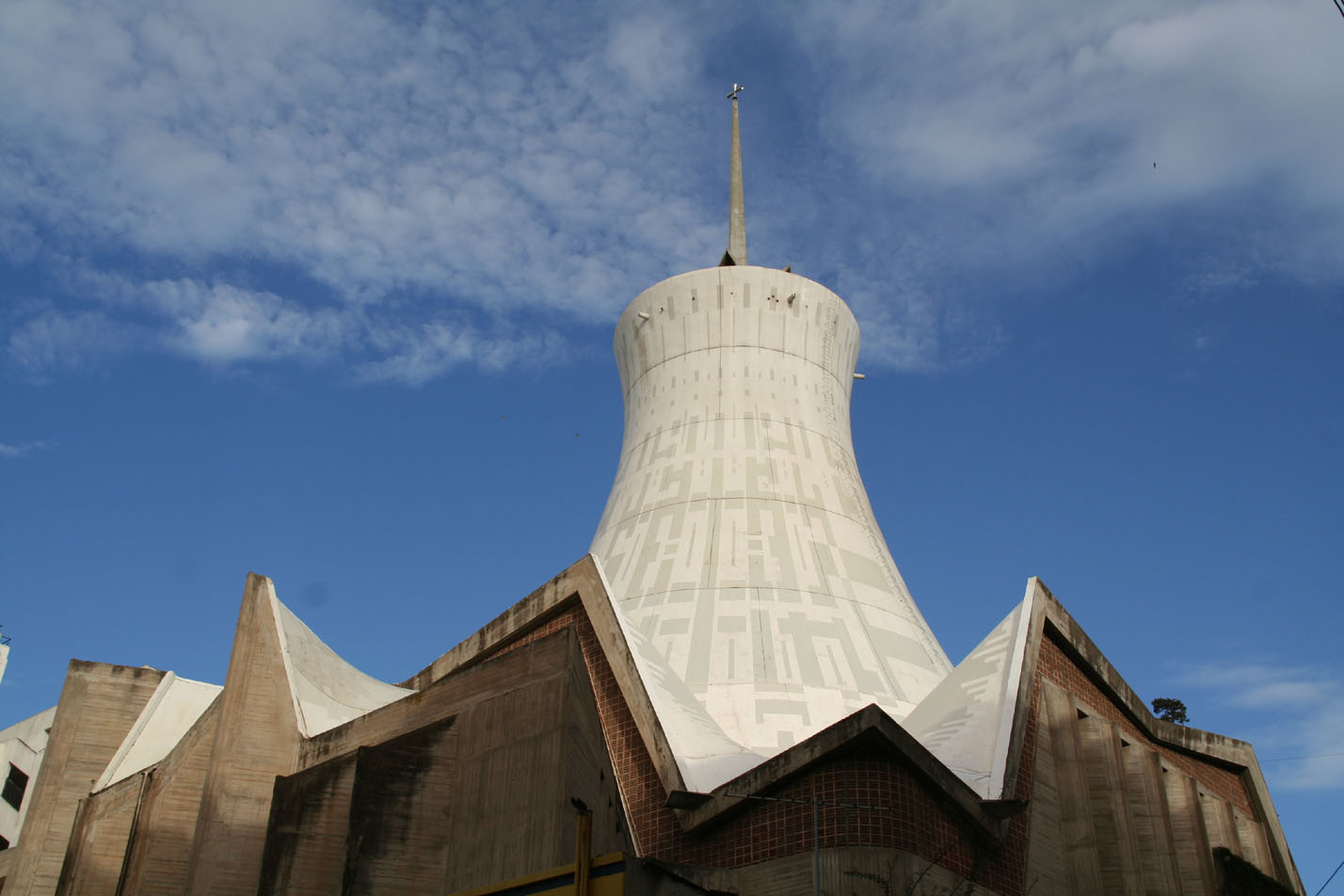
Cathedrale du Sacre-Coeur d'Alger
There is something almost paradoxical about the Sacred Heart Cathedral of Algiers. It was built because France needed a new cathedral in the capital of its most prized colony -- the old one, the Cathedral of Saint Philippe, was about to revert to its original identity as the Ketchaoua Mosque upon Algerian independence. But the new cathedral was completed in 1956, just six years before independence rendered its purpose moot. Today it stands as one of the few active Roman Catholic churches in a country that is overwhelmingly Muslim, serving the tiny remaining Christian community and the Archdiocese of Algiers.
A Cathedral Born of Displacement
Construction began in 1944, initiated by Bishop Leynaud, who recognized that the Cathedral of Saint Philippe -- the converted Ketchaoua Mosque -- could not serve permanently as a cathedral in a city where such conversions carried deep historical wounds. The Ketchaoua Mosque had been seized from Muslim worshippers at bayonet-point in 1831 and consecrated as a Catholic cathedral in 1832. Its transformation remained a source of resentment throughout the colonial period. Leynaud's new cathedral would be purpose-built and located away from the Casbah, in the modern part of the city. Designers Paul Herbe and Jean Le Couteur, working with engineer Rene Sarger, created a structure that broke sharply with traditional church architecture.
Modernism on North African Soil
The cathedral's design reflects the mid-century modernist movement that was reshaping sacred architecture across the Catholic world. The building uses reinforced concrete in bold, sweeping forms that owe more to Le Corbusier's contemporaneous chapel at Ronchamp than to the Gothic or Romanesque traditions of French cathedrals. Yet inside, it holds traces of a far longer history. The altar is carved from Carrara marble and houses relics of African saints. At the entrance to the nave, small organs donated by the parish of Boufarik face a mosaic mural that dates to 324 CE, recovered from the first Roman basilica at Castellum Tingitanum -- modern-day Chlef. This single artifact bridges seventeen centuries: a Roman-era Christian mosaic incorporated into a modernist French cathedral on Algerian soil.
Faith in a Changed World
The cathedral was elevated to its current status in December 1962 and consecrated in 1963 -- the very year after Algeria won its independence. With the departure of nearly a million Pied-Noirs, the Catholic population of Algiers shrank from hundreds of thousands to a few thousand. The Ketchaoua Mosque was restored to Islamic worship, fulfilling what many Algerians saw as an act of historical justice. The Sacred Heart Cathedral became the seat of a drastically diminished archdiocese, serving a community of foreign workers, diplomats, and a small number of Algerian Christians. It remains a place of quiet worship in a city shaped by the collision of empires, faiths, and the long aftermath of decolonization. The cathedral endures as both a functioning church and a monument to the complexity of Algeria's layered religious heritage -- a building that exists because one faith's house of worship was taken to serve another, and then taken back.
From the Air
Located at 36.764N, 3.048E in the modern district of Algiers, south of the Casbah. The cathedral's modernist concrete form is visible among the surrounding buildings. Nearest airport: Houari Boumediene Airport (DAAG), approximately 16 km southeast. The building sits on the heights overlooking the Bay of Algiers, with panoramic views of the Mediterranean and the city's waterfront.