Cave Creek Disaster
The platform was supposed to hold people safely above a 40-metre chasm where Cave Creek emerges from the limestone karst of Paparoa National Park. It was built in April 1994 by Department of Conservation workers who were not qualified engineers, using nails where the design called for bolts because nobody had brought a drill to the site. A warning sign limiting occupancy to five people had been ordered but never installed. A building consent had never been obtained. On 28 April 1995, when 18 people walked to the edge together, the platform tipped forward into the void.
Eleven Twenty-Five
The group that morning was from Tai Poutini Polytechnic in Greymouth, students on a field trip through the national park. En route through the bush, five people split off: the polytechnic tutor, a Department of Conservation officer, and three students. The remaining 17 students and a second DOC officer continued to the platform. They reached it first and walked to the edge together at about 11:25 a.m. Several students began shaking the platform, and it toppled forward into the chasm. Fourteen people died: the DOC officer and 13 students. Four others survived the 40-metre fall with serious injuries. The smaller group arrived shortly after the collapse. The surviving DOC officer and a student ran back to the trailhead for help, but the vehicle keys were not there. The student ran along the road carrying a handwritten note describing the accident's location. By 12:15 p.m. he had reached a phone and called police in Greymouth.
Twelve Failures Deep
The Commission of Inquiry, led by District Judge Graeme Noble, catalogued twelve major problems in the platform's construction. No qualified engineer had designed or approved the structure. Nails secured the bearers to the piles instead of the bolts specified in the plans, because no drill had been brought to the remote construction site. The steps, designed to serve as a counterweight, had not been properly attached. A building consent was never obtained; by the time someone noticed, the original plans had been lost. Replacement schematics were hastily drawn by an unqualified volunteer exchange student to lodge a retrospective application, but further confusion about the Building Act meant the consent was never actually filed. The platform was not listed in any inspection register. The warning sign capping occupancy at five people was ordered but never installed at the site.
A Tragedy Almost Bound to Happen
Judge Noble's commission went beyond cataloguing construction errors. It found that the root causes were systemic: the Department of Conservation was seriously underfunded and under-resourced. The department had not been given sufficient resources to meet its responsibilities without cutting corners, and was frequently forced to accept poor quality standards because there simply was not enough money. The commission's conclusion was blunt. Given the state of the department, "a tragedy such as Cave Creek was almost bound to happen." The platform should have been built to withstand any use that could reasonably be expected, including the kind of roughhousing that young people on a field trip might engage in. Ten years later, survivor Stacy Mitchell publicly acknowledged that he and some other students had been shaking the platform hard when it collapsed, something he had not reported at the time for fear of being blamed.
What Changed
In the aftermath, the Department of Conservation inspected more than 520 structures across New Zealand, closing 65 for repairs and removing many others entirely. Safety notices appeared on structures throughout the conservation estate, sometimes to a degree some felt was excessive, with bridges and platforms labelled for a maximum of one person. Although DOC accepted responsibility, no prosecutions were possible: New Zealand law at the time did not allow the Crown to prosecute itself. The families of the victims received $2.6 million in compensation. Prime Minister Jim Bolger initially dismissed the inquiry's findings, arguing the platform failed "essentially because it lacked about $20 worth of bolts," but the political fallout continued. Conservation Minister Denis Marshall resigned in May 1996. The law itself was eventually changed so that government departments could be held criminally liable for negligent building practices, a direct legacy of Cave Creek.
A Place of Remembrance
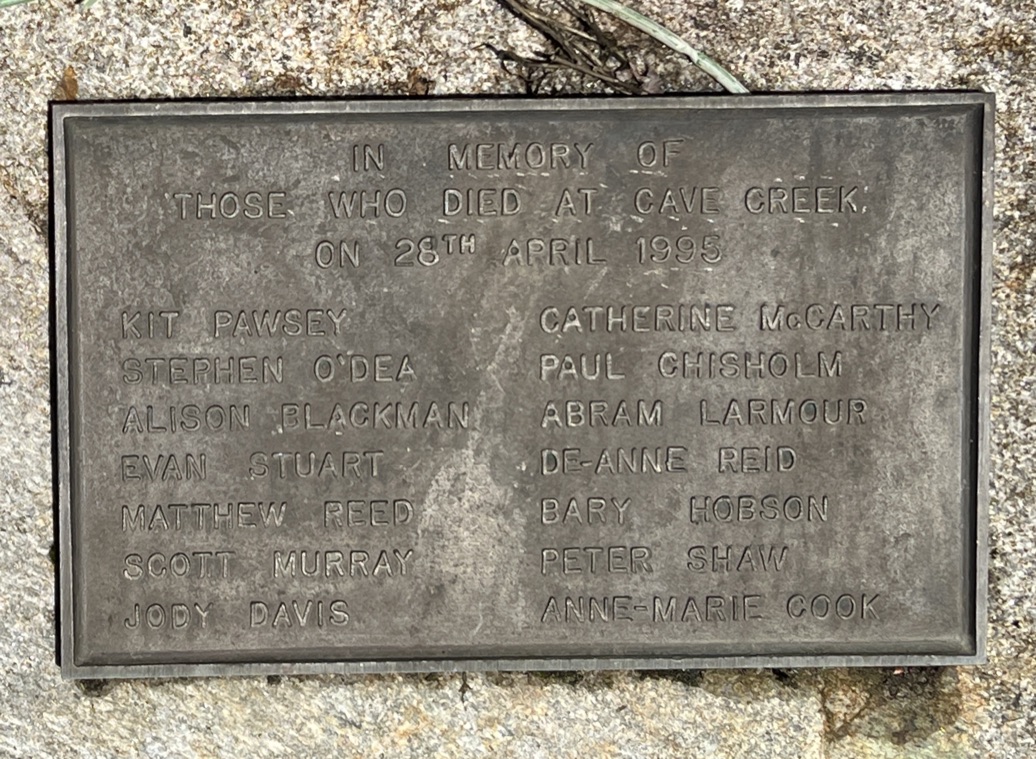
A memorial plaque was unveiled in April 1996, a year after the disaster. The track reopened to the public in 1998 with new stairs, but the viewing platform was never rebuilt. Where it once stood, a fence and warning signs mark the edge of the chasm. In 2020, the path was renamed the Cave Creek Memorial Track, known also by its Maori name Kotihotiho, as part of the 25th anniversary remembrance. A memorial along the track honours each of the fourteen people who died. In 2025, a new track opened on the 30th anniversary. The bush around Cave Creek remains as it was: dense, green, quiet. The creek still emerges from the cave system below, indifferent to what happened above it. What changed was not the landscape but the country's understanding of its duty to the people who walk through it.
From the Air
Cave Creek is located at approximately 42.10S, 171.40E within Paparoa National Park on the West Coast of New Zealand's South Island. The park is characterised by dense bush, limestone karst formations, and the Paparoa Range. From the air, look for the rugged coastal landscape between Greymouth and Westport, with the Pancake Rocks at Punakaiki visible along the coast. Greymouth Aerodrome (NZGM) is the nearest airfield, roughly 40 km to the south. Hokitika Aerodrome (NZHK) lies further south. Westport Airport (NZWS) is to the north. The site itself is deep in the bush and not directly visible from altitude, but the Paparoa Range and the coastal cliffs of the park are distinctive landmarks. Best observed at 2,000-4,000 feet AGL.