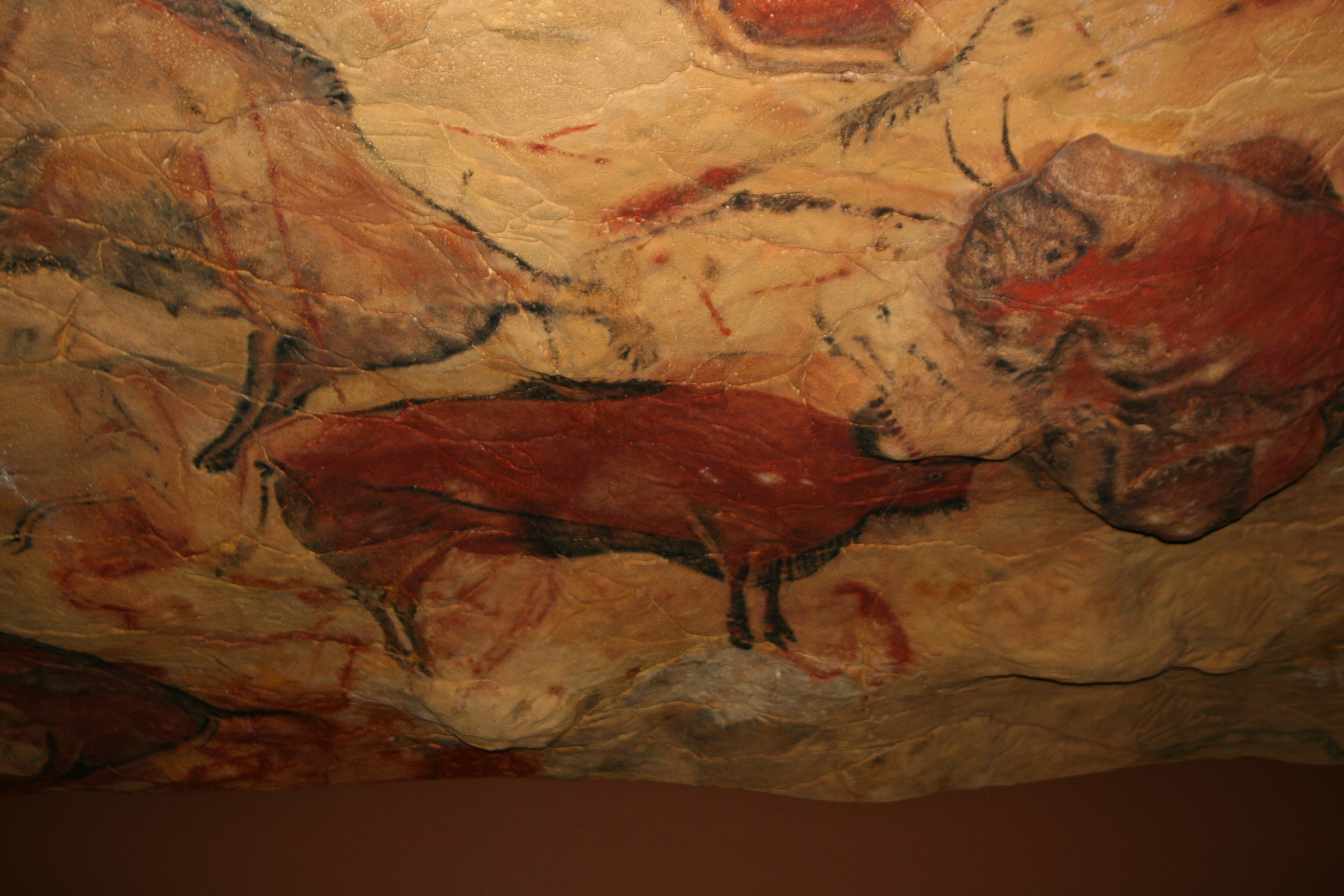
Cave of Altamira
An eight-year-old girl looked up. In 1879, Maria Sanz de Sautuola wandered into a side chamber of a cave near Santillana del Mar while her father, amateur archaeologist Marcelino, excavated the floor near the entrance. "Look, Papa, oxen!" she reportedly called out. What she had spotted on the ceiling overhead would eventually reshape humanity's understanding of its own past: a gallery of polychrome bison, horses, and deer painted with a sophistication that the scientific establishment of the day refused to believe possible from prehistoric hands.
A Gallery Sealed in Stone
The Cave of Altamira stretches roughly 270 meters into Mount Vispieres through a series of twisting passages and chambers. Its main corridor varies between two and six meters in height, carved by karst processes through the calcareous rock over millennia. Around 13,000 years ago, a rockfall sealed the entrance, creating an accidental time capsule that preserved its contents in near-perfect condition until a fallen tree disturbed the rubble and revealed the opening. Archaeological excavations have uncovered artifacts spanning two distinct periods of occupation: the Upper Solutrean, roughly 18,500 years ago, and the Lower Magdalenian, between 16,590 and 14,000 years ago. In the gap between those periods, only wild animals inhabited the darkness.
Pigment, Contour, and Light
The artists who worked inside Altamira were not primitive doodlers. They ground charcoal, ochre, and hematite into pigments, then diluted them to create variations in intensity that produce an effect resembling chiaroscuro, the technique Renaissance painters would not rediscover for thousands of years. They studied the natural bulges and contours of the cave walls, incorporating them into their compositions to give animals a three-dimensional quality. The Polychrome Ceiling, the cave's most celebrated feature, depicts a herd of extinct steppe bison in different poses alongside horses, a large doe, and possibly a wild boar. Some paintings date to the Solutrean period, including handprints made by blowing pigment over outstretched fingers to leave negative impressions on the rock. Uranium-thorium dating has revealed that the paintings were not made in a single burst of creativity but accumulated over a period of more than 20,000 years.
The Discoverer They Called a Fraud
Marcelino Sanz de Sautuola published his findings in 1880 with the support of archaeologist Juan Vilanova y Piera, arguing that the paintings were Paleolithic in origin. The reaction was brutal. French specialists led by Gabriel de Mortillet and Emile Cartailhac rejected the claim outright. The art was too accomplished, they argued, to have been produced by prehistoric humans who supposedly lacked the capacity for abstract thought. Sautuola was accused of commissioning a modern artist to paint the cave walls. At the 1880 Prehistorical Congress in Lisbon, his findings were publicly ridiculed. Sautuola eventually discovered that the artists could have used marrow fat in their lamps, which produced far less soot than other fuels, explaining the pristine ceilings. But the damage to his reputation was done. He died in 1888, fourteen years before vindication arrived.
Mea Culpa
By 1902, similar prehistoric paintings had been discovered across the Franco-Cantabrian region, making the case against Altamira's antiquity untenable. That year, Emile Cartailhac, one of Sautuola's most vocal critics, published a remarkable article titled "Mea culpa d'un sceptique" in the journal L'Anthropologie, explicitly admitting his error. Sautuola was not alive to read it. Cartailhac subsequently collaborated with priest and draughtsman Henri Breuil to produce detailed studies of the cave, and further excavations continued through the twentieth century. UNESCO declared Altamira a World Heritage Site in 1985. In 2007, Spaniards voted it one of the Twelve Treasures of Spain.
The Cave That Cannot Be Visited
Success nearly destroyed what time had preserved. During the 1970s, the carbon dioxide and moisture from thousands of visitors began degrading the paintings. Altamira was closed entirely in 1977, reopened with strict limits in 1982, and closed again in 2002 after green mold appeared on some works. A replica cave and museum, completed in 2001, now allows visitors to experience the Polychrome Ceiling without endangering the originals. The replicas were created by Pedro Saura and Matilde Muzquiz using the same pigment techniques as the Paleolithic artists, and the process of recreating the works led to the discovery of previously unknown paintings and engravings. The original cave remains sealed, its bison and handprints waiting in the dark as they have for thousands of years, witnessed now only by the scientists charged with their preservation.
From the Air
Located at 43.38N, 4.12W near Santillana del Mar in Cantabria, northern Spain. The cave sits in the rolling green hills south of the Cantabrian coast. Nearest airport is Santander (LEXJ), approximately 30 km to the east. The National Museum and Research Center of Altamira is visible as a modern building complex near the original cave site. Fly at 2,000-3,000 feet AGL over the lush countryside to see the museum grounds and the surrounding medieval town of Santillana del Mar.