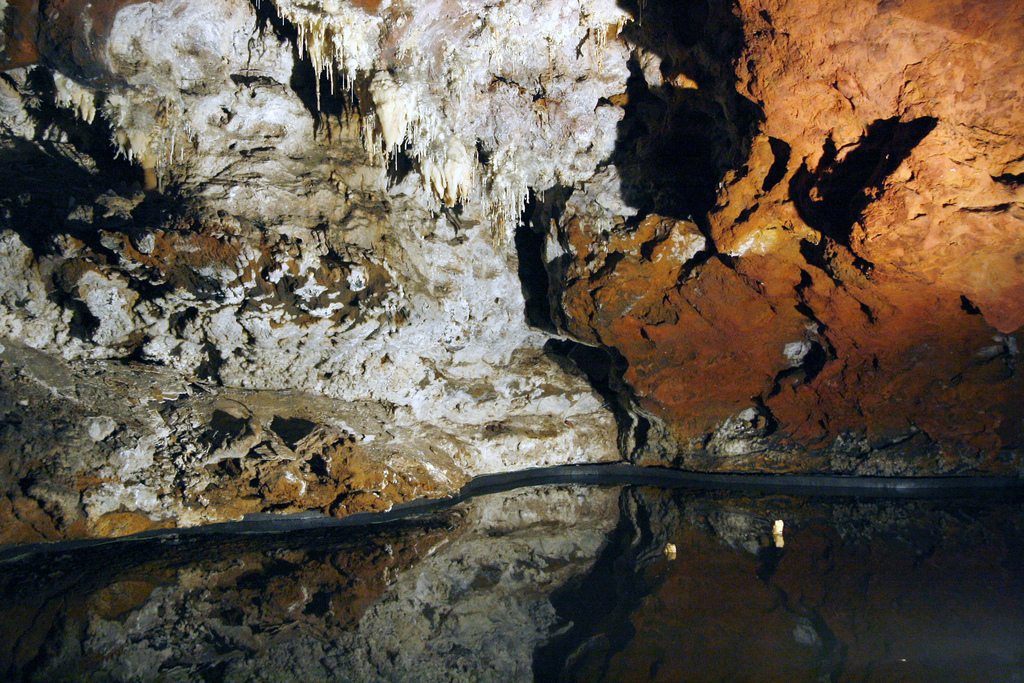
Cave of El Soplao
The miners were looking for zinc and lead. What they drilled into was a darkness that kept going -- seventeen kilometers of passages stacked on multiple levels, their ceilings bristling with stalactites that grew sideways, curled upward, and spiraled in apparent defiance of gravity. El Soplao, tucked into the Sierra de Arnero in Cantabria, was an accident. Its geological formations, dating back to the Cretaceous period, are anything but.
Gravity's Rebels
El Soplao's signature features are its helictites -- stalactites that ignore the vertical. Instead of hanging straight down, they twist, branch, and curl in every direction, driven by capillary forces and crystal growth patterns that override gravity. Alongside them hang curtains of calcite, thin translucent sheets that drape from the ceiling like frozen fabric. The cave contains such a concentration of these formations that geologists consider it unique. Aragonite, calcite, dolomite, sphalerite, galena, marcasite, and pyrite have all been identified within its passages. In 2011, researchers discovered underground stromatolites formed by manganese-oxidizing bacteria, and the cave has yielded a mineral new to science: zaccagnaite-3R.
From Mine to Monument
For decades, El Soplao was simply part of the La Florida mining operation. Local families depended on the income from zinc and lead extraction, supplemented by livestock farming. The miners knew the cave was remarkable -- the Gallery of the Ghosts, a 350-meter-long room filled with thick white stalagmites rising from the floor like sentinels, served as a storage area -- but the cave's true value went unrecognized until speleologists from the Cantabria University Speleology Club began systematic exploration in 1975. Their work revealed passage after passage: the Gallery Gorda with its underground lake, the Gallery of the Forest where stalagmites and stalactites merge into columns resembling a petrified woodland, the Gallery Genesis with its 30-meter ceilings and rainbow of mineral salts. On July 1, 2005, the Government of Cantabria opened six kilometers of passages to the public.
Time Trapped in Amber
Deep within El Soplao, researchers have found deposits of amber -- fossilized tree resin dating back roughly 110 million years to the Cretaceous period. Trapped inside are insects so perfectly preserved that their wing veins and body segments remain visible, frozen in the act of whatever they were doing when the resin engulfed them. Among the species identified are ancient snakeflies, including Cantabroraphidia marcanoi, a species named for the region. The amber provides a window into an ecosystem that existed when dinosaurs walked the land above these caves. El Soplao is just one of at least 6,500 caves in Cantabria, but few anywhere in the world offer both spectacular geological formations and a fossil record spanning more than a hundred million years.
Music in the Deep
In recent years, El Soplao has found a new purpose beyond science and tourism. The cave's acoustics -- shaped by vast chambers, irregular walls, and the natural dampening of stone -- have made it a concert venue. Artists including Bertin Osborne and Nando Agueros have performed for hundreds of listeners in rooms where the only previous audience was geological. From the air, the Sierra de Arnero runs parallel to the Cantabrian coast, its maximum altitude reaching 682 meters. The cave entrance sits at 540 meters, hidden in forested slopes near the town of San Vicente de la Barquera. Nothing about the surface suggests what lies beneath -- which is, of course, part of the point.
From the Air
Located at 43.30°N, 4.41°W in the Sierra de Arnero of Cantabria, Spain. The cave entrance is at 540 m (1,772 ft) elevation. The Sierra de Arnero runs parallel to the Cantabrian Sea with a maximum altitude of 682 m. Nearest airport: Santander (LEXJ), approximately 70 km to the east. The coastal town of San Vicente de la Barquera is a useful visual landmark to the north. Terrain is hilly but not extremely mountainous.