Cave of La Pasiega
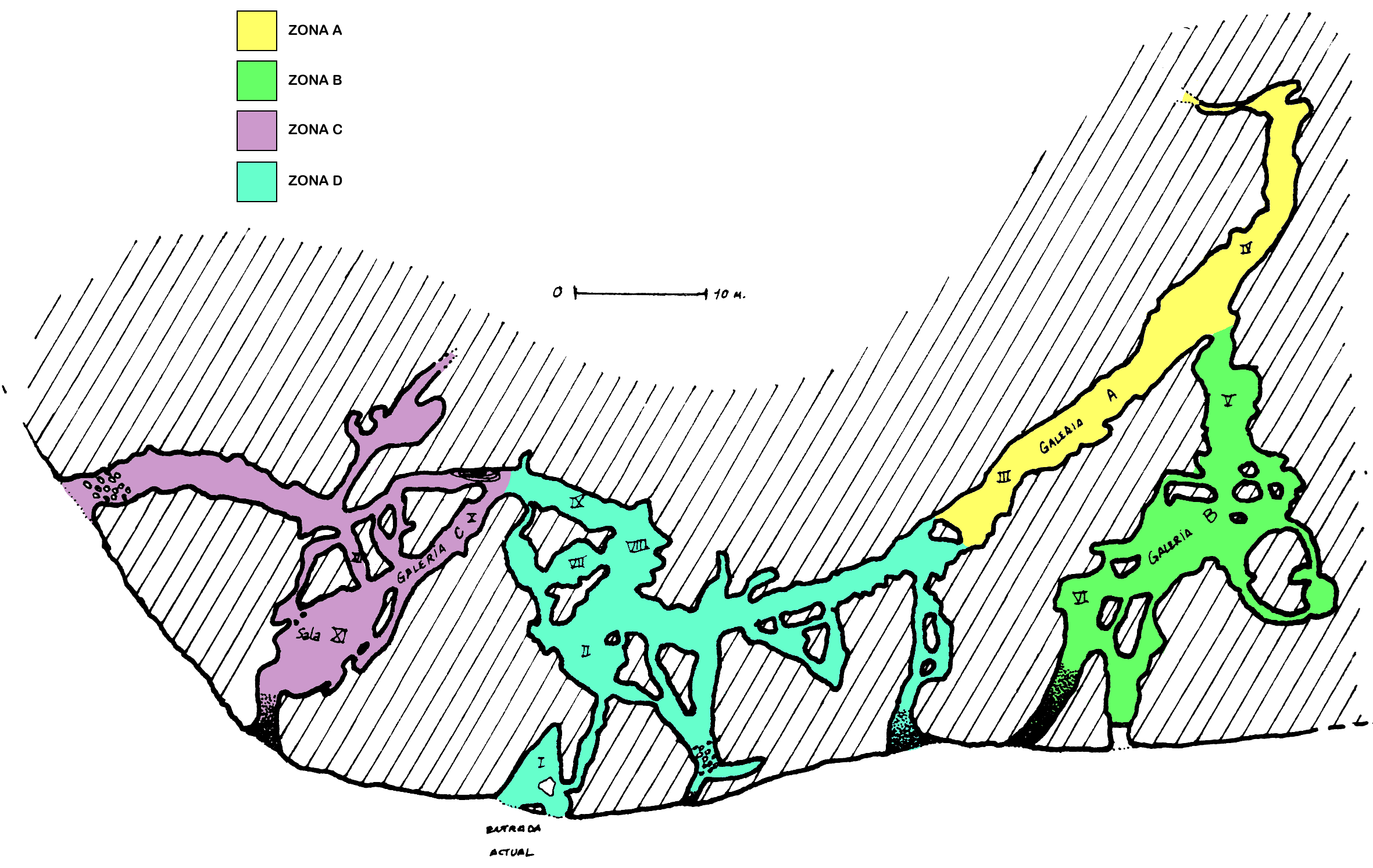
Walk seventy meters into the principal gallery of La Pasiega, and the passage begins to split. Secondary corridors wind away into darkness, opening into chambers that the first researchers labeled with letters and Roman numerals: Gallery B, room II-VIII, room 11 of Gallery C. Each holds Paleolithic decorations. The cave runs more than 120 meters through Monte Castillo, parallel to the slope, punctuated by six small mouths where it once opened to daylight. Most are blocked now. Only two remain accessible. What lies inside has earned La Pasiega a place on the UNESCO World Heritage List and a central role in one of archaeology's most contentious debates.
The Galleries of Monte Castillo
La Pasiega occupies the heart of the Pas River valley near Puente Viesgo in Cantabria, sharing Monte Castillo with the caves of El Castillo, Las Monedas, and Las Chimeneas. Together they form one of the most complete sequences of Old Stone Age material culture and art in Europe. La Pasiega's principal gallery stretches approximately 70 meters before branching into deeper secondary passages, winding and labyrinthine, that broaden in places to form large chambers. The recorded remains belong mainly to the Upper Solutrean and Lower Magdalenian periods, though older material has also been found. More than 700 painted and engraved representations have been identified throughout the cave system, making it one of the most densely decorated Paleolithic sites in the world.
What the Walls Hold
The art of La Pasiega spans an enormous range. There are horses, deer, bison, ibex, and aurochs rendered with careful attention to proportion and movement. Abstract signs, geometric patterns, and arrangements of dots appear alongside the animals, their meaning lost but their deliberateness unmistakable. The cave also contains hand stencils, created by the same blown-pigment technique found throughout the Franco-Cantabrian region. What makes La Pasiega unusual is the concentration and variety of its non-figurative signs, including a distinctive ladder-shaped symbol painted in red that would become the subject of intense scientific scrutiny. The art is not evenly distributed; some chambers are densely covered while others hold only scattered marks, suggesting the cave's different spaces may have served different purposes across the millennia.
Older Than Our Species?
In 2018, uranium-thorium dating of carbonate crusts overlying painted symbols in La Pasiega returned a date of at least 64,800 years for a red ladder-form symbol. If correct, this pushes the painting back more than 20,000 years before the accepted arrival of anatomically modern humans in western Europe, placing its creation squarely in the era of Neanderthals. The implications were profound: Neanderthals, long dismissed as cognitively inferior to Homo sapiens, would have been capable of symbolic thought and artistic expression. The 2018 study sparked vigorous debate. Some researchers questioned the reliability of the dating method when applied to thin mineral crusts, arguing that contamination or open-system behavior could produce falsely old dates. Others accepted the results as evidence that the cognitive gap between Neanderthals and modern humans was narrower than previously believed.
Darkness and Discovery
La Pasiega was first studied by Henri Breuil, Hugo Obermaier, and Hermilio Alcalde del Rio, who published their findings in the landmark 1913 monograph on the caves of the Cantabrian region. More than a century of subsequent research has refined the understanding of the cave's chronology and artistic program, but the labyrinthine layout continues to challenge investigators. Deep inside, where natural light has never reached, someone carried a flame and painted. The effort required to navigate these passages, to haul pigments and fat-burning lamps through narrow corridors, speaks to the importance these spaces held. La Pasiega was added to the UNESCO World Heritage List in July 2008 as part of the broader designation for Paleolithic Cave Art of Northern Spain, joining Altamira and sixteen other caves in a recognition that the Cantabrian coast preserves an artistic heritage unmatched anywhere on Earth.
From the Air
Located at 43.29N, 3.97W near Puente Viesgo in Cantabria, northern Spain. Part of the Monte Castillo cave complex along the Pas River valley. Nearest airport is Santander (LEXJ), approximately 25 km north. The limestone hill of Monte Castillo is visible from moderate altitude. Fly at 2,000-3,000 feet AGL to see the valley and surrounding hills. Multiple cave entrances dot the hillside, though most are sealed.