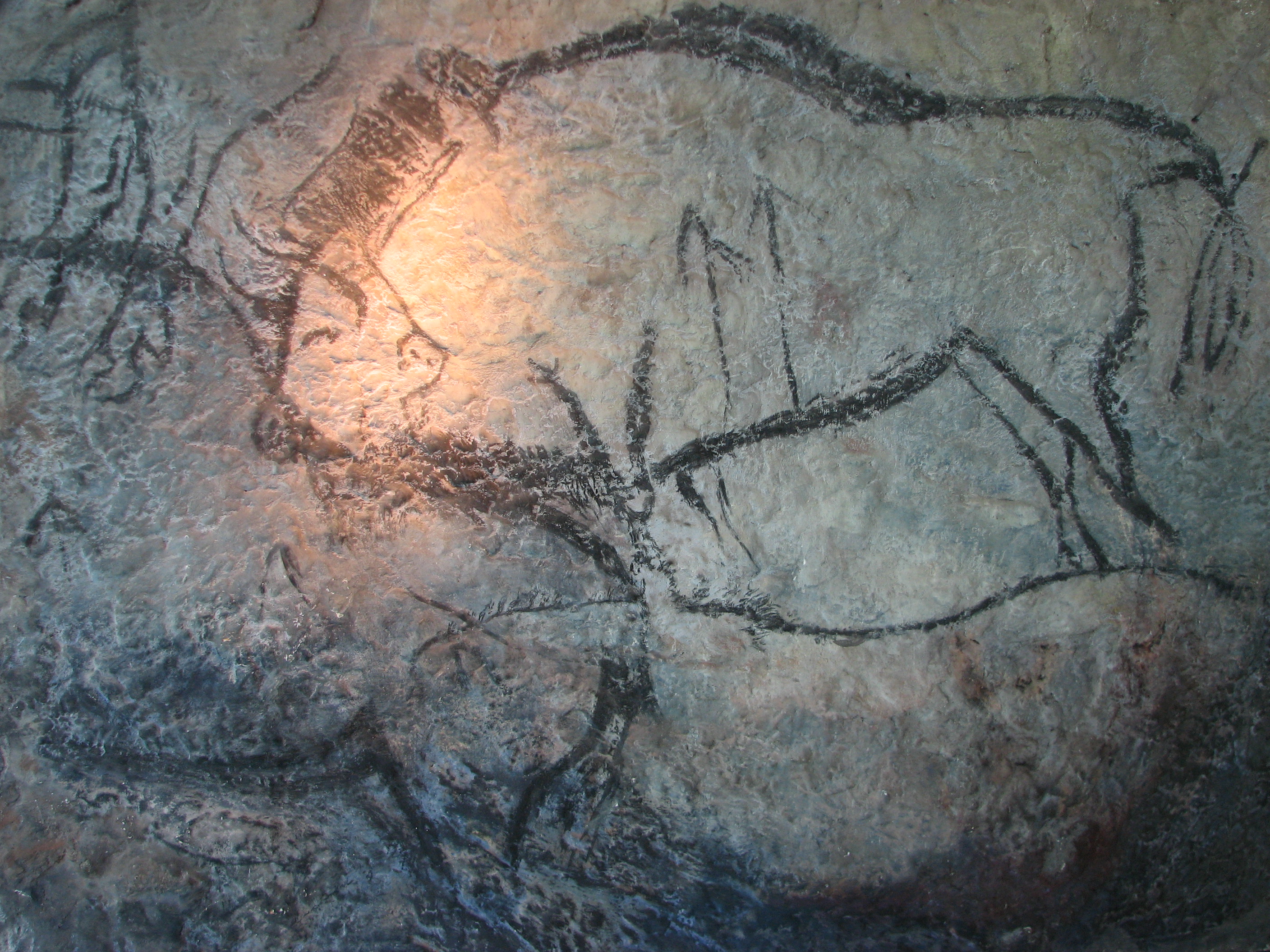
Cave of Niaux
Thirteen thousand years ago, someone walked deep into a Pyrenean hillside carrying a lamp and a stick of manganese dioxide, passed through narrow passages and vast chambers, and drew bison on a wall with the assurance of an artist who had done this many times before. The Cave of Niaux, in the Ariege department of southwestern France, is one of the last places on Earth where visitors can stand in front of original Magdalenian wall paintings without a pane of glass or a digital reproduction between them and the work. The cave floor is still wet, uneven, and slippery -- exactly as it was when the painters walked it.
The Black Hall
The heart of Niaux is the Salon Noir, the Black Hall, discovered in 1906 by a Commander Molard and his sons. The paintings here are executed almost entirely in black -- manganese oxide lines on bare rock, with occasional touches of red for certain signs and symbols. The upper portion of the main panel is dominated by bison, drawn with a naturalism that makes their postures immediately readable. On the left, a female bison with a modest hump stands in profile. Opposite her, a male displays the heavier musculature of his sex. Below them, horses crowd the lower wall -- stocky, heavy-maned animals that closely resemble the Przewalski horse, the last truly wild horse species. Two goats complete the composition, one rendered with careful anatomical detail, the other reduced to a few schematic lines. The panel is 13,000 years old. Standing before it requires walking through both cathedral-scale chambers and passages so tight they compress the experience down to single file.
A System of Passages
Niaux is not a single cave but part of a vast geological system that includes the Sabart Cave and the Lombrives Cave, all connected within the hill of Cap de la Lesse de Bialac. The combined network contains more than fourteen kilometers of underground passages and chambers. The Niaux section alone holds numerous distinct galleries of wall art, all executed in the black-outlined style characteristic of the Magdalenian period, roughly 17,000 to 11,000 years ago. In 1970, the previously unknown Reseau Clastres network was discovered, containing a series of prehistoric footprints preserved in the cave floor and a rare charcoal sketch of a weasel -- an unusual subject among the bison, horses, and deer that dominate Ice Age art across Europe.
Scholars in the Dark
The cave's documented history begins in 1864, when Felix Garrigou, a prehistorian and hydrologist known for investigating the caves of southern France, visited the site and noted some of its features. But Niaux did not attract serious scholarly attention until Commander Molard and his sons published a plan of the cave after their 1906 discovery of the Salon Noir. Henri Breuil and Emile Cartailhac investigated shortly after, conducting expeditions in 1907 and 1908, and the cave received full scientific recognition. In 1925, J. Mandeman found another gallery with black paintings and named it the Cartailhac Gallery. The most comprehensive study came in 1971, when Jean Clottes and Robert Simonnet began a major scientific examination. Between 1980 and 1981, a team of scientists made a complete inventory of every image in the cave, creating the definitive catalog of one of the Magdalenian period's greatest artistic achievements.
What Survives, What We See
Niaux remains open to the public, one of only a handful of decorated caves in Europe that have not been sealed to protect their paintings. The decision carries risk: breath, body heat, and the microorganisms visitors bring with them can damage surfaces that survived intact for millennia in stable underground conditions. But the alternative -- closing the cave and offering only reproductions -- would sever the physical connection between modern visitors and Magdalenian artists that makes Niaux extraordinary. A facsimile of the Salon Noir, along with reproductions of other figures from the cave and the Reseau Clastres network, is displayed at the nearby Park of Prehistoric Art near Tarascon-sur-Ariege, offering an alternative for those who cannot make the walk or who want to see the paintings in their reconstructed original condition. The originals, though, are the point. In the Salon Noir, in the dark, with the cave floor slick underfoot and the paintings emerging from the rock by lamplight, the distance between 13,000 years ago and now shrinks to the thickness of a line of black pigment.
From the Air
Located at 42.82N, 1.59E in the Ariege department of southwestern France, in a steep-sided valley in the Tarascon basin of the Pyrenees. The cave entrance is set into the hillside near the commune of Vicdessos. Tarascon-sur-Ariege is nearby to the east. Nearest airport is Toulouse-Blagnac (LFBO), approximately 110 km north. The Park of Prehistoric Art, which houses facsimiles of the cave paintings, is visible near Tarascon-sur-Ariege. Approach from the north along the valley for the best views of the steep terrain surrounding the cave system.