Cave of the Crystals
Without proper protection, a human being can survive about ten minutes inside. The air temperature reaches 58 degrees Celsius. Humidity hovers between 90 and 99 percent, creating conditions as hot as Death Valley but so saturated with moisture that sweat cannot evaporate from your skin. Your body's cooling system fails. Your lungs burn. And all around you, in every direction, translucent gypsum crystals as long as 11 meters jut from the floor, the walls, and each other -- the largest natural crystals ever found on Earth, grown in absolute darkness over at least half a million years.
An Accidental Cathedral
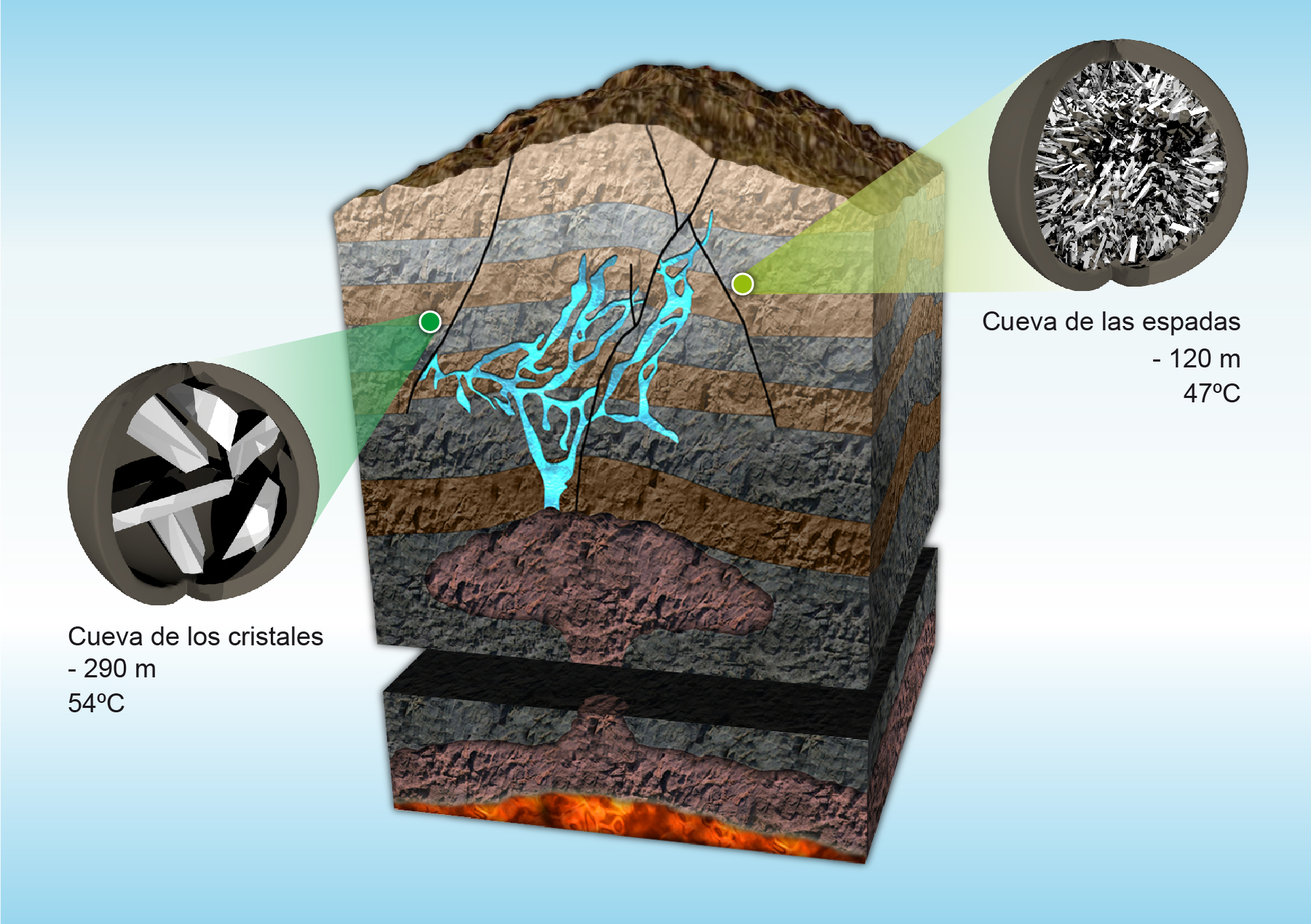
In April 2000, brothers Juan and Pedro Sanchez were drilling through the Naica fault line in a silver, zinc, and lead mine operated by Industrias Penoles in Naica, Chihuahua, Mexico. They were worried about flooding -- the Naica Mine sits above an underground magma chamber roughly three kilometers below the surface, and the geology is riddled with water-bearing faults. What they found instead was a horseshoe-shaped cavity in the limestone, 109 meters long, with a volume of about 5,000 cubic meters. Its floor was covered with perfectly faceted crystalline blocks. Enormous crystal beams jutted from blocks and floor alike, crossing the space in every direction. The miners had drilled into something that looked less like a geological formation and more like the interior of a geode scaled up to the size of a cathedral.
Half a Million Years of Patience
The crystals owe their existence to an improbable set of conditions maintained over geological time. Magma beneath the cave heated groundwater saturated with sulfide ions. When cooler, oxygen-rich surface water seeped down and contacted this heated mineral soup, the two layers did not mix -- their different densities kept them stratified. Oxygen slowly diffused into the hot water, converting sulfides into sulfates that first precipitated as anhydrite. As the cave's temperature gradually dropped, the anhydrite dissolved and gypsum began to crystallize in its place. Uranium-thorium dating by Stein-Erik Lauritzen of the University of Bergen determined the crystals to be at least 500,000 years old. A team led by A. E. S. Van Driessche directly measured the growth rate using present-day Naica water and found it to be the slowest ever recorded for any crystal growth process. At that pace, the largest crystals would have taken approximately one million years to reach their current size.
Ice Suits and Ancient Bacteria
Exploring the cave required solving an engineering problem that had no precedent. In 2006, a team coordinated by Paolo Forti of the University of Bologna partnered with equipment makers Ferrino and La Venta to develop refrigerated caving suits -- overalls threaded with cooling tubes connected to a backpack reservoir of ice water. The system, dubbed the Tolomea suit, provided roughly thirty minutes of working time before the ice melted. A cold-breathing apparatus called the Sinusit respirator kept lungs from scorching. Even with this gear, the work was punishing. But the science justified the suffering. In 2017, at a meeting of the American Association for the Advancement of Science, researcher Penelope Boston announced that her team had extracted and reanimated bacteria from fluid inclusions trapped inside the crystals. These organisms were not closely related to anything in known genetic databases -- life forms sealed in mineral for tens of thousands of years, revived under sterile conditions in a laboratory.
The Water Returns
The Cave of the Crystals was never meant to be accessible. Its existence above the water table depended entirely on the Naica Mine's pumping operations, which kept the natural groundwater from flooding the tunnels. When mining operations ceased, the pumps stopped. In October 2015, the cave was allowed to refill with the warm, mineral-rich water in which the crystals had grown for millennia. The crystals are once again submerged, once again growing -- adding perhaps a fraction of a millimeter per century to beams that already dwarf any human construction. Exploration had hinted at the existence of further chambers beyond the known cave, but reaching them would have required removing crystals, an act the scientific community was unwilling to sanction. The cave is sealed now, patient as it has always been, its cathedral of crystal growing in silence beneath the Chihuahuan desert.
From the Air
Located at 27.85N, 105.50W near Naica, Chihuahua, Mexico. The cave is 300 meters underground and not visible from the air, but the Naica Mine complex and the small town of Naica are identifiable. The terrain is semi-arid Chihuahuan desert. Nearest major airport is General Roberto Fierro Villalobos International Airport (MMCU/CUU) at Chihuahua city, approximately 160 km northwest. The landscape is flat to gently rolling desert with scattered mining operations.