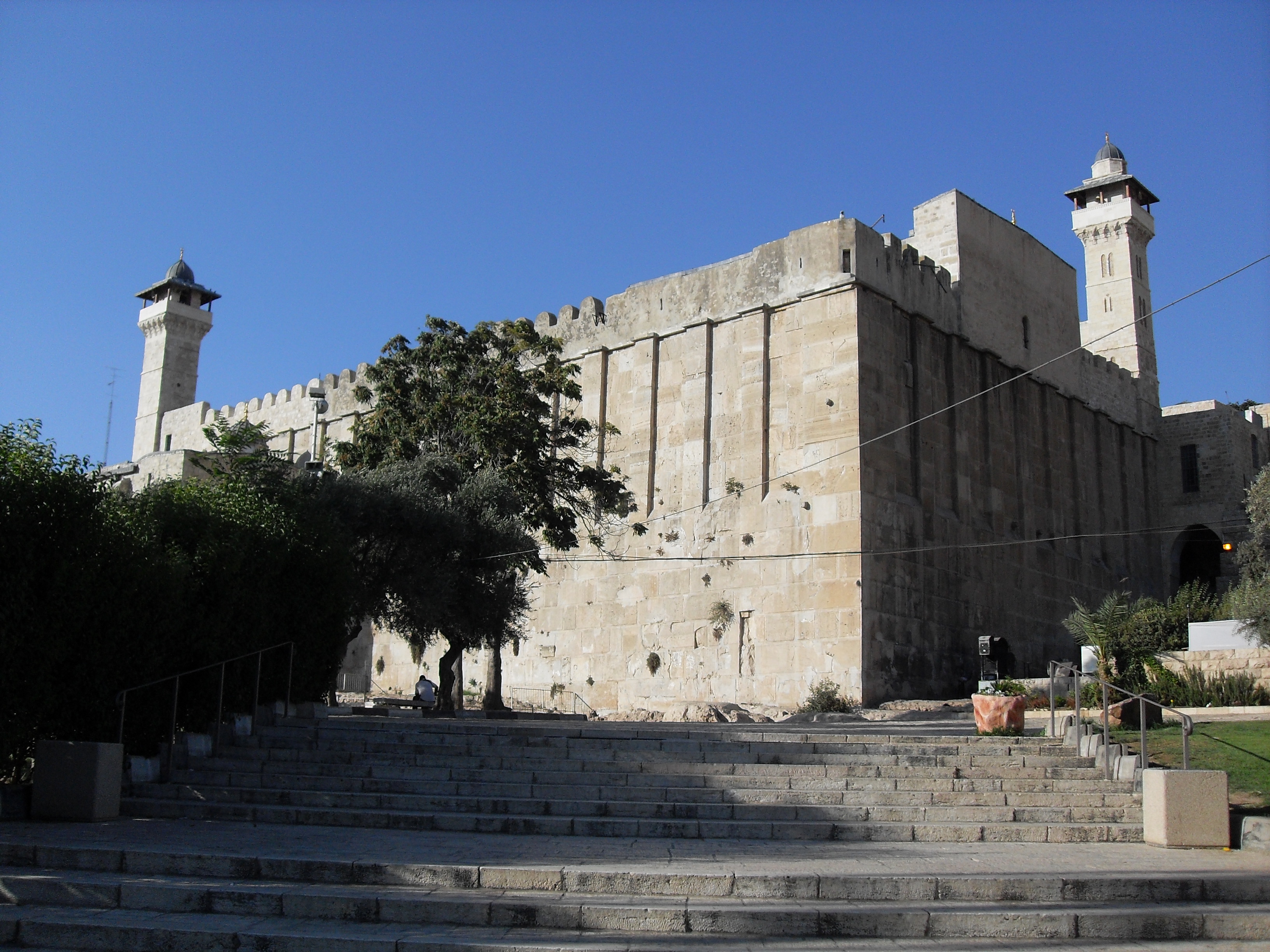
Cave of the Patriarchs Massacre
It was 5:00 a.m. on February 25, 1994 -- the overlap of two holy calendars, the Jewish festival of Purim and the Muslim month of Ramadan. Approximately 800 Palestinian Muslims had passed through the east gate of the Cave of the Patriarchs in Hebron to perform Fajr, the first prayer of the day. The cave was under Israeli military guard, but of the nine soldiers assigned to duty that morning, four were late and only one officer was present. Baruch Goldstein, an American-born physician living in the nearby settlement of Kiryat Arba, dressed in his Israeli army reserve uniform and carrying an assault rifle, walked through the Hall of Abraham and into the Hall of Isaac, where the worshippers knelt facing Mecca. He opened fire. By the time someone hurled a fire extinguisher that struck him in the head, allowing the crowd to overpower and kill him, twenty-nine people were dead and one hundred twenty-five were wounded. Among the dead were six children aged fourteen and younger.
A Man with Warnings Attached
Goldstein was not an unknown quantity. Born and raised in Brooklyn, he had been a charter member of the Jewish Defense League before emigrating to Israel in 1983. He settled in Kiryat Arba, a settlement adjacent to Hebron, where he worked as an emergency physician and became deeply involved with the Kach movement, the ultranationalist party founded by Rabbi Meir Kahane. Kahane's views had been deemed so extreme that his party was banned from the Knesset in 1988 for racism. When Kahane was assassinated in New York in 1990, Goldstein reportedly vowed revenge. In 1981, he had written a letter to the New York Times calling for the removal of Israel's Arab minority. In October 1993, four months before the massacre, he was identified as the person who poured acid on the floor of the Ibrahimi Mosque, burning holes in the carpets and assaulting six worshippers. A Shin Bet agent who had infiltrated Kach warned his superiors about Goldstein, attributing to him the statement: 'There will be a day when one Jew will take revenge on the Arabs.' The warning was not acted upon.
The Morning of Purim
On the eve of the massacre, Goldstein attended a reading of the Scroll of Esther in the Hall of Abraham and spoke to others about the need to act like the biblical Esther. In the tradition of Jewish extremism, the Purim holiday carries associations with the ancient enemy Amalek, a designation that radical settlers sometimes apply to Palestinians. Whether Goldstein consciously timed his attack to coincide with both Purim and Ramadan is debated, but the convergence amplified the horror. The testimonies of what happened inside the Hall of Isaac are fragmentary and terrible. Goldstein fired methodically into the rows of praying men and boys, reloading as he went. Several survivors were left permanently paralyzed. Contradictory accounts from Israeli military officials about whether guards fired into the crowd -- one officer said they fired 'only in the air,' while the guards themselves testified to firing 'chest high' -- were never fully resolved by the subsequent inquiry.
Condemnation and Its Exceptions
The Israeli response was swift and largely unambiguous. Prime Minister Yitzhak Rabin stood before the Knesset and called Goldstein 'a degenerate murderer,' 'a shame on Zionism and an embarrassment to Judaism.' He addressed not just Goldstein but the settler movement that had produced him: 'You are not part of the community of Israel. You are a foreign implant. You are an errant weed. Sensible Judaism spits you out.' Benjamin Netanyahu, then leading the opposition Likud party, declared the act 'a despicable crime.' A poll found that 78.8 percent of Israeli adults condemned the massacre. The Kach party was banned and designated a terrorist organization. But there were exceptions. At Goldstein's funeral, Rabbi Yaacov Perrin claimed that even one million Arabs were 'not worth a Jewish fingernail.' A shrine was erected at his grave, its epitaph reading that he 'gave his life for the people of Israel, its Torah and land.' It was not dismantled until 1999, after Israel passed legislation outlawing monuments to terrorists.
Shattering the Peace
The massacre struck the Oslo peace process like a hammer. Protests erupted throughout the West Bank, and in the ensuing clashes between Palestinian demonstrators and Israeli forces, twenty to twenty-six more Palestinians were killed and one hundred twenty wounded. In the weeks that followed, Hamas -- which had until then refrained from attacking civilian targets inside Israel -- carried out its first suicide bombings, killing eight people in Afula on April 6, 1994, at the end of the forty-day mourning period for Goldstein's victims, and six more in Hadera a week later. According to Matti Steinberg, then the Shin Bet head's advisor on Palestinian affairs, this shift in Hamas strategy was a direct consequence of the massacre. Sociologist Baruch Kimmerling wrote that the attack 'created perceptions of religious warfare' and argued that it planted the seeds of the Second Intifada. The Israeli government also restricted Palestinian movement in Hebron after the massacre, banning Palestinians from Al-Shuhada Street and other areas near the Cave of the Patriarchs. Rabin himself was assassinated by another right-wing Israeli extremist eighteen months later, after signing the Oslo Accords. The United Nations Security Council adopted Resolution 904 condemning the massacre and calling for measures to protect Palestinian civilians.
From the Air
Located at 31.52N, 35.11E in Hebron in the southern West Bank, approximately 30 km south of Jerusalem. The Cave of the Patriarchs / Ibrahimi Mosque compound is a massive Herodian-era stone structure visible from altitude in the center of the old city. Hebron sits at approximately 930 meters (3,050 ft) elevation in the Judean Hills. Nearest major airport: Ben Gurion International (ICAO: LLBG) approximately 60 km to the northwest. Fly at 4,000-6,000 ft AGL for terrain clearance.