Cave of the Winds
Two brothers noticed their candle flames bending sideways. John and George Pickett had been hiking through Williams Canyon in the summer of 1880, led by their church pastor, when they ducked into a small shelter cave and watched the light dance. Wind was blowing from a crack in the rock. They crawled through the crevice and emerged into a chamber that had been waiting half a billion years to be found. Within days, the Reverend Roselle T. Cross had written up the discovery in his church newsletter, and the Colorado Springs Gazette reprinted the story on July 2, 1880. The Colorado Encyclopedia later noted that Cross's account was "remarkably free of the florid Victorian hyperbole typical of most cave descriptions of that time" -- a refreshing restraint for a man who had just stumbled into one of Colorado's hidden wonders.
Written in Stone by Ancient Seas
The story of Cave of the Winds begins roughly 500 million years ago during the Ordovician period, when warm shallow seas covered the Pikes Peak region. Shell creatures lived and died by the millions, their remains accumulating on the sea floor and compressing over the ages into the rock known as Manitou Limestone. About 70 million years ago, those seas receded and the land buckled upward to form the Rocky Mountains. Then, between 4 and 7 million years ago, the limestone dropped below the water table. Rainwater mixed with carbon dioxide to form a weak carbonic acid that slowly ate through the rock, carving pockets that widened into passageways and eventually into the chambers visitors walk through today. Every corridor in this cave is the work of water and deep time.
The Crystals That Defy Gravity
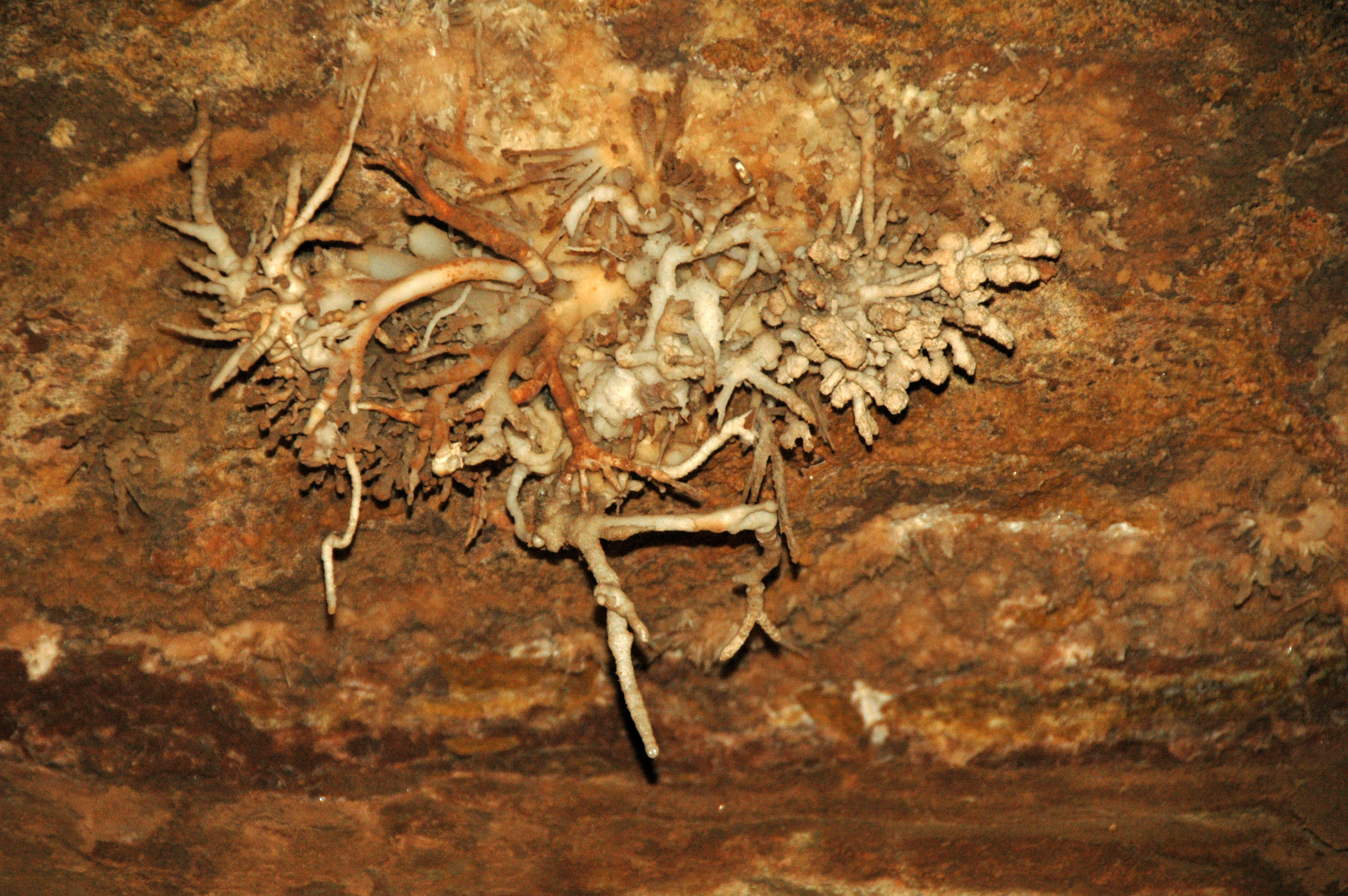
The cave's most celebrated treasure is a room called Silent Splendor, discovered in 1984. Inside, rare crystalline formations called helictites twist and curl in directions that seem to ignore every law of physics. Described in shapes ranging from butterflies to curly fries to "clumps of worms," these delicate structures change their growth axis at unpredictable stages, and no scientific theory has yet fully explained why. They are so fragile that the slightest touch can shatter them, which is why Silent Splendor remains sealed behind an environmental gate -- a barrier fitted with a tube that locks in moisture to preserve the atmosphere these formations need to keep growing. The cave also displays stalactites, stalagmites, and curtain-like flowstone draperies, but it is the helictites that set Cave of the Winds apart from every ordinary limestone cave.
Canopy Hall and the Mob That Followed
In that same discovery year of 1880, a stonecutter from Ohio named George Washington Snider arrived in Colorado seeking his fortune. Snider excavated deeper into what was then called the Williams Canyon caves and broke through into Canopy Hall -- a chamber nearly 200 feet long, dripping with thousands of stalactites and stalagmites. He wrote that it was "as though Aladdin with his wonderful lamp had effected the magic result." But Snider made a costly mistake: he talked about his discovery in town. The next day, a mob of townspeople descended on the cave and stripped the cavern of many of its stalactites. It was an early and painful lesson in the tension between wonder and preservation -- a tension that still shapes how the cave is managed today.
A Spirit of the Wind
Both the Apache and Ute peoples knew about the cave long before the Pickett brothers crawled through that crevice. According to Apache legend, the cave was the home of a Great Spirit of the Wind -- a belief that gave the place its enduring name. Later additions to the cave's tour routes have kept that sense of mystery alive. In 1988, the Adventure Room opened on Mother's Day, left in a more natural state with dirt floors and dim lighting, serving as a gateway to the Manitou Grand Caverns and their lantern tours. A year later, the Old Curiosity Shop passage debuted as the cave's narrowest corridor, offering glimpses of the Colorado Rose -- a beaded helictite -- and Spider Web Valley, a delicate cluster of helictite formations. Even the cave's lighter side has character: guides at the "bottomless pit" are known for practical jokes, and the Terror-Dactyl, a free-fall amusement ride, adds a jolt of adrenaline to the surface experience above.
Approaching from the Air
Cave of the Winds sits just west of Colorado Springs along U.S. Highway 24, near the Manitou Cliff Dwellings and within the broader Pikes Peak region. From the air, Williams Canyon cuts a visible notch into the foothills at approximately 38.87 degrees north latitude and 104.92 degrees west longitude. The canyon walls and surrounding red rock formations stand out against the green slopes, especially in clear conditions at lower altitudes. The Colorado Springs Airport (KCOS) lies about 15 nautical miles to the southeast, and the approach along the Front Range offers a dramatic panorama of the transition from high plains to the first ridges of the Rockies. What you cannot see from the air, of course, is the labyrinth below -- half a billion years of geology hidden beneath a thin skin of Colorado mountainside.
From the Air
Located at 38.8725N, 104.92W in Williams Canyon, just west of Colorado Springs along US-24. Nearest airport: Colorado Springs (KCOS), approximately 15 nm southeast. The canyon entrance is visible as a notch in the foothills at lower altitudes. Best viewed at 3,000-5,000 ft AGL in clear conditions. The Pikes Peak massif dominates the western horizon and serves as a primary visual reference.