Caves of Nerja
On January 12, 1959, five friends followed a colony of bats into a narrow sinkhole called La Mina on the hillside above Nerja. What they found below would transform this quiet stretch of the Costa del Sol: nearly five kilometers of caverns, stretching deep into the marble bedrock of the Sierra de Almijara, filled with formations that had been growing in darkness for millions of years. Within two years, the caves were open to tourists. Within a few more, they had become one of Spain's most visited natural attractions. And the discoveries -- some of them potentially rewriting the earliest chapters of human art -- have not stopped.
Five Million Years in the Making
The caves began forming approximately five million years ago, during the Upper Miocene, when water penetrated fissures in the marble rock and began dissolving it from within. Over geological time, seismic movements and landslides during the Holocene forced water to find new pathways, and as it dripped and flowed through the expanding chambers, it deposited calcium carbonate into the stalactites, stalagmites, and flowstone curtains that fill the caves today. The centerpiece is in the Hall of the Cataclysm -- a chamber over 100 meters long dominated by the world's largest known column (formed where a stalactite and stalagmite merged), measuring 13 by 7 meters at its base and standing 32 meters high. Further into the cave, the Organ Corner features fluted columns that produce different musical notes when struck. Some of these columns appear to have been intentionally altered by the cave's prehistoric inhabitants to create specific tones, making this possibly the oldest musical instrument site in Europe.
Twenty-Seven Thousand Years of Residents
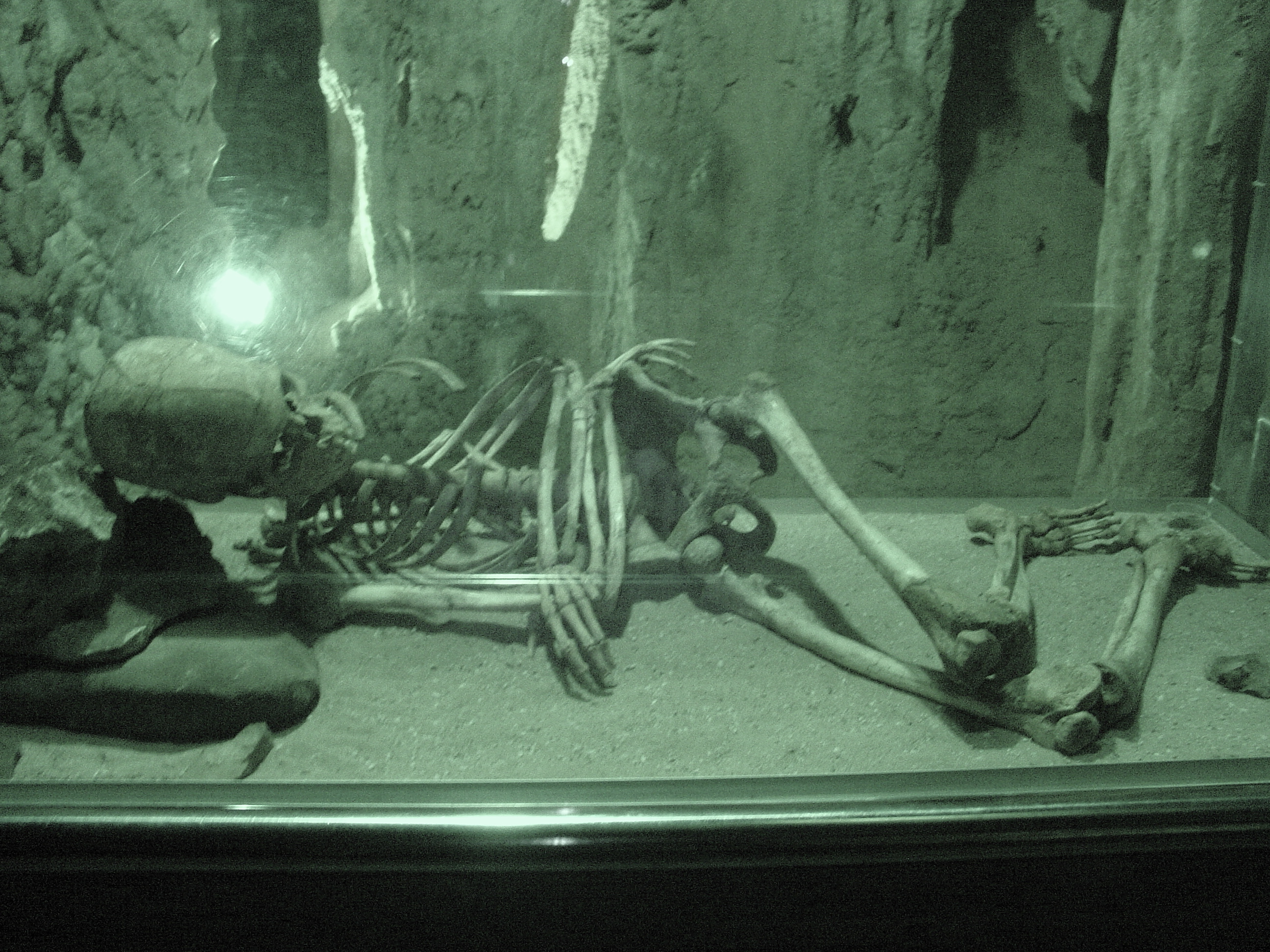
Skeletal remains indicate that humans occupied these caves from around 25,000 BC until the Bronze Age. For the first four thousand years, occupation was seasonal -- small groups of hunter-gatherers used the caves as shelter, sharing space with cave hyenas that moved in during the humans' absence. By 21,000 BC, the human population had settled year-round, developing a culture based on hunting the local fauna. Pine nuts and snails formed important parts of the diet. Cave paintings from this period depict scenes from daily life and the natural world. As millennia passed, the residents' toolkit expanded: by 10,800 BC they were hunting goats, rabbits, fish, and marine mammals, leaving behind stone and bone tools alongside animal bones and shells from offshore species. By 4,500 BC, domesticated animals had appeared, pottery was being produced, and the land around the caves was being farmed. By 3,800 BC, parts of the cave served as burial chambers, and the residents were weaving textiles.
Art That May Rewrite History
In February 2012, researchers announced a discovery that sent shockwaves through the archaeological world. Organic remains associated with paintings of seals in the cave's restricted galleries were dated to approximately 42,000 years ago. If confirmed, these would be the oldest known works of art in human history -- and crucially, they would predate the arrival of modern humans in the region, suggesting they were created by Neanderthals. The claim remains debated; further analysis is needed to establish whether the organic material is truly contemporaneous with the paintings. But the possibility has made the caves a focal point of ongoing research into the cognitive abilities of Neanderthals and the origins of symbolic expression.
A Concert Hall Carved by Water
The caves are divided into two main systems. Nerja I includes the Show Galleries, open to the public via concrete pathways and stairways. Visitors descend through the Entrance Hall, where archaeological finds are displayed, into the Hall of the Nativity with its columns of calcite, past a glass case holding a skeleton recovered from the cave, and down into the Hall of the Waterfall -- a natural amphitheater where about 100 permanent seats host regular concerts and dance performances. The acoustics are extraordinary, shaped by stone walls that have been tuning themselves for five million years. Nerja II -- the Upper and New Galleries, discovered in 1960 and 1969 respectively -- remains closed to the public, its prehistoric paintings and spectacular formations accessible only to researchers. The caves were declared a Historical Artistic Monument in 1961 and a Bien de Interes Cultural in 1985.
From the Air
Located at 36.762N, 3.845W on the coast of Malaga province, just east of the town of Nerja and south of the Sierras of Tejeda, Almijara and Alhama Natural Park. The cave entrance is on a hillside above the coast; the cave system extends underground beneath the mountains. Nearest airport is Malaga-Costa del Sol (LEMG), approximately 60 km to the west. From the air, the coastal cliffs and the mountains rising sharply behind Nerja are the most distinctive visual landmarks.