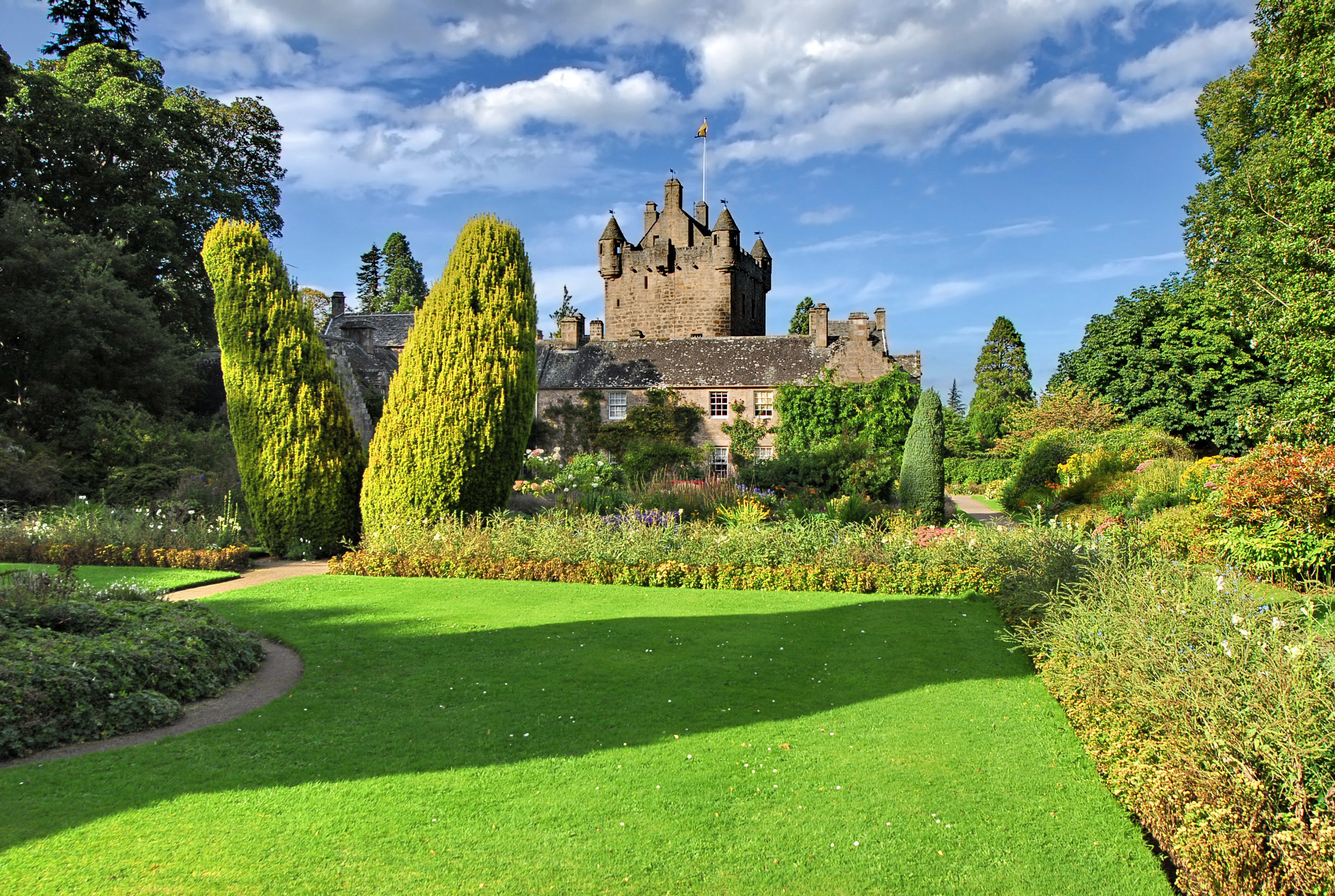
Cawdor Castle
"I wish the Bard had never written his damned play!" So lamented the 5th Earl Cawdor, and you can understand his frustration. Cawdor Castle, tucked into the rolling countryside of Nairnshire in the Scottish Highlands, has spent centuries shackled to a literary association that is, by any historical measure, entirely fictional. Shakespeare's Macbeth is named Thane of Cawdor as a stepping stone to the crown, but the real King Macbeth died around 1057 -- some four hundred years before anyone thought to build the castle that now bears the name. The play never even mentions the building. Yet visitors arrive expecting bloodstains on the staircase, and the castle has learned to live with its unwanted fame.
A Holly Tree at the Heart
The earliest documented date for Cawdor Castle is 1454, when William Calder, 6th Thane of Cawdor, received a licence to fortify his tower house. Legend holds that the thane chose the site by loading a donkey with gold and following it until the animal lay down to rest beneath a holly tree. He built his tower around the tree, and remarkably, the remains of a long-dead tree trunk still stand in the castle's vaulted basement. Radiocarbon dating has placed it to around 1372, lending some credibility to the old story, though whether a donkey was involved remains unverified. The original tower house forms the core of the castle today, its thick walls and narrow windows a reminder that this was first and foremost a defensive structure in a landscape where clan rivalries could turn lethal overnight.
The Campbells Take Hold
The castle's passage from the Calder family to the Campbells is a tale of raw Highland politics. In 1510, Muriel, the young heiress of the Calders, was married to Sir John Campbell of Muckairn. The Campbells, one of Scotland's most powerful clans, were not a family easily refused. Through this union, Cawdor passed into Campbell hands, where it has remained for over five centuries. John Campbell, 3rd of Cawdor, expanded the estate significantly in the late 16th and early 17th centuries, purchasing rich lands on the island of Islay and transforming the tower house into something more befitting a prosperous landowner. Successive generations added wings, improved the gardens, and softened the fortress into a family home -- though one that never entirely lost its martial character.
Gardens and Growing Things
The castle grounds are nationally recognized, included in the Inventory of Gardens and Designed Landscapes in Scotland. The Walled Garden dates to the 17th century, its sheltered enclosure still producing flowers and herbs in a climate that can be unkind to anything that grows. The Flower Garden was added in the 18th century, and together the two create a sequence of outdoor rooms that contrast sharply with the raw Highlands beyond the estate walls. The surrounding woodlands, threaded with walking paths, extend the visitor's experience well beyond the castle itself. In spring, the grounds fill with bluebells and wild garlic. The gardens represent centuries of cultivation in a landscape where nature tends to reassert itself with particular vigor.
Shakespeare's Uninvited Ghost
The Macbeth connection, however tenuous, has proven impossible to shake. Shakespeare wrote the play around 1606, drawing on Holinshed's Chronicles for a story set in 11th-century Scotland. The historical Macbeth was a real king who ruled from 1040 to 1057, a full four centuries before Cawdor Castle existed. The play's Macbeth is named Thane of Cawdor by King Duncan as a reward, but Shakespeare never describes or sets a scene at the castle. None of this has stopped generations of visitors from making the pilgrimage. The castle itself takes a wryly resigned approach to the association. It is a category A listed building, recognized for its genuine architectural and historical significance, but the tourist brochures know what draws the crowds. The castle remains a private residence, currently home to Angelika Campbell, Dowager Countess Cawdor, and the family's centuries-old stewardship continues alongside the daily business of welcoming visitors who come for a play but stay for the real history.
From the Air
Located at 57.52N, 3.93W in the parish of Cawdor, Nairnshire, Scottish Highlands. The castle sits amid gardens and woodland, visible as a cluster of stone buildings with a distinctive tower. Nearest airport: Inverness (EGPE), approximately 10 nm to the southwest. Best viewed at 2,000-3,000 ft AGL. The surrounding landscape is rolling farmland and forestry.