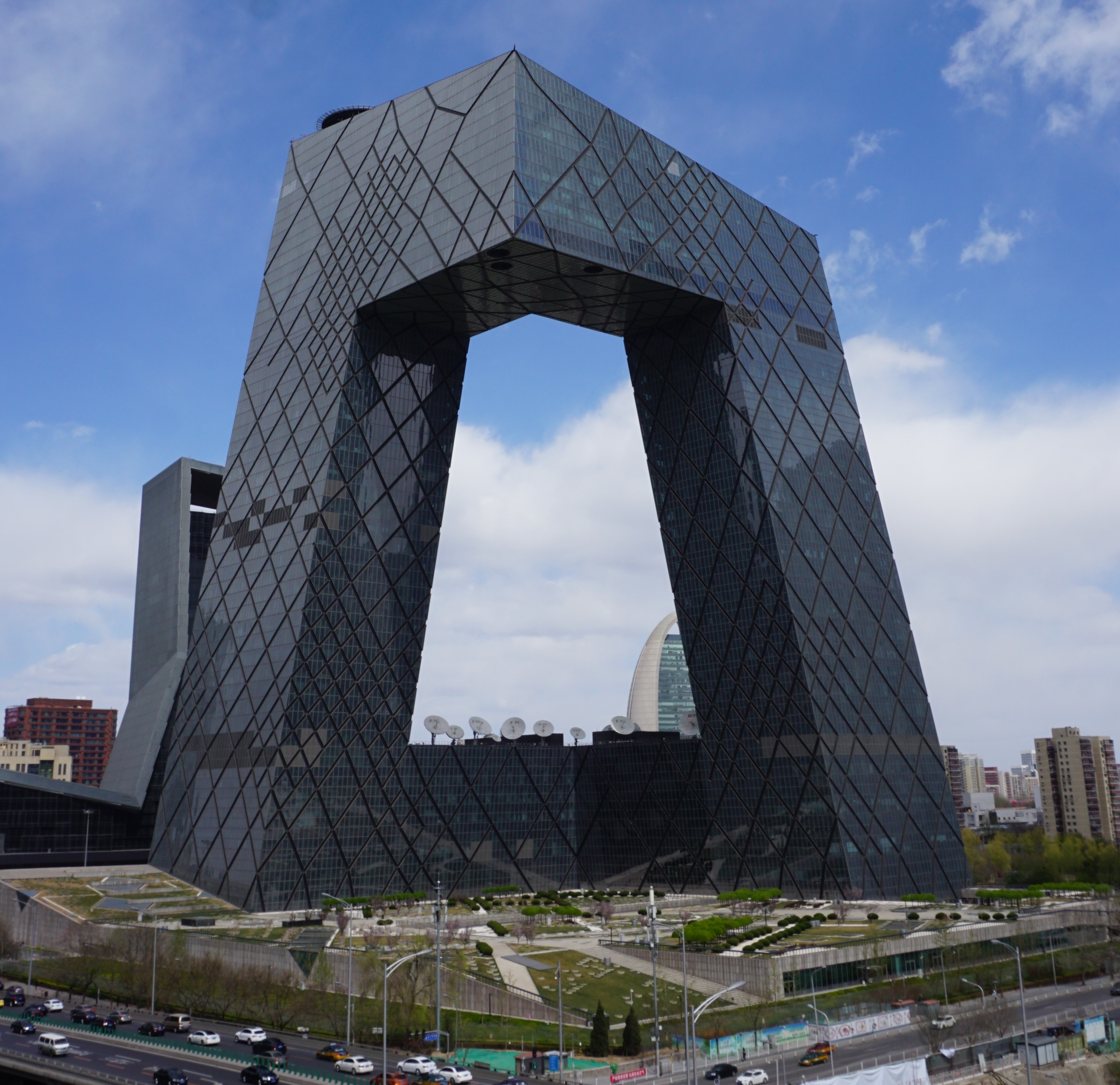
CCTV Headquarters
Beijingers call it "big pants." The nickname is affectionate and irreverent in equal measure, and it captures something essential about the CCTV Headquarters that architectural criticism often misses: the building is genuinely strange. Two leaning towers connected by a cantilevered bridge at the top and a shared base at the bottom, forming a continuous loop with a gaping void at its center. It looks like it should not stand. That it does, in a seismic zone, is the point.
The Loop That Defied Convention
Dutch architect Rem Koolhaas and his partner Ole Scheeren at OMA designed the CCTV Headquarters not as a tower reaching for height, but as a loop exploring structure. The building's 51 floors cover 473,000 square meters of floor space, making it the world's 10th largest office building. Its form -- six horizontal and vertical sections joined into a continuous circuit -- creates an irregular diagrid pattern on the facade. Each visible line represents a structural element, the density of the grid varying to show where forces concentrate. Cecil Balmond at Arup engineered the complex geometry, solving problems that had no precedent. Construction began on June 1, 2004, and the facade was completed in January 2008. The building won the 2013 Best Tall Building Worldwide award from the Council on Tall Buildings and Urban Habitat.
Joining the Loop
The most technically demanding moment came on May 30, 2007, when the two towers were joined at the top to close the loop. Engineers scheduled the connection for early morning, when the steel in both towers had cooled to the same temperature, preventing thermal differentials from locking stress into the structure. The building sits in a seismic zone, and the entire design had to account for earthquake forces that would push and pull on the cantilevered overhang in ways no conventional skyscraper experiences. Koolhaas himself described the result as a hybrid: "It could never have been conceived by the Chinese and could never have been built by Europeans." The Office for Metropolitan Architecture won the design competition on January 1, 2002, beating entries judged by a panel that included architect Arata Isozaki and critic Charles Jencks.
Media Fortress on the Third Ring
The building sits on the East Third Ring Road in Beijing's Central Business District, the first of 300 new towers planned for the expanding CBD. Inside, it consolidates everything China Central Television needs: administration, news operations, broadcasting studios, and program production. The design's ambition was to make the process of television visible -- to create a building where the loop of production, from conception to broadcast, was mirrored in the architecture itself. The symbolism of collectivity, communication, and integration that Koolhaas intended reads differently depending on who is looking. For architecture critics, it represents perhaps "the greatest work of architecture built in this century." For the Chinese public, the pants metaphor endures.
Controversy and Consequence
The building's history is not purely triumphant. On Chinese New Year 2009, an unsanctioned fireworks display organized by CCTV itself set fire to the adjacent Television Cultural Center, a companion building designed by the same team. The fire killed one firefighter, injured seven others, and resulted in 71 people being held responsible, including the project director and CCTV's chairman. The director of the headquarters project and 19 others were imprisoned. Yet the main building survived all of it -- the political fallout, the neighborhood's transformation, the skeptics who said the structure was too radical for Beijing. The CCTV Headquarters stands on the Third Ring Road, its loop intact, its steel grid catching the light, looking exactly like nothing else in the world.
From the Air
Located at 39.92°N, 116.46°E on the East Third Ring Road in Beijing's CBD. The building's distinctive looped silhouette is recognizable from the air at lower altitudes. Nearest major airport is Beijing Capital International (ZBAA/PEK), approximately 22 km northeast.