Cemetery of Confucius
Seventy-six generations. The Cemetery of Confucius in Qufu, Shandong Province, contains the unbroken burial record of a single family spanning more than two millennia -- from the philosopher himself, interred here around 479 BC, to descendants who lived into the twentieth century. No other family cemetery in the world has been in continuous use for so long. With more than 10,000 mature trees shading the graves, the 183-hectare grounds feel less like a cemetery and more like a forest that happens to contain the dead.
The Expanding Wall
By the second century AD, at least 50 of Confucius's descendants had already been buried alongside him. As the Kong clan grew across centuries, so did the cemetery. In 1331, construction began on an enclosing wall and gate. Over the following centuries, the site underwent 13 renovations and extensions. By the late 18th century, the perimeter wall stretched 7.5 kilometers, enclosing an area of 3.6 square kilometers -- a city of the dead larger than many cities of the living. Since 1994, the cemetery has been part of the UNESCO World Heritage Site that also includes the Temple of Confucius and the Kong Family Mansion, collectively known in Qufu as San Kong -- the Three Confucian Sites.
Spirit Ways and Stone Guardians
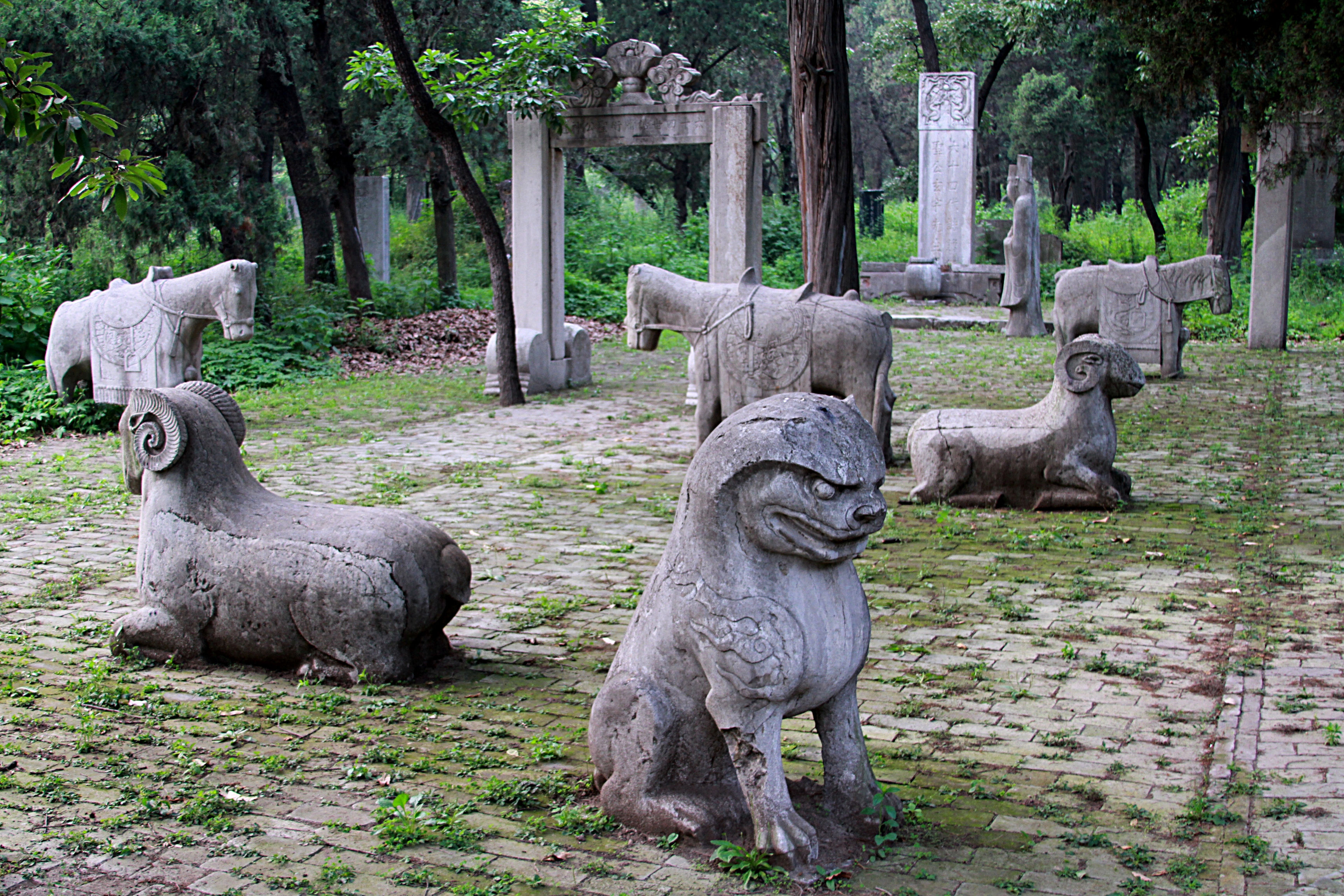
A grand avenue runs north from the walled city of Qufu for 1,266 meters, decorated with the Wan Gu Chang Chun memorial arch and lined with cypresses and pines, before arriving at the cemetery's southern gates. Inside, the burials are organized by era. Ming dynasty tombs cluster in the western section; Qing dynasty burials occupy the east. The most elaborate graves belong to the Dukes of Yansheng -- the hereditary title granted to the senior male descendant of Confucius -- from the 55th through the 64th generation. Each duke has his own spirit way, a ceremonial path oriented south to north, flanked by carved stone animals (felines, rams, horses), a memorial arch, a tortoise-borne stele, and guardian figures: a warrior on the west, a civil official on the east.
Reverence and Desecration
The cemetery's history is not one of unbroken reverence. During the Cultural Revolution, Red Guards targeted the site as a symbol of the feudal values Mao Zedong sought to destroy. The corpse of the 76th-generation Duke Yansheng (1872-1919), a late Qing official known for his collaboration with Japan, was dug up and hung naked from a tree in front of the palace. The desecration of the cemetery reflected the extremes of a political movement that sought to sever China from its Confucian past. Yet the cemetery survived, as it had survived wars, floods, and dynastic collapses before. The trees still stand, the stone guardians still flank the spirit ways, and the family line -- now stretching into the 83rd generation -- continues.
A Forest of Memory
Walking through the cemetery today, the overwhelming impression is of age and green silence. More than 10,000 mature trees -- cypresses, pines, and other species -- give the grounds a forest-like canopy. Stelae and tumuli emerge from the undergrowth, some well-maintained, others half-swallowed by time. The tomb of Confucius himself sits near the center, marked by a simple mound. Nearby lie the graves of his son Kong Li and his grandson Kong Ji, continuing a pattern of family proximity that the cemetery has maintained for 24 centuries. It is a place where the abstract idea of tradition becomes something tangible: stones inscribed with names, paths worn by feet, trees planted by people who expected their descendants to tend them.
From the Air
Located at 35.62N, 116.99E, north of the walled city of Qufu in Shandong Province. The cemetery's 183 hectares of dense tree canopy are visible from altitude as a distinctly forested area contrasting with surrounding urban and agricultural land. Nearest airport is Jining Qufu Airport (ZLJN). The tree-lined approach avenue from the city is a useful visual reference.