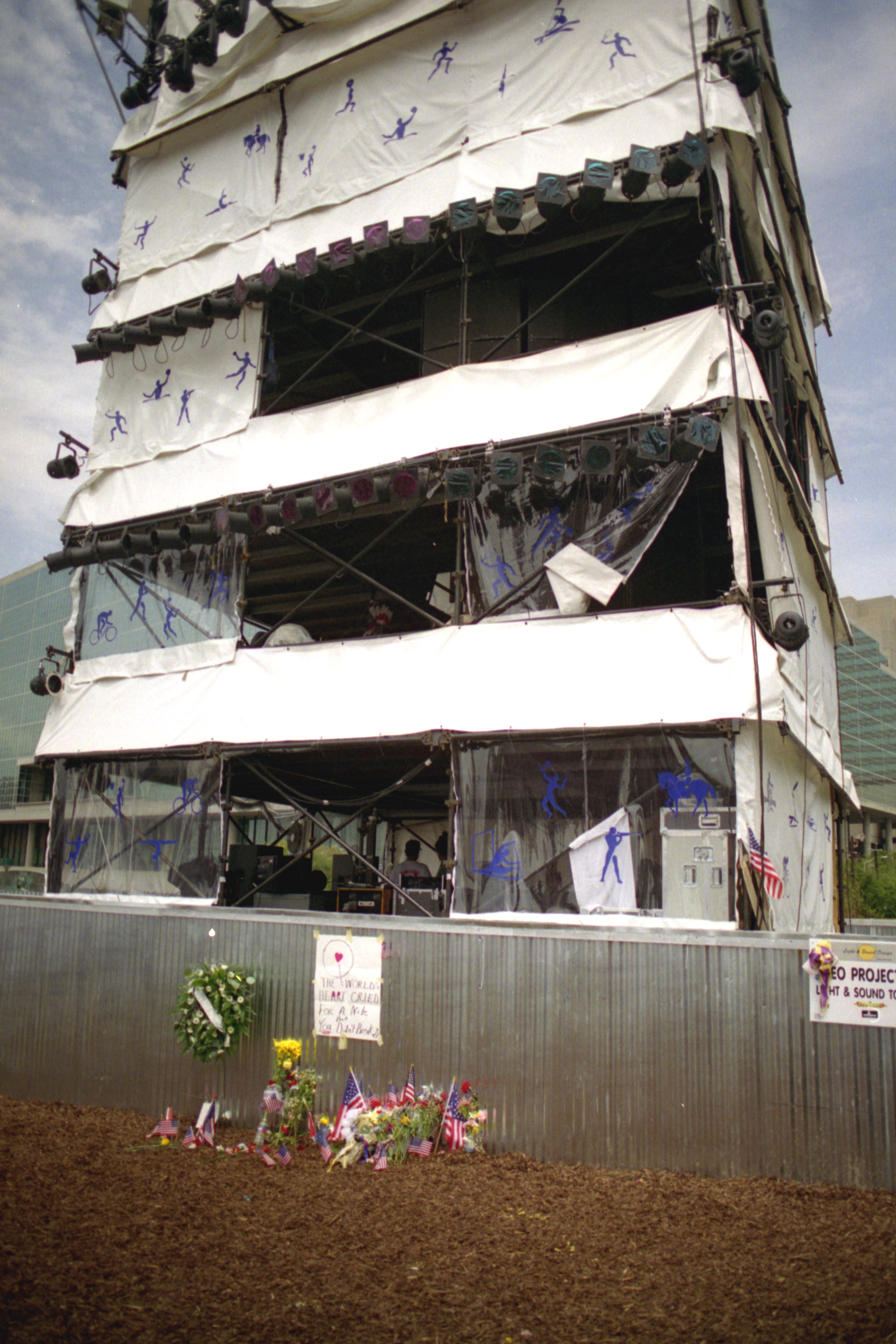
Centennial Olympic Park Bombing
Sometime after midnight on July 27, 1996, a security guard named Richard Jewell noticed a green military backpack tucked beneath a bench in Centennial Olympic Park. Thousands of spectators were packed into the park - designed as the town square of the Atlanta Olympics - enjoying a late-night concert. Jewell alerted the Georgia Bureau of Investigation. A bomb squad was called. Eighteen minutes earlier, a 911 caller had warned that a bomb would explode in the park within thirty minutes. The evacuation had barely begun when the pack detonated: three pipe bombs filled with smokeless powder, surrounded by masonry nails, directed outward by a steel plate. One woman was killed instantly. A Turkish cameraman died of a heart attack running toward the blast. One hundred and eleven others were wounded. The Olympic Games continued. The investigation that followed became nearly as devastating as the bomb itself.
The Town Square of the World
Centennial Olympic Park was Atlanta's showpiece for the 1996 Summer Olympics, a 21-acre gathering place in the heart of downtown where athletes and spectators could mingle freely. On the night of July 26, the band Jack Mack and the Heart Attack was performing a concert near the NBC sound tower while thousands danced and celebrated. The bomber, Eric Robert Rudolph, planted a green ALICE pack containing the device beneath a bench near the tower's base, then left the area. The pack was designed as a directed charge - a steel plate meant to focus the blast outward into the crowd. It would have caused even greater carnage, but the pack was slightly shifted at some point before detonation. Alice Hawthorne, 44, of Albany, Georgia, was standing with her 14-year-old daughter when a nail from the bomb penetrated her skull. Her daughter survived but was badly injured.
The Hero Who Became the Suspect
Richard Jewell was hailed as a hero in the hours after the bombing. The security guard had spotted the suspicious pack, alerted law enforcement, and helped move spectators away before the blast. Within four days, the narrative inverted completely. Media organizations reported that Jewell was a person of interest. His home was searched, his background picked apart, and a media siege descended on his apartment. The FBI had been contacted by a former employer at Piedmont College, and Jewell fit a lone-wolf profile. He was never arrested or charged, but his life was effectively destroyed by the investigation and the relentless coverage. Jewell fought back through 15 years of defamation litigation. The Georgia Court of Appeals ruled in 2011 that newspapers had accurately reported his suspect status while noting the weakness of the case against him. Jewell died on August 29, 2007, at age 44, from medical complications related to diabetes - never having fully escaped the shadow of suspicion.
Five Years to Find the Bomber
After clearing Jewell, the FBI publicly admitted it had no other suspects. The investigation stalled until early 1997, when two more bombings struck the Atlanta area - an abortion clinic and the Otherside Lounge, a lesbian nightclub. Similarities in bomb construction linked all three attacks. A fourth bombing, at an abortion clinic in Birmingham, Alabama, killed a police officer working security and seriously injured nurse Emily Lyons. The bomber was identified as Eric Robert Rudolph, a survivalist who fled into the Appalachian wilderness of western North Carolina. He evaded capture for over five years, living off the land in the Nantahala National Forest until a rookie police officer found him scavenging behind a grocery store in Murphy, North Carolina, in 2003. On April 8, 2005, Rudolph pleaded guilty to all four bombings. He is serving four consecutive life sentences without the possibility of parole.
What Remains in the Park
Centennial Olympic Park still stands in downtown Atlanta, now a 22-acre green space anchoring the city's convention district. A memorial at the base of the former sound tower marks the spot where the bomb detonated. The park hosts concerts, festivals, and everyday lunches in the shadow of the Georgia Aquarium and the World of Coca-Cola. The 1996 bombing was the first major act of domestic terrorism at an American sporting event - a category that would grow grimly familiar in the decades to come. Clint Eastwood's 2019 film Richard Jewell brought renewed attention to the human cost of the investigation's failures, with Paul Walter Hauser portraying the security guard whose instinct to protect others was rewarded with suspicion. The park itself carries no visible scars. The crowd gathers where the crowd once fled.
From the Air
Located at 33.76°N, 84.39°W in downtown Atlanta, Georgia. Centennial Olympic Park is a 22-acre green space visible as an open rectangle amid the dense urban core, adjacent to the Georgia World Congress Center and CNN Center. From altitude, Atlanta's skyline and the park are unmistakable. Hartsfield-Jackson Atlanta International Airport (KATL) is approximately 8 nm south - the world's busiest airport by passenger traffic. Dekalb-Peachtree Airport (KPDK) lies 10 nm northeast. Atlanta's airspace is Class B, heavily controlled. The park sits in flat Piedmont terrain at roughly 1,000 ft elevation. Best viewed on approach to or departure from KATL on clear days.