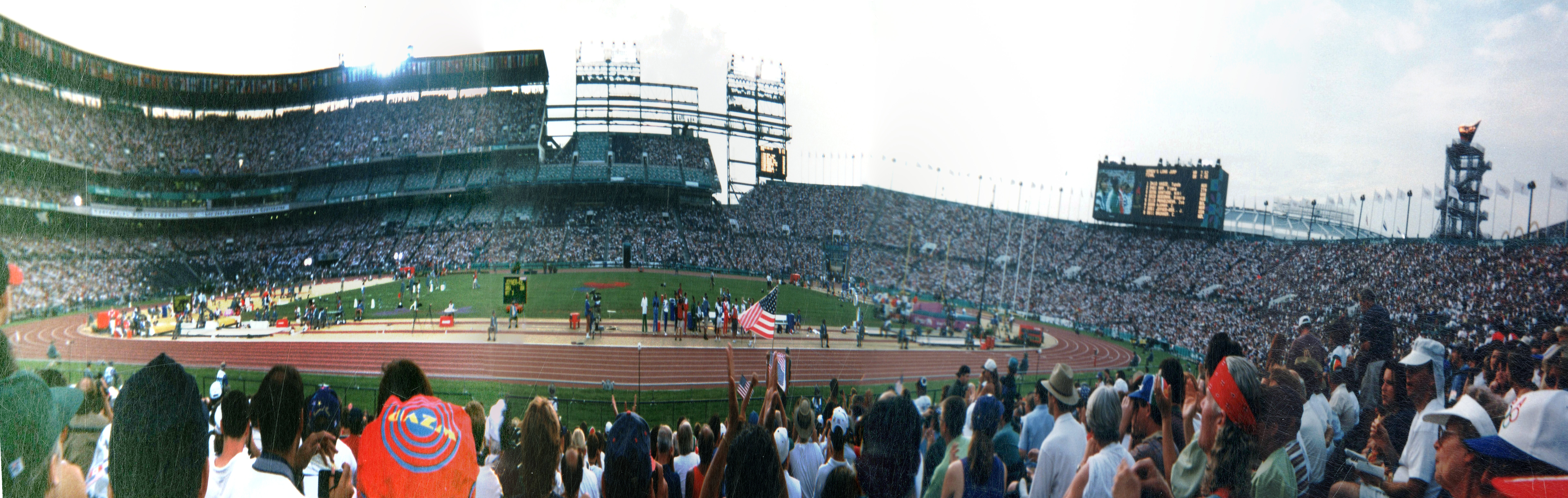
Centennial Olympic Stadium: Three Lives of One Building
No building in American sports has reinvented itself as many times as the structure at 755 Hank Aaron Drive in downtown Atlanta. Centennial Olympic Stadium opened in July 1996 to host the Summer Olympics, was half-demolished and rebuilt as Turner Field for the Atlanta Braves, then gutted again and transformed into Center Parc Stadium for Georgia State University. Three different sports. Three different configurations. Three different names. The same patch of ground. What makes it remarkable is that the first transformation was planned before the first brick was laid - the Atlanta Committee for the Olympic Games designed the stadium so that its northern half could be torn down and its southwestern corner could cradle a baseball diamond. Planned obsolescence elevated to architectural philosophy.
Nine Point Eight Four Seconds
For one week in the summer of 1996, the stadium held 85,000 spectators and some of the most extraordinary athletic performances in Olympic history. Donovan Bailey of Canada won the 100 meters in 9.84 seconds, a world record. Michael Johnson became a legend by winning both the 200 and 400 meters, shattering the 200-meter world record in gold shoes that seemed to blur across the track. France's Marie-Jose Perec matched him with her own 200/400 double. And Carl Lewis, at 35 years old, won his fourth consecutive Olympic long jump title, joining Al Oerter as only the second person to win the same athletics event at four straight Games. The running track that witnessed all of this was later ripped up and relocated to Clark Atlanta University's field hockey stadium. The records remain; the surface that held them is gone.
Built to Be Broken
The genius of Centennial Olympic Stadium was its planned asymmetry. The southwest corner was built permanently - four tiers of seats, luxury boxes, a street-facing facade, and a roof - because that section would become the seating behind home plate for the future baseball park. The northern half was built cheaply and simply, a two-tiered temporary structure that everyone knew would be torn down. Atlanta already had the 71,000-seat Georgia Dome for football, completed just four years earlier. There was no long-term use for an 85,000-seat track venue. But the Atlanta Braves needed a new home to replace aging Atlanta-Fulton County Stadium, and ACOG needed someone to take over the facility after the Games. The deal was elegant: the Olympic Committee paid to build the stadium, then paid to convert it. The Braves got a new ballpark. Atlanta avoided a white elephant.
The Turner Field Years
After the 1996 Paralympics closing ceremony, demolition crews moved in. The northern grandstands came down, the running track was pulled up, and a baseball diamond was laid into the southwestern shell. Capacity dropped from 85,000 to 49,000. The facility was renamed Turner Field in 1997, and the Braves played their first game there that spring. Across the street, their old home - Atlanta-Fulton County Stadium, which had hosted Olympic baseball events - was imploded. The rubble was cleared and the site became a parking lot for Turner Field. For twenty seasons, from 1997 through 2016, the Braves called the former Olympic stadium home. The foul territory was noticeably larger than most modern ballparks because the field of play had originally been designed to fit a running track. It was one of the last visible reminders of the stadium's Olympic origins.
A Third Act
When the Braves departed for Truist Park in Cobb County after their lease expired in 2016, the story could have ended with another implosion and another parking lot. Instead, Georgia State University acquired Turner Field and its surrounding parking lots in January 2017 for a mixed-use campus expansion. The ballpark was rebuilt a second time - this time as Center Parc Stadium, configured for college football. The university's plans extended beyond athletics: private and student housing, academic buildings, retail, and office space now surround the site. Every Father's Day, the Atlanta Track Club's four-mile road race still ends inside the stadium, runners crossing the finish line near the warning track where Olympic athletes once sprinted. The ground remembers what the buildings have forgotten.
From the Air
Located at 33.736°N, 84.389°W in downtown Atlanta, just south of the city center. From altitude, look for the stadium footprint along Hank Aaron Drive SE, adjacent to the Georgia State University campus. The facility sits about 1.5 miles south of the cluster of downtown Atlanta skyscrapers. Nearby airports include Hartsfield-Jackson Atlanta International (KATL) approximately 7 miles to the south, and DeKalb-Peachtree Airport (KPDK) about 12 miles northeast. Best viewed at 3,000-5,000 feet AGL in clear weather. The stadium's oval footprint and the surrounding university development are distinguishable from the broader urban grid.