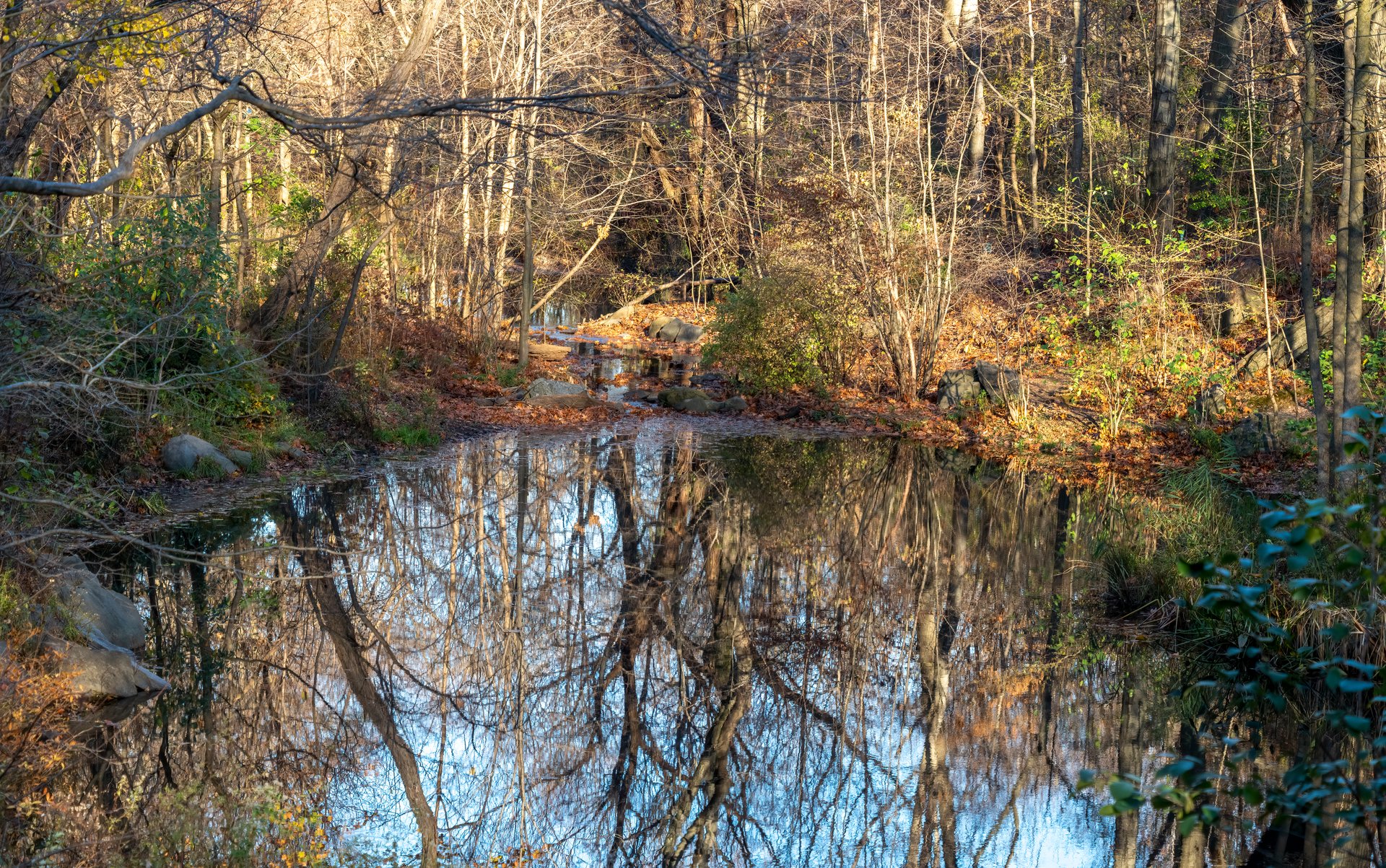
Central Park: Manhattan's Manufactured Wilderness
The land that became Central Park cost more than Alaska. In 1853, when the New York State Legislature authorized the purchase of a swath of Manhattan between 59th and 106th Streets, supporters promised the price tag would be $1.7 million. The final bill came to $7.39 million, exceeding what the United States would pay Russia for the entire territory of Alaska a few years later. What the city got for its money was not a garden but a construction site of staggering ambition: rocky schist outcroppings, fetid swamps, and the homes of approximately 1,600 residents, including the property-owning Black community of Seneca Village, who were evicted under eminent domain so that Frederick Law Olmsted and Calvert Vaux could build their radical vision of democratic green space from scratch.
Blasting a Paradise from Bedrock
Nothing about Central Park is natural. Every lake was dammed from seeps and streams. Every meadow was graded and seeded. The bedrock that surfaces throughout the park, Manhattan schist formed 450 million years ago in the Iapetus Ocean, was the only thing the designers could not move, so they incorporated it. Everything else required brute force. More gunpowder was used to clear the terrain than at the Battle of Gettysburg. Topsoil was imported from Long Island and New Jersey because the existing soil could not sustain the plants specified in Olmsted and Vaux's winning Greensward Plan. Over 20,000 laborers, many of them Irish immigrants paid by the day, hauled rock, laid drainage, and planted trees. Custom tree-moving machines were built for the project. Five workers died during construction, a remarkably low number for the era, thanks to extreme safety precautions. The park's first feature opened to the public in December 1858: the Lake, frozen solid and filled with ice skaters.
The Greensward Gamble
In April 1858, the park commissioners selected the Greensward Plan from among 33 competition entries. Olmsted and Vaux's design was radical for its time. Where other entries integrated the park with the surrounding city grid, Olmsted and Vaux created sharp separations, sinking four transverse roadways below grade so that crosstown traffic could pass through the park without being seen or heard by anyone inside it. The plan rejected symmetry in favor of a picturesque landscape that mimicked nature while being entirely artificial. Olmsted, who served as the park's superintendent during construction, saw the project in grand terms: "of great importance as the first real Park made in this country, a democratic development of the highest significance." He hired mounted police classified as "keepers" to enforce strict rules: no gambling, no speechmaking, no picking flowers. By 1866, the park had hosted nearly eight million visits with only 110 arrests. The park was completed in 1876 when the northern section, extended to 110th Street in 1859, was finished.
Decay, Moses, and the Mothers of Central Park
Central Park's history is a cycle of splendor and neglect. By the early twentieth century, Tammany-affiliated mayors had allowed the park to deteriorate. In 1934, newly appointed parks commissioner Robert Moses found lawns full of weeds, dead trees, vandalized monuments, and rusted ironwork. His biographer Robert Caro described the Mall as looking "like a scene of a wild party the morning after. Benches lay on their backs, their legs jabbing at the sky." Moses transformed the park using New Deal funds: he replanted lawns, created the Central Park Zoo from an old menagerie, built twenty-one playgrounds, converted a shantytown into the Great Lawn, and turned the Pond into Wollman Rink. But Moses also overreached. In 1956, he tried to bulldoze a wooded hollow near Tavern on the Green for a parking lot. A group of neighborhood mothers blocked the demolition, and only the threat of a lawsuit stopped the project. It was an early victory in the long struggle over who the park belonged to.
The Billion-Dollar Backyard
After Moses left in 1960, Central Park entered its darkest period. Eight commissioners cycled through in twenty years. Vandalism, drug use, and violent crime made headlines, though the park's crime rate was actually lower than the surrounding precincts. In 1980, the Central Park Conservancy was founded to halt the decline. Under administrator Elizabeth Barlow, the Conservancy launched a $100 million restoration plan that rebuilt the Dairy as a visitor center, restored Bethesda Terrace and the Bow Bridge, and reopened the Zoo after a $35 million renovation. The Jacqueline Kennedy Onassis Reservoir was decommissioned from the city water supply in 1993 and renamed the following year. By 2005, the land value of Central Park was estimated at $528.8 billion. Today, the park draws an estimated 42 million visits annually, supports over $656 million in annual city tax revenue, and has been featured in more than 231 movies, making it one of the most filmed locations on Earth.
An Ecosystem in the Grid
Central Park is far more than a lawn. A 2013 survey found 571 species living within its boundaries, including 173 species not previously documented there. Over 303 bird species have been recorded since the first official count in 1886, making the park a critical stop on the Atlantic Flyway for migratory birds. A red-tailed hawk named Pale Male made his perch on a Fifth Avenue apartment building in 1991 and became a citywide celebrity. A Eurasian eagle-owl named Flaco escaped from the Central Park Zoo in 2023 after his enclosure was vandalized and became a beloved fixture of the park's skies. The park contains over 20,000 trees representing more than 170 species, including the largest remaining stands of American elms in the Northeastern United States, protected by their isolation from Dutch elm disease. A 2019 squirrel census counted 2,373 Eastern gray squirrels. Glacial erratics dropped by the Wisconsin glacier 12,000 years ago still dot the landscape, and Cleopatra's Needle, a red granite obelisk erected at the Temple of Ra around 1450 BC, stands near the Metropolitan Museum of Art, predating the park by over three millennia.
From the Air
Central Park (40.782N, 73.965W) stretches from 59th Street to 110th Street in Manhattan, New York City. From the air, the park is unmistakable: an 843-acre rectangle of green carved into Manhattan's dense urban grid. The Jacqueline Kennedy Onassis Reservoir, a large oval body of water between 86th and 96th Streets, is the most prominent visual landmark. The Great Lawn, Sheep Meadow, and the Lake are visible at lower altitudes. The Metropolitan Museum of Art sits along the park's eastern edge at approximately 82nd Street. Nearby airports: KJFK (John F. Kennedy, 24km SE), KLGA (LaGuardia, 13km NE), KEWR (Newark Liberty, 17km W). Best viewed at 3,000-5,000 feet AGL for full park perspective, or 1,500-2,500 feet for individual features.