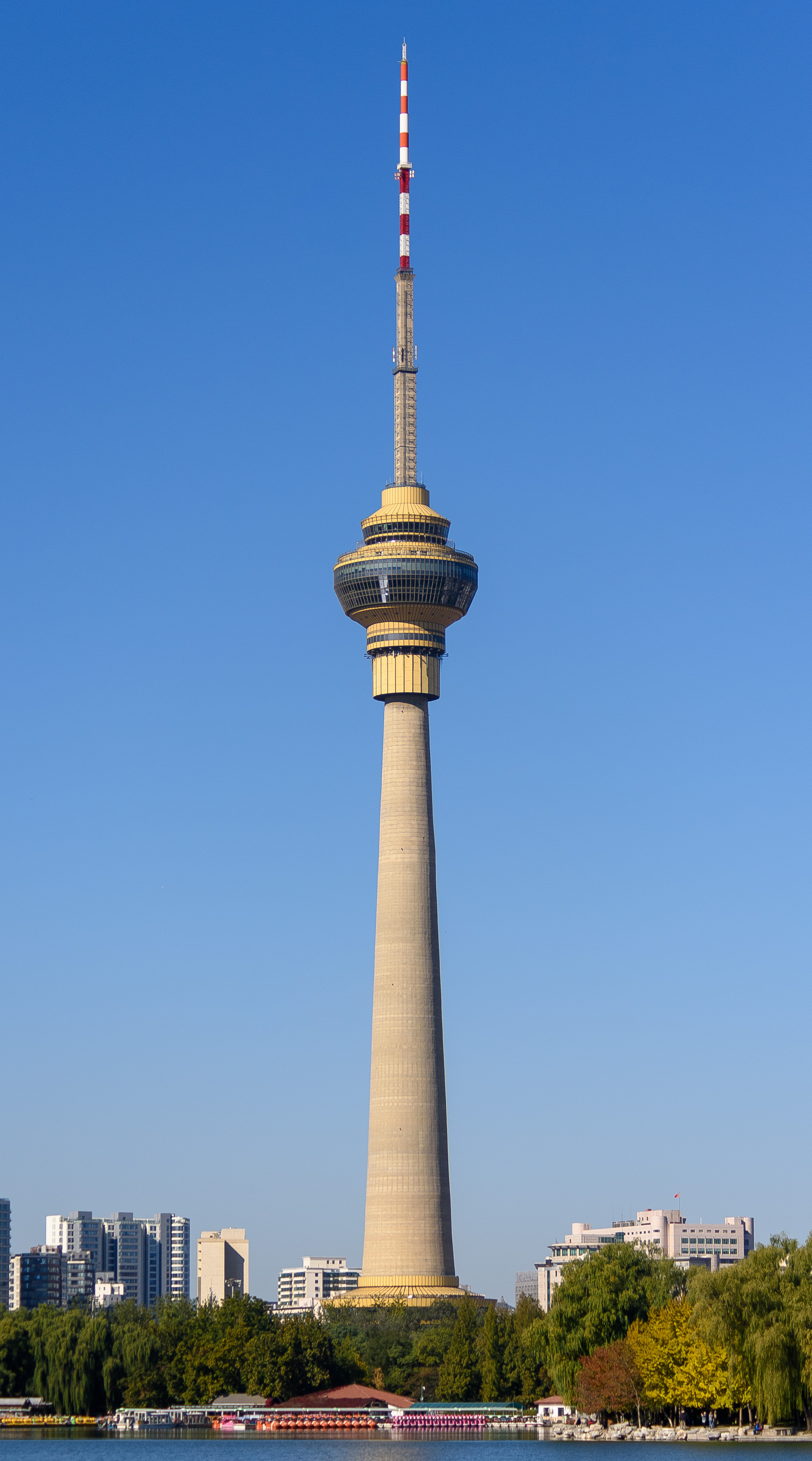
Central Radio & TV Tower
Every year, runners gather at the base of Beijing's Central Radio & TV Tower for an event that sounds like punishment: two laps around the tower's perimeter, then a climb up 1,484 steps to the observation deck 238 meters above the city. The race captures something essential about this structure -- it demands to be experienced vertically. At 405 meters, the tower was Beijing's tallest building for 26 years, from its completion in 1992 until China Zun surpassed it in 2018. It remains the ninth-tallest tower in the world and a member of the World Federation of Great Towers.
A Dutch Design for Chinese Television
The tower was designed in the late 1980s by Dutch architect Paulus Snoeren and completed in 1992, an era when Beijing's skyline was still defined by low-rise hutong neighborhoods and Soviet-influenced institutional buildings. Its primary function was utilitarian: housing broadcasting equipment for China Central Television, the state broadcaster whose signal reached nearly every household in the country. The tower rises from Haidian District, near the Gongzhufen metro station and the green expanse of Yuyuantan Park. In the years since, CCTV moved its headquarters to the Rem Koolhaas-designed building in Chaoyang District -- the famously angular structure sometimes also called the "CCTV Tower," a source of occasional confusion. But the original tower continues to broadcast and remains a fixture of western Beijing's skyline.
Views from 238 Meters
Four public floors give visitors layered experiences of the city. The ground floor serves as a starting point, with lifts rising to the upper levels. The second floor offers exhibitions on notable figures in Chinese history. The third floor explains the workings of Chinese television broadcasting. But the fourth floor is the destination: a wraparound observation deck where Beijing unfolds in every direction -- the Western Hills to the northwest, the Forbidden City's gold rooftops to the east, the modern towers of the Central Business District glinting in the distance. A revolving restaurant completes the picture, rotating slowly enough that a full meal carries diners through a complete 360-degree survey of the capital. On clear days, the view extends to the mountains that ring Beijing's northern and western edges.
The Skyline Moves On
When China Zun, a 528-meter supertall skyscraper, topped out in the Central Business District in 2018, the TV tower quietly lost its title as Beijing's tallest structure. But height rankings tell only part of the story. The tower occupies a different category -- slender, purposeful, rooted in an era when broadcasting infrastructure was a matter of national ambition. It was built not to house offices or apartments but to carry a signal, and it still does. The annual stair-climb race, the revolving restaurant, the observation deck -- these are secondary functions grafted onto what remains, at its core, a piece of communications infrastructure. Standing beside the green shores of Yuyuantan Park, the tower bridges two Beijings: the low-rise city of parks and temples and the vertical city of glass and steel now rising around it.
From the Air
Located at 39.92N, 116.30E in Beijing's Haidian District, near Yuyuantan Park and the Gongzhufen metro station. The 405-meter tower is one of the most prominent vertical structures visible from the air when approaching Beijing from the west. Nearest major airport is Beijing Capital International Airport (ZBAA/PEK), approximately 30 km northeast. Beijing Daxing International Airport (ZBAD/PKX) lies about 48 km south. The tower is an excellent visual reference point for western Beijing at any altitude.