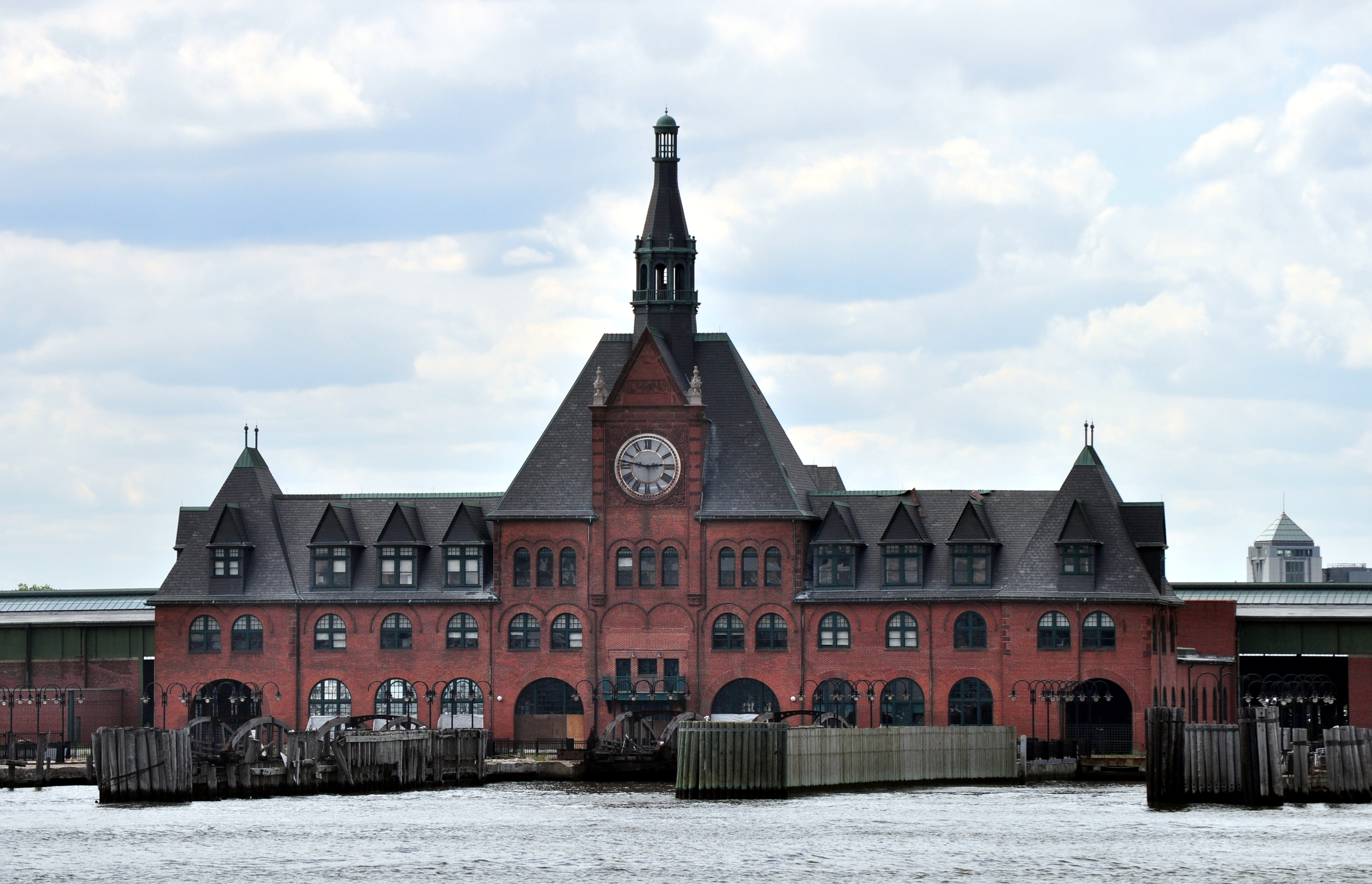
Central Railroad of New Jersey Terminal
The Lenape called this place Communipaw -- "big landing place at the side of a river" -- and the name proved prophetic in ways no one could have anticipated. Over 78 years, an estimated 10.5 million immigrants walked through the Central Railroad of New Jersey Terminal after being processed at Ellis Island, stepping off ferries and onto trains that carried them into the interior of a country they had only just entered. The terminal stands on the Jersey City waterfront, facing the Statue of Liberty across the harbor, a Richardsonian Romanesque headhouse that once anchored one of the most consequential transit corridors in American history.
Where Five Terminals Lined the Waterfront
The terminal was built in 1889, replacing an earlier structure that had served since 1864. It was one of five passenger railroad terminals that lined the Hudson Waterfront during the 19th and 20th centuries -- the others at Weehawken, Hoboken, Pavonia, and Exchange Place. Together they formed a wall of transit infrastructure along the western shore of New York Harbor, each one a gateway between the railroads reaching across New Jersey and the ferries crossing to Manhattan. Of the five, only Hoboken's still operates. The Central Railroad of New Jersey Terminal served not just its own railroad but also the Reading Railroad, the Baltimore and Ohio Railroad, and the Lehigh Valley Railroad at various periods, making it a nexus where competing lines converged on the same waterfront real estate.
Twelve Platforms and a Bus-Type Shed
The main building is designed in Richardsonian Romanesque style, its heavy stone arches giving the headhouse a solidity that seems to anchor it against the harbor winds. Inside, the intermodal facility contained more than a dozen platforms and several ferry slips. Passengers arriving by train walked to the railhead concourse, passed through or around the main waiting room, and descended to the ferry level. The Bush-type train sheds -- the largest ever constructed, designed by A. Lincoln Bush and built in 1914 -- covered 12 platforms and 20 tracks. They were never restored, but their skeletal remains recall the scale of operations that once filled this space. The land itself was reclaimed fill, built up beside the Morris Canal Big Basin, a canal that the railroads themselves had helped make obsolete.
The Blue Comet and the Royal Blue
From these platforms, named trains departed for destinations across the Eastern Seaboard. Jersey Central's Blue Comet offered elaborate service to Atlantic City. The Baltimore and Ohio's Royal Blue made the run to Washington, D.C. in under five hours. CNJ's long-distance trains reached Harrisburg, Scranton, and the coal country town then known as Mauch Chunk. A September 1936 timetable shows 132 weekday departures, an almost unimaginable volume of rail traffic flowing through a single waterfront terminal. Ferries crossed the North River to Liberty Street in lower Manhattan, with additional service to 23rd Street until the railroad went bankrupt in 1945. In the early 1900s, the B&O even ran luxury ferry service to Whitehall Terminal for its Royal Blue passengers, a convenience that ended when New York City purchased the Staten Island Ferry in 1905.
The Aldene Connection and Abandonment
In April 1967, the opening of the Aldene Connection diverted all remaining passenger trains to Penn Station in Newark, ending 78 years of service. The terminal sat unused but maintained and guarded by the Central Railroad of New Jersey. When nearby shops and engine facilities closed in the early 1970s, the building was truly abandoned. It entered a strange afterlife. A portion of the 1968 film Funny Girl was filmed inside the empty terminal. In the aftermath of September 11, 2001, its parking lot became the staging area for dozens of ambulances mobilized to transport victims from across the harbor. Hurricane Sandy badly damaged the building in 2012, flooding its lower levels, but it was restored and reopened in 2016.
Liberty's Front Door
Today the headhouse is the centerpiece of Liberty State Park. The ferry slips have been restored, though the structures that housed them and the tracks are gone. Ferries to the Statue of Liberty, Ellis Island, and Liberty Island depart from these same waters daily. The cobbled road that once brought passengers to the terminal entrance -- originally called Johnston Avenue, for a president of the Central Railroad -- is now named Audrey Zapp Drive, honoring the environmentalist who championed the creation of the park. Listed on the National Register of Historic Places since 1975, the terminal has become a popular gathering point for fireworks viewing on the Fourth of July and a venue for concerts and heritage festivals. The building endures as a physical link between the age of immigration and the age of commemoration -- a place where millions once arrived and where millions now come to remember that they did.
From the Air
Located at 40.7083N, 74.0442W on the Jersey City waterfront, directly facing the Statue of Liberty and Ellis Island across New York Harbor. The terminal is the prominent historic building at the eastern end of Liberty State Park, with its restored ferry slips extending into the harbor. From altitude, look for Liberty State Park's green expanse along the Jersey City waterfront, with the terminal building at its northeastern corner. The relationship between the terminal, Ellis Island, and the Statue of Liberty is clearly visible from 3,000-5,000 ft. Nearest airports: KEWR (Newark, 6nm W), KLGA (LaGuardia, 12nm NE), KJFK (JFK, 15nm SE). Recommended viewing altitude: 3,000-5,000 ft AGL for the full harbor context.