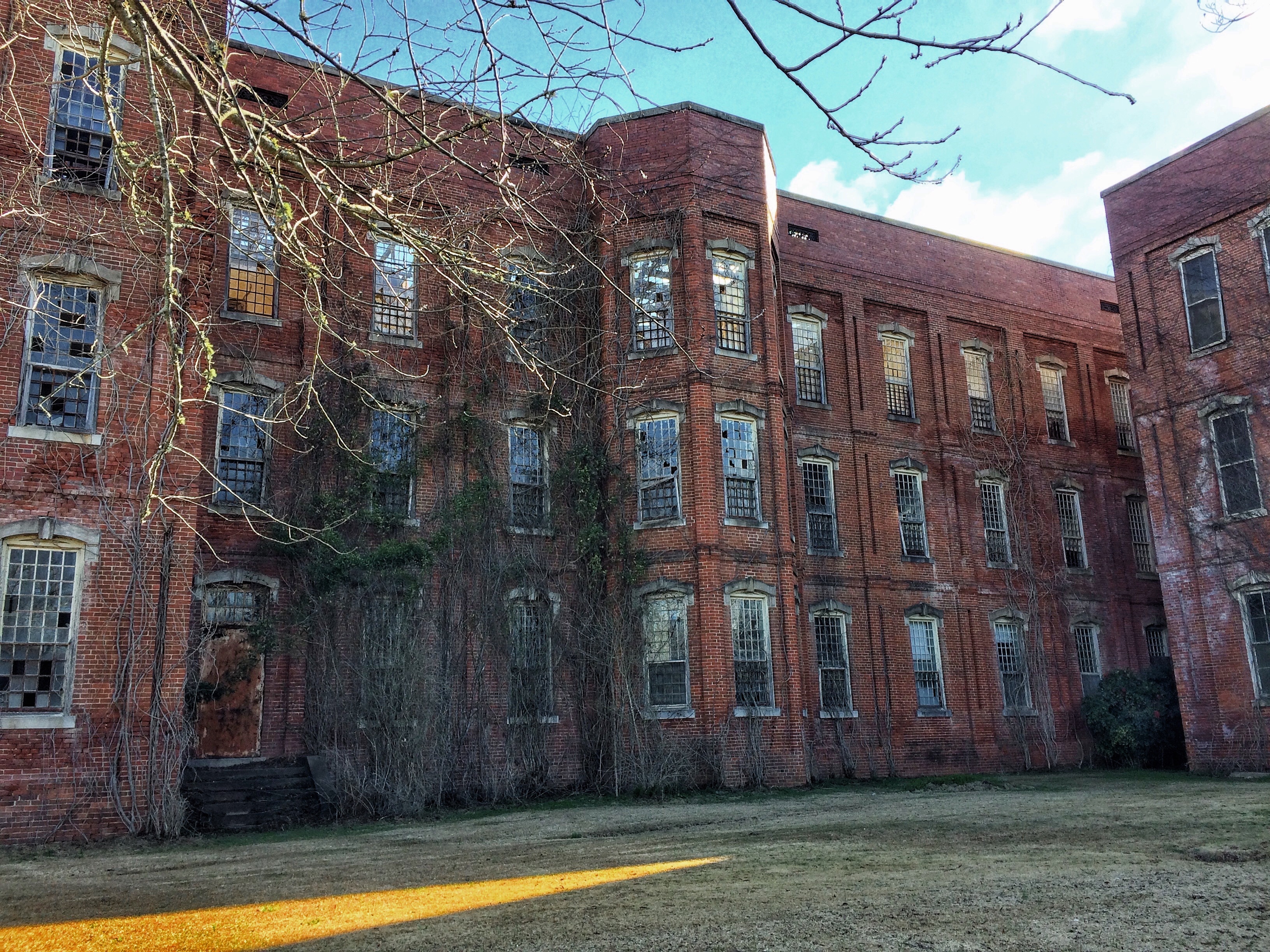
Central State Hospital
More than 25,000 people are buried beneath the grounds of Central State Hospital in Milledgeville, Georgia, most of them in graves without names. No headstones, no markers -- just flat earth under pecan trees, slowly swallowing the memory of patients who lived and died inside the walls of what was, by the 1960s, the largest mental hospital in the world. The campus sprawls across two thousand acres: some 200 buildings, many of them abandoned, their windows dark and their corridors empty. The landmark Powell Building still stands. The vast 1929 Jones Building looms vacant. Today, Central State serves roughly 200 patients. At its peak, it held nearly 12,000. The distance between those two numbers is the story of American psychiatry itself.
An Asylum in the State Capital
In the 1830s, a reform movement swept several American states -- an impulse to improve prisons, build public schools, and create state-funded hospitals for the mentally ill. In 1837, the Georgia State Legislature, responding to a call from Governor Wilson Lumpkin, passed a bill establishing the "State Lunatic, Idiot, and Epileptic Asylum." The name alone speaks volumes about the era's understanding of mental illness. Milledgeville was then the state capital, and the facility opened there in 1842, accepting its first patient in December. Under Dr. Thomas A. Green, who served as superintendent from 1845 to 1879, the hospital pioneered what was called the "institution as family" model. Green abolished chain and rope restraints, ate meals daily with staff and patients alike, and tried to create an environment that resembled, however imperfectly, something like a home. It was an early and genuine attempt at humane care, even as the institution's capacity to provide it was already being outpaced by demand.
The World's Largest
What began as a modest asylum grew relentlessly over the next century. Georgia sent its mentally ill, its developmentally disabled, its elderly, and its inconvenient to Milledgeville -- and the institution accepted them all. By the 1960s, Central State Hospital was contending with Pilgrim Psychiatric Center in New York for the grim distinction of being the largest mental hospital on earth. Nearly 12,000 patients occupied a campus of some 200 buildings spread across two thousand acres. The sheer scale defied comprehension: it was less a hospital than a small city, with its own farms, kitchens, laundry facilities, and cemeteries. Overcrowding was chronic. Staff-to-patient ratios were inadequate. The institution that Dr. Green had modeled on a family had become something closer to a warehouse, holding people whom society had decided it did not want to see.
The Unmarked Graves
Perhaps nothing captures Central State Hospital's history more starkly than its cemeteries. Scattered across the grounds, they hold the remains of more than 25,000 patients -- the vast majority buried in unmarked graves. For over a century, patients who died at the hospital and whose families did not claim their bodies were laid to rest without headstones, without names, without any record visible above the surface. The pecan groves and open fields that blanket parts of the campus conceal entire populations of the forgotten. These were not casualties of a single disaster or a brief period of neglect; they accumulated over decades, a slow accretion of lives deemed unworthy of remembrance. The graves stand as a rebuke to every era that contributed to them, and as a reminder that institutional care, however well-intentioned at its origin, can become its own form of erasure.
From Thousands to Hundreds
The deinstitutionalization movement that swept American psychiatry beginning in the 1960s hit Central State with particular force. As new medications and community-based care models emerged, the push to reduce asylum populations gained momentum. Central State's patient count fell from its peak of nearly 12,000 to a fraction of that number over the following decades. Buildings that had held hundreds of patients emptied and were shuttered. The Jones Building, constructed in 1929, stands abandoned -- a massive shell that speaks to the scale of what once operated inside it. Today, Central State Hospital continues to function on a vastly reduced scale, serving about 200 patients with short-stay acute treatment, residential programs for people with developmental disabilities, recovery programs requiring longer stays, and specialized nursing care. Some programs serve primarily the central Georgia region; others draw patients from across the state. The campus, with its pecan groves, its historic cemeteries, and its rows of silent buildings, remains one of the most haunting institutional landscapes in the American South.
From the Air
Located at 33.05N, 83.32W on the south side of Milledgeville, Georgia. The campus spans approximately 2,000 acres and is visible from moderate altitude as a large complex of institutional buildings, many abandoned, surrounded by open land, pecan groves, and wooded areas. The contrast between the sprawling campus and its current minimal occupancy is striking from the air. Nearest airports: Baldwin County Airport (KMLJ) approximately 3nm northeast in Milledgeville, Middle Georgia Regional Airport (KMCN) approximately 28nm southwest in Macon. The campus is roughly 2nm south of the historic Milledgeville town center, Georgia's antebellum capital. Best viewed at 2,000-3,500 feet AGL.