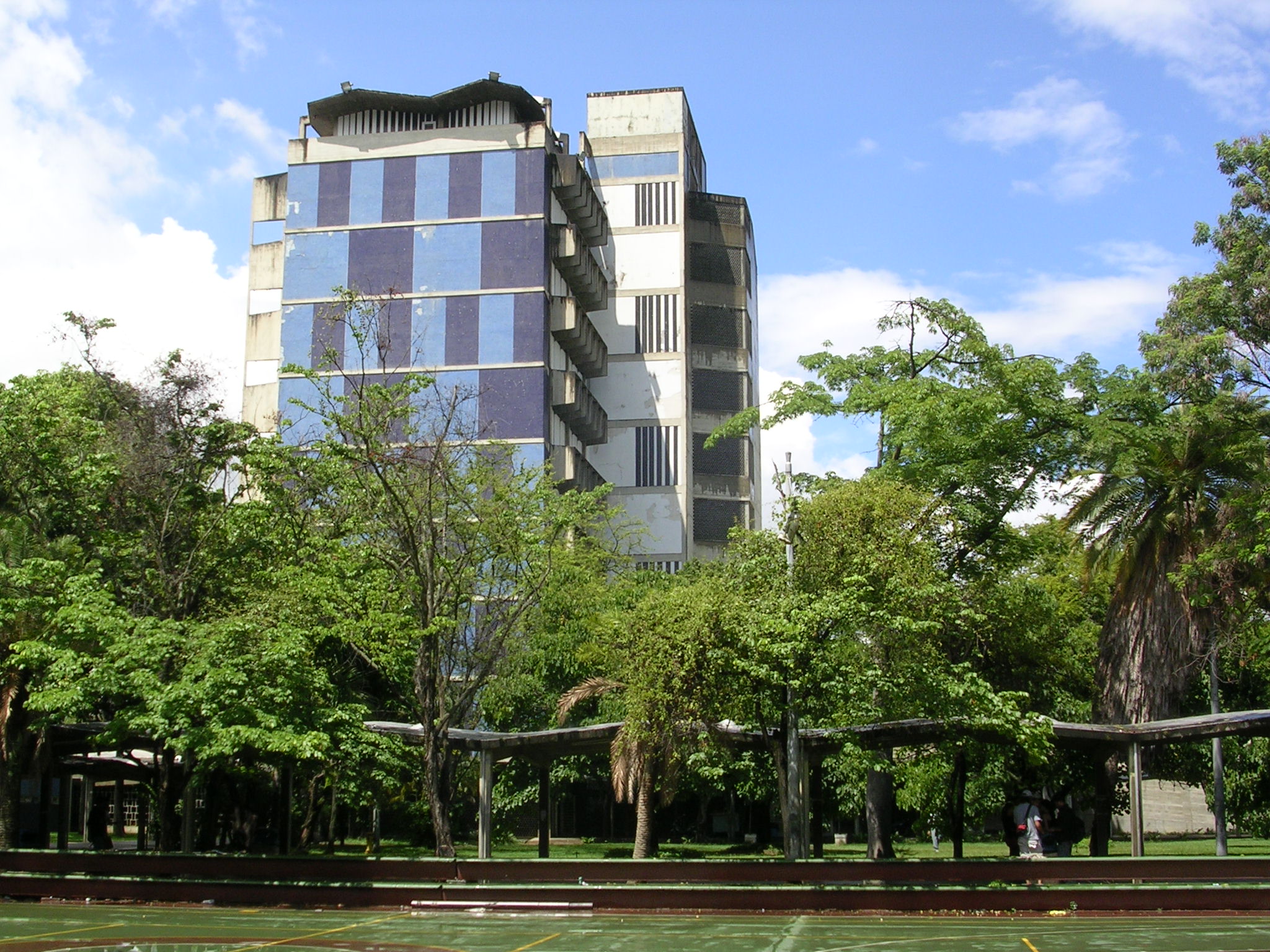
Central University of Venezuela
Alexander Calder's Floating Clouds hang from the ceiling of the Aula Magna auditorium — massive acoustic sculptures that double as art, suspended above the audience like thoughts that refuse to settle. This is the kind of place the Central University of Venezuela became in the 20th century: a campus where avant-garde art and architecture merged so completely that UNESCO declared the whole thing a World Heritage Site, the only modern university campus designed by a single architect to receive that honor. But the story starts three centuries earlier, with a bishop, a seminary, and students who had to cross an ocean to earn a degree.
A Seminary Becomes a University
In 1673, Bishop Antonio Gonzalez de Acuna — a Spaniard born in present-day Peru — founded the Seminary of Saint Rose of Lima in Caracas, named after the first Catholic saint born in the Americas. The seminary grew under Friar Diego de Banos y Sotomayor, who expanded it into a formal school by 1696. Yet Venezuelan students seeking university degrees still faced grueling journeys to Santo Domingo, Bogota, or Mexico City. Rector Francisco Martinez de Porras petitioned the Spanish crown to create a university closer to home. On December 22, 1721, Philip V of Spain signed the royal decree transforming the school into the Universidad Real y Pontificia de Caracas. Pope Innocent XIII confirmed the charter with a papal bull in 1722. The university offered degrees in philosophy, theology, canon law, and medicine, and for nearly a century it remained the only university in the country.
Smuggled Books and the Generation of 1928
By the late 18th century, despite official censorship from both the Crown and the Church, the works of Rousseau, Voltaire, Montesquieu, and Locke were being smuggled into Venezuela on ships of the Guipuzcoana Company. The university became a seedbed for the ideas that would fuel independence. Simon Bolivar himself issued new Republican statutes for the institution on June 24, 1827, giving it a secular character. A century later, the university would again incubate revolution. In 1928, a group of students organized protests against the dictatorship of Juan Vicente Gomez during a campus event called Students Week. This Generation of 1928 — including future president Romulo Betancourt, writer Miguel Otero Silva, and others — launched an attempted overthrow on April 7. Most were jailed or exiled without finishing their studies, but the movement they ignited would reshape Venezuelan politics for decades.
Villanueva's Synthesis of Arts
By the 1940s, the university had outgrown its colonial quarters, with faculties scattered across Caracas in borrowed buildings. President Isaias Medina Angarita purchased the Hacienda Ibarra and commissioned architect Carlos Raul Villanueva to design a new campus. What emerged over the following years was extraordinary: a 200-hectare urban complex of 40 buildings where architecture and art coexisted in what Villanueva called a Synthesis of Arts. He collaborated with 28 avant-garde artists from Venezuela and abroad. Victor Vasarely contributed murals. Jean Arp and Henri Laurens provided sculptures. Fernand Leger and Wifredo Lam painted walls. And in the Aula Magna, Calder's Floating Clouds — installed in 1953 — served as both acoustic panels and kinetic art, transforming a concert hall into a piece of sculpture you could sit inside. UNESCO designated the Ciudad Universitaria de Caracas a World Heritage Site in 2000.
Guerrillas, Raids, and Exile Within
After the fall of dictator Marcos Perez Jimenez in 1958, a new university law guaranteed academic freedom and tolerance. That guarantee was soon tested. During the 1960s, guerrilla rebels backed by Fidel Castro used the campus as a refuge from government prosecution, exploiting the university's legal autonomy as a shield. Tensions escalated until 1969, when students demanding reform occupied the campus entirely. On October 3, 1970, President Rafael Caldera ordered a military raid, and Rector Jesus Maria Bianco was forced to resign. The university reopened in 1971 with new leadership and a renovation plan. Throughout this turbulence, the institution benefited enormously from an influx of European intellectuals who had fled the Spanish Civil War and World War II. These scholars developed new lines of research and teaching, educating the generation of faculty members who would carry the university into the 21st century.
Three Centuries of Minds
The roster of people who have taught or studied here reads like an intellectual history of Venezuela. In the 18th century, Friar Baltasar de los Reyes Marrero was convicted by the Spanish Crown for teaching the theories of Newton, Copernicus, and Locke — doctrines the king had forbidden. In the 19th century, Jose Gregorio Hernandez pioneered microbiology in the country, while Adolf Ernst, a Prussian-born scientist, introduced instruction in natural history based on Darwin and Lamarck. Today the university is organized into 11 faculties and 40 departments, offering undergraduate degrees through five-year licenciaturas and graduate programs including 109 master's degrees and 40 doctoral programs. The Graduate School, founded in 1941, provides 222 different specializations. For three centuries, through colonial rule, independence, dictatorship, and crisis, the Central University of Venezuela has remained what a university is supposed to be: a place where the next generation argues with the last one.
From the Air
Located at 10.488°N, 66.891°W in central Caracas. The Ciudad Universitaria campus covers roughly 200 hectares and is visible from the air as a large complex of modernist buildings and green spaces southeast of Plaza Venezuela. The adjacent Caracas Botanical Garden (70 hectares) adds to the green footprint. Nearest major airport is Simon Bolivar International Airport (SVMI/CCS), approximately 20 km north. The distinctive covered walkways and Aula Magna auditorium are identifiable features of the campus at lower altitudes.