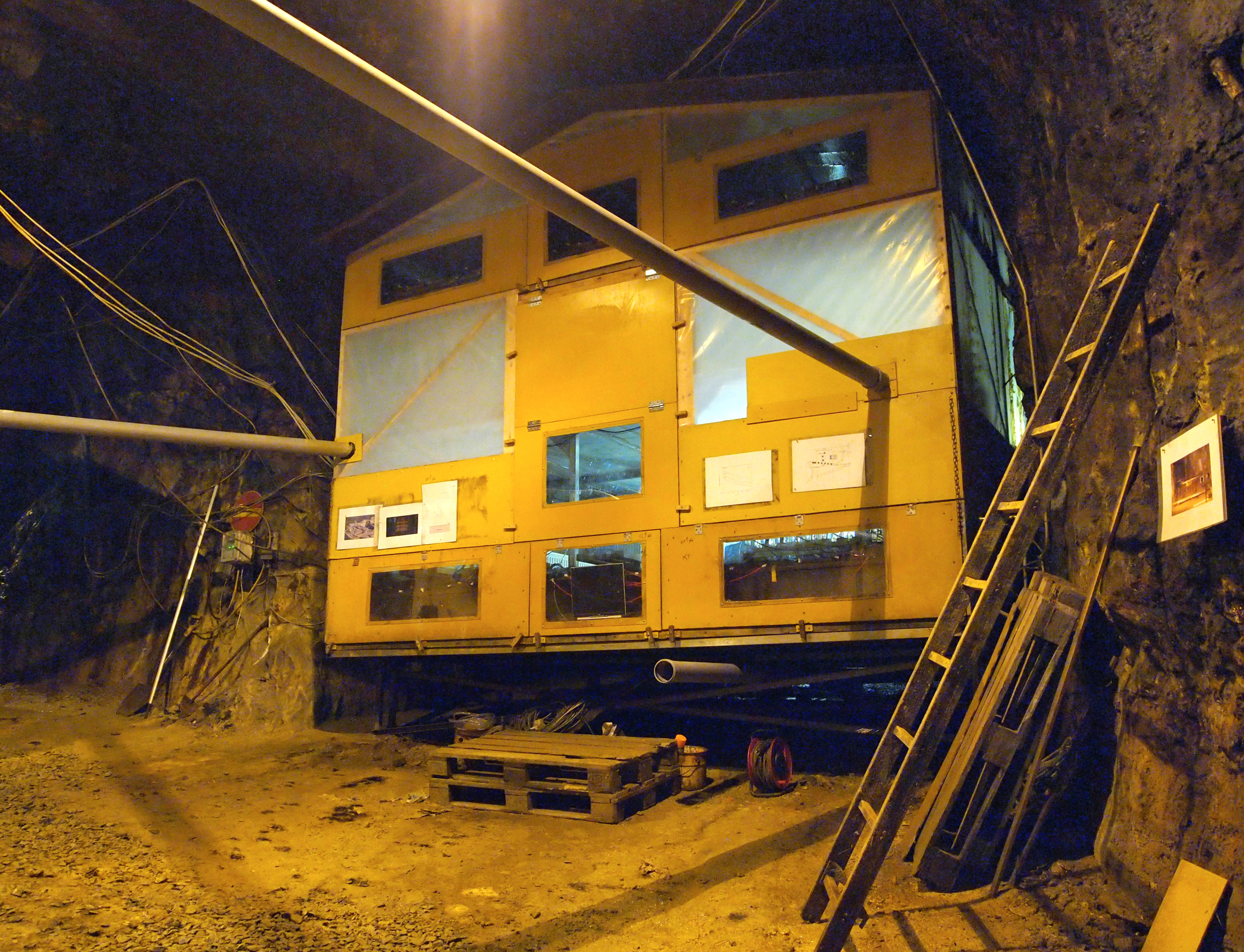
Centre for Underground Physics in Pyhäsalmi
To study what comes from the sky, sometimes you have to go underground. Nearly a mile beneath the forests of central Finland, inside Europe's deepest base metal mine, physicists operate sensitive detectors in near-perfect silence. The Centre for Underground Physics in Pyhäsalmi, known as CUPP, occupies tunnels within the Pyhäsalmi Mine at depths reaching 1,430 meters. At that depth, the rock overhead absorbs the background radiation that blinds surface-level particle detectors, turning a zinc and copper mine into one of the quietest laboratories on Earth.
Why Physicists Go Underground
Particle physics has a noise problem. Cosmic rays bombard Earth's surface constantly, flooding detectors with a blizzard of particles that obscure the faint signals scientists actually want to measure. The solution is elegantly simple: put your instruments under enough rock to filter out everything except the particles you are hunting. The Pyhäsalmi Mine, reaching 1,444 meters, provides one of the thickest natural radiation shields available to European researchers. CUPP, managed by the Oulu Southern Institute of the University of Oulu, takes advantage of the mine's existing infrastructure to run experiments at multiple depth levels, ranging from around 75 meters down to its deepest installations at 1,430 meters.
Catching Cosmic Whispers
The laboratory's flagship project is EMMA, the Experiment with MultiMuon Array. A collaboration between the universities of Oulu, Jyväskylä, and Aarhus, along with the Russian Academy of Sciences, EMMA studies the composition of cosmic rays at energies above one petaelectronvolt, in a region physicists call the "knee" of the cosmic ray energy spectrum. Installed at around 75 meters depth, EMMA filters out all secondary particles except muons with energies greater than 45 gigaelectronvolts. The experiment's drift chambers, repurposed from the DELPHI experiment at CERN, measure the multiplicity, lateral distribution, and arrival direction of these muon showers.
Carbon-14 in the Dark
At 1,430 meters depth, another experiment probes a different mystery. The C14 experiment, a collaboration between Finnish universities and the Russian Academy of Sciences, measures the radioactive purity of scintillator liquids used in particle detectors worldwide. These hydrocarbon-based liquids are assumed to contain virtually no carbon-14 because the hydrocarbons are ancient and the isotope's half-life is roughly 5,730 years. The experiment has produced a surprising result: the carbon-14 activity in scintillator liquids is consistently higher than expected. The apparatus is modest, a 1.6-liter scintillator sample with two photomultiplier tubes inside a radiation shield, but its findings have implications for neutrino experiments across the globe.
A Mine Becomes a Window on the Universe
CUPP was once a candidate site for LAGUNA, a proposed European neutrino observatory that would have been one of the largest underground physics facilities ever built. The project ultimately lost momentum as the global neutrino research community shifted focus toward the American DUNE project. But the laboratory endures. Previous experiments including MUG and MUD studied cosmic ray depth dependence and muon flux between 2001 and 2005. With just seven permanent staff and a stream of visiting researchers, CUPP operates as a compact but productive outpost of frontier physics. Above it, the Finnish forests give no hint of the science unfolding a mile below. The mine that once yielded copper and zinc now yields something rarer: data from the edges of the known universe.
From the Air
Located at 63.66°N, 26.04°E in Pyhäjärvi, central Finland. The mine complex is visible from altitude as industrial structures amid dense boreal forest. Nearest airports: Kokkola-Pietarsaari Airport (EFKK) approximately 120 km west, Kuopio Airport (EFKU) approximately 150 km southeast. The area is characterized by lakes and coniferous forest typical of Finland's interior. Recommended viewing altitude: 5,000-10,000 ft for mine complex visibility.