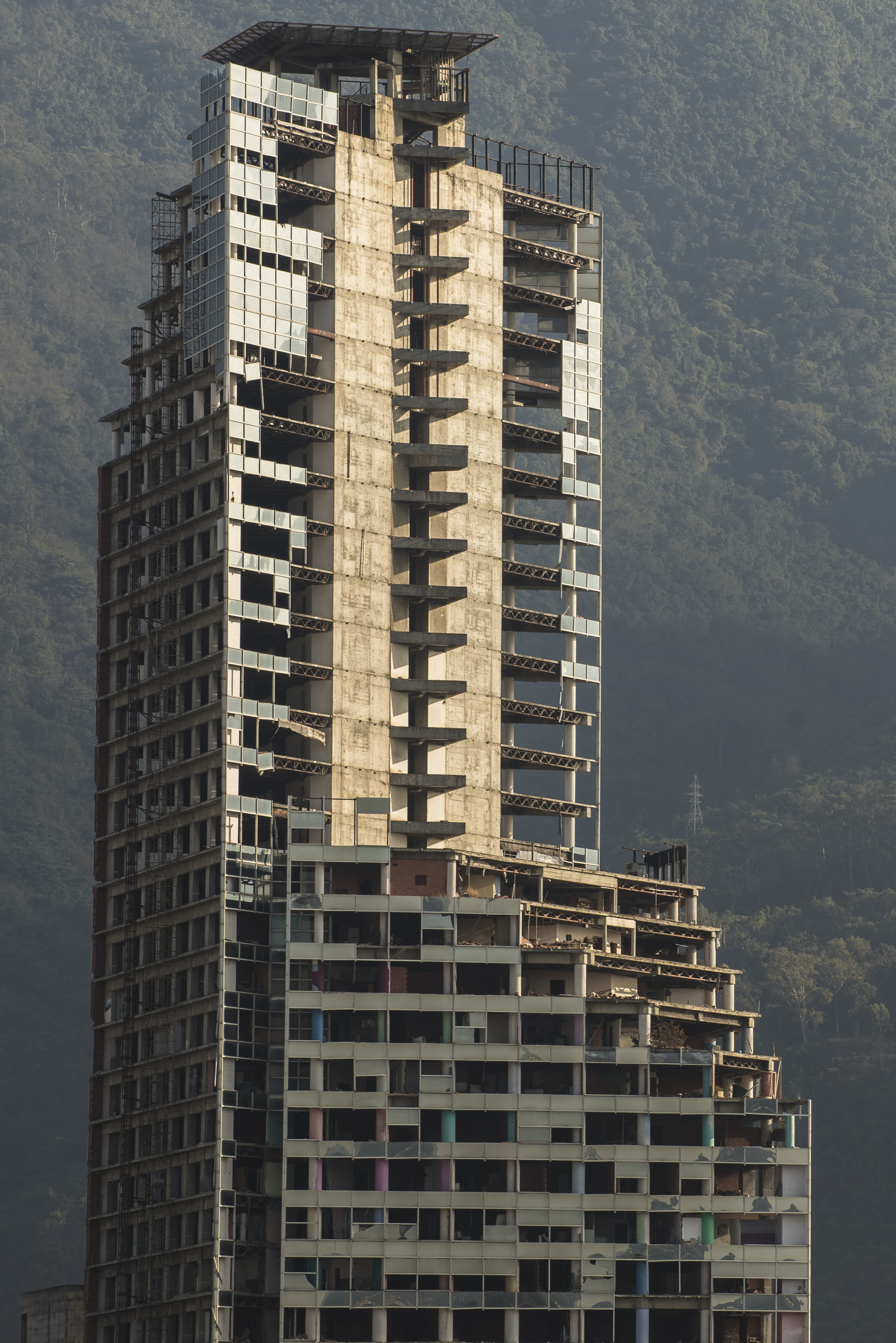
Centro Financiero Confinanzas
Forty-five stories of concrete and rebar, no elevators, no running water above the twenty-second floor, no windows in half the rooms -- and yet for nearly a decade, more than 2,500 people called it home. Centro Financiero Confinanzas, known to the world as the Torre de David, is a skyscraper that never became what it was meant to be. Instead, it became something its designers never imagined: the tallest occupied squatter building on Earth, a vertical neighborhood suspended between ambition and abandonment in the heart of Caracas.
A Fortune That Crumbled
The tower is named for David Brillembourg, the Venezuelan financier who envisioned a gleaming financial center for downtown Caracas. Construction began in 1990 on a complex of six buildings, the crown jewel being Torre A -- 171 meters tall, 45 stories, with a heliport on the roof. The plans called for a modern business hub worthy of the oil-rich capital. But Brillembourg died of cancer in 1993, and the following year the Venezuelan banking crisis gutted the country's financial sector. The government seized the unfinished complex. No buyer materialized at a 2001 auction. What remained was a concrete skeleton: no elevators, no electricity, no walls in many places -- just the bones of a building waiting for a purpose that would never arrive in the way anyone expected.
The Vertical City
By the late 2000s, Caracas was short roughly 400,000 homes. Construction had stalled across Venezuela as fears of government expropriation discouraged private builders, and the Bolivarian government could not build fast enough to close the gap. People began moving into empty buildings wherever they could find them, and the Torre de David -- massive, central, structurally sound if unfinished -- drew the most attention. Residents organized themselves floor by floor. They rigged electrical connections and plumbed water lines that reached up to the twenty-second story. Shops opened on the lower levels. Children played in the corridors. By 2011, roughly seven hundred families occupied the tower, navigating its open stairwells by foot each day, climbing sometimes twenty floors to reach home. It was precarious, improvised, and unmistakably alive.
A Symbol Claimed by Many
The Torre de David became a mirror in which different observers saw what they wanted. For some, it was evidence of Venezuela's housing crisis made vertical -- a damning image of government failure. For others, it represented human resilience, a community that built its own infrastructure where none existed. The architectural collective Urban Think Tank produced a documentary that won the Golden Lion at the 2012 Venice Architecture Biennale, treating the occupation as an experiment in informal urbanism. The BBC, Vice, and The Atlantic all sent journalists and photographers inside. JJ Amaworo Wilson based his 2016 novel Damnificados on the occupation. The building even appeared in the television series Homeland. Each telling added another layer to a story that resisted simple conclusions.
Departure and Silence
In July 2014, President Nicolas Maduro acknowledged the government had not decided the building's fate, floating three possibilities: demolition, conversion into a commercial center, or construction of proper housing. The relocation of residents began that month and continued through June 2015, when the last families moved to government-provided homes elsewhere in Caracas. In April 2015, officials announced the tower would serve as an emergency response center, housing National Guard and fire department personnel. That plan dissolved. A proposal involving a Chinese bank fell through by April 2016. The tower stands as it has stood for three decades now -- unfinished, mostly empty, its concrete slowly weathering above the Caracas skyline. Earthquakes in August 2018 damaged the upper floors, tilting the last five stories by 25 degrees, adding structural concern to the building's long list of unresolved questions.
From the Air
Located at 10.505N, 66.899W in downtown Caracas. The 45-story tower is visible from altitude as a distinctive unfinished concrete structure among the Caracas skyline. Nearest major airport is Simon Bolivar International Airport (SVMI/CCS), approximately 25 km to the north across the Avila mountains. Best viewed at 5,000-8,000 feet AGL when approaching from the south over the Caracas valley. The Parque Central twin towers nearby provide visual reference.