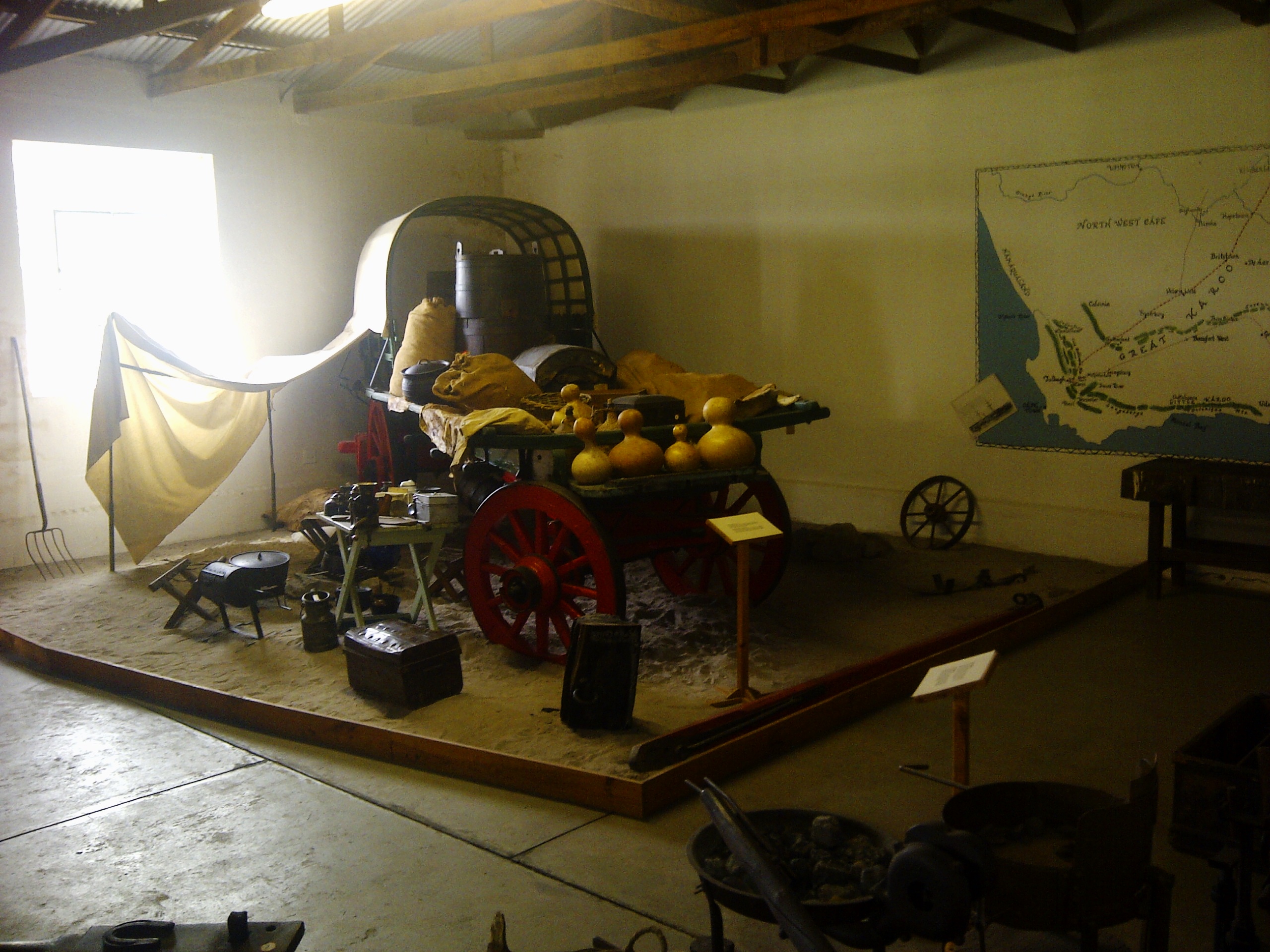
Ceres Transport Riders' Museum
The building started life as a flour mill in the early 1930s. Decades later, heritage architect Gawie Fagan -- one of Cape Town's most respected voices in conservation design -- reshaped it into a museum. What it preserves is not the grain trade but the people who came before it: the transport riders, or togryers, whose ox-wagons once made Ceres a vital link between the Cape coast and the diamond fields of Kimberley, 900 kilometers to the northeast.
When Michell's Pass Opened the Door
Ceres existed in relative isolation until 1848, when the completion of Michell's Pass finally made the town accessible to wagons. That single road changed everything. One of the main routes to the newly discovered diamond fields in Kimberley ran directly through Ceres, and the transport riders -- men who made their living hauling goods by ox-wagon across vast distances -- became the town's economic lifeblood. Their influence on Ceres was so profound that when the community began collecting its history in the 1970s, they named the museum after these riders. The Ceres Togryers Museum was proclaimed a local museum on November 7, 1978, and became a province-aided institution in 1987.
What the Wagons Carried
The museum's collection ranges far beyond wagons, though a fine assembly of them anchors the exhibitions. Displays cover the natural history of the Ceres area, the establishment of the town and the lifestyles of its earliest inhabitants, and the transport riders' daily existence -- the grueling days, the long routes, the animals they depended upon. Photographs and articles document the destructive 1969 earthquake that leveled much of the surrounding region. There are exhibitions on the development of local schools and churches, tracing the institutional growth of a community that began as a remote mountain outpost.
Histories That Were Not Always Told
The museum does not shy from the harder chapters of Ceres's past. An exhibition on the slave uprising at Houdenbek Farm documents resistance by enslaved people in the area -- a story that many South African towns have been slow to acknowledge. Another exhibition addresses the apartheid-era forced removals of the 1960s and their devastating impact on the local community, when families were uprooted from neighborhoods they had built over generations. In 2025, the Western Cape Cultural Awards recognized this inclusive approach, naming the Togryers Museum the winner in the category "Contribution to the Promotion of Social Inclusion in the Field of Museums, Heritage and Geographical Names." The award confirmed what the museum's curators had long understood: that a town's heritage belongs to all its people, not only those who held power.
A Living Archive
Beyond its exhibitions, the museum functions as a community resource. Staff assist with genealogical research, helping families trace connections through the generations of people who passed through or settled in this mountain town. Educational programs serve primary and secondary schools, and outreach initiatives reach both youth and elderly residents. Guided tours provide context that the exhibitions alone cannot -- the human stories behind the artifacts, the connections between the wagons in the hall and the passes in the mountains outside. The Board of Trustees, empowered by the Western Cape Province under the Cape Museum Ordinance, holds the museum's assets in trust for the people of Ceres. It is, in the fullest sense, their museum.
From the Air
The Ceres Transport Riders' Museum is located at 33.22S, 19.18E in the town of Ceres, nestled in a mountain valley at approximately 450m elevation. From the air, Ceres is identifiable at the junction of the R46 and R303 roads, surrounded by fruit orchards and the Witzenberg and Skurweberg mountain ranges. Michell's Pass is visible as a road threading south through the mountains toward Wolseley. Nearest airports: Cape Town International (FACT, ~130km SW). The museum building, a converted 1930s flour mill, is in the town center.