Cerro Ballena
The highway workers had no idea they were cutting through a cemetery. In the early 2000s, crews expanding Chile's Route 5 -- part of the Pan-American Highway -- blasted into a hillside a few kilometers north of the port city of Caldera and uncovered bones. Not human bones. Whale bones. Dozens of them, laid out in parallel rows as if arranged by some deliberate hand. The locals had long called this rise "Cerro Ballena" -- Whale Hill -- a name that turned out to be more literal than anyone had imagined. What the highway project revealed was one of the most extraordinary fossil sites on Earth: over 40 whale skeletons from the Late Miocene epoch, roughly 6 to 9 million years old, alongside the remains of seals, sharks, swordfish, and an animal that should not have been anywhere near an ocean -- an aquatic sloth.
Death by Algae
The central mystery of Cerro Ballena is not why the fossils are here but why so many animals died together. Paleontologists led by Nicholas D. Pyenson, who published the site's definitive study in 2014, determined that the answer lay in the water itself. Iron-rich conditions in the ancient sea fueled massive blooms of toxic algae -- the same harmful algal blooms that still poison marine mammals today. Whales, seals, and fish consumed the toxins, died at sea, and their carcasses floated toward shore. Strong waves pushed the bodies onto a flat coastal berm, where they were gradually buried in sediment. The geological record shows this happened not once but four separate times over a span of roughly 10,000 to 16,000 years, each event leaving a new layer of death preserved in stone. The repetition suggests that the conditions for mass mortality recurred with grim regularity along this stretch of ancient coastline.
A Menagerie in Stone
Whales dominate Cerro Ballena, but they are not alone. The site contains fossils of pinnipeds -- including a dwarf seal species -- sailfish, sharks, and swordfish. Most unexpected are the remains of Thalassocnus, a genus of ground sloth that had adapted to life in the water. These were not small animals; Thalassocnus grew to substantial size and fed on sea grasses along the Pacific coast. Their presence alongside open-ocean predators like sharks speaks to an ecosystem that was both diverse and interconnected. Invertebrate trace fossils round out the picture, capturing the burrows and trails of smaller creatures that lived on the seafloor. Together, the assemblage provides a snapshot of an entire marine ecosystem at the moment of its collapse -- juvenile and adult whales side by side, predator and prey united in the same catastrophe.
The Race Against the Road
The fossils had been known since 1965, when Chilean Army engineers first noticed them during early road work. But nobody formally reported the find, and the bones were forgotten for over 40 years. When the modern highway expansion reached Cerro Ballena, the project's environmental review covered archaeology, flora, and fauna -- but not paleontology. The bulldozers advanced into fossil-bearing rock before anyone with the expertise to recognize the significance had been consulted. Mario Suarez Palacios, curator of the Paleontological Museum of Caldera, sounded the alarm. Working with the director of the Atacama Regional Museum, he secured a meeting with the regional governor and convinced the Ministry of Public Works to halt construction. Chile's National Monuments Council intervened to protect the site by law in 2012. The sheer density of the finds -- over 30 nearly complete whale skeletons -- slowed research to a crawl and kept the highway on hold for years.
A National Treasure in the Desert
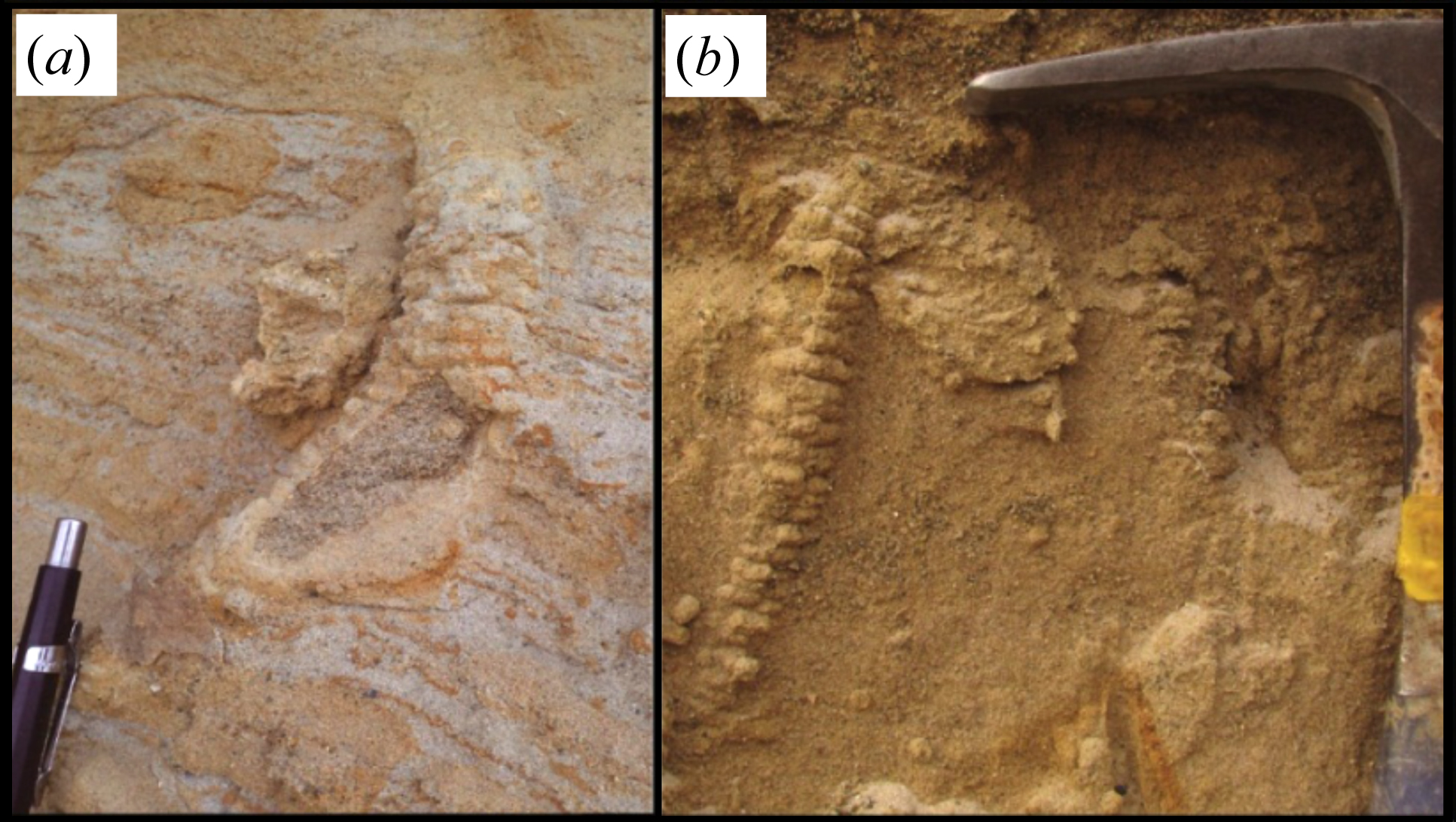
Cerro Ballena is now considered a national treasure of Chile, protected by law and recognized as one of the most significant marine vertebrate fossil sites in the world. The Smithsonian Institution's 3D scanning team digitized the site, creating a permanent record of fossils that could not all be removed from the rock without damage. Iron-stained domal structures in the strata -- the fossilized traces of the algal blooms that caused the mass die-offs -- remain visible in the exposed rock face. The Pan-American Highway now curves around the site rather than through it. From the road, the hillside looks unremarkable: pale desert rock baking under the Atacama sun. But beneath that surface lie the compressed remains of an ancient catastrophe, preserved with a clarity that lets scientists read each chapter of disaster as distinctly as the pages of a book.
From the Air
Located at 27.04S, 70.80W along the Pan-American Highway (Route 5), a few kilometers north of Caldera on the Chilean coast. The site is a low hillside adjacent to the highway in otherwise flat, arid desert terrain. Best viewed from 2,000-4,000 feet AGL. Nearest airport: Copiapo Desierto de Atacama (SCAT/DAT) approximately 70 km to the northeast. The Pacific coastline is immediately to the west, and the port of Caldera is visible to the south.