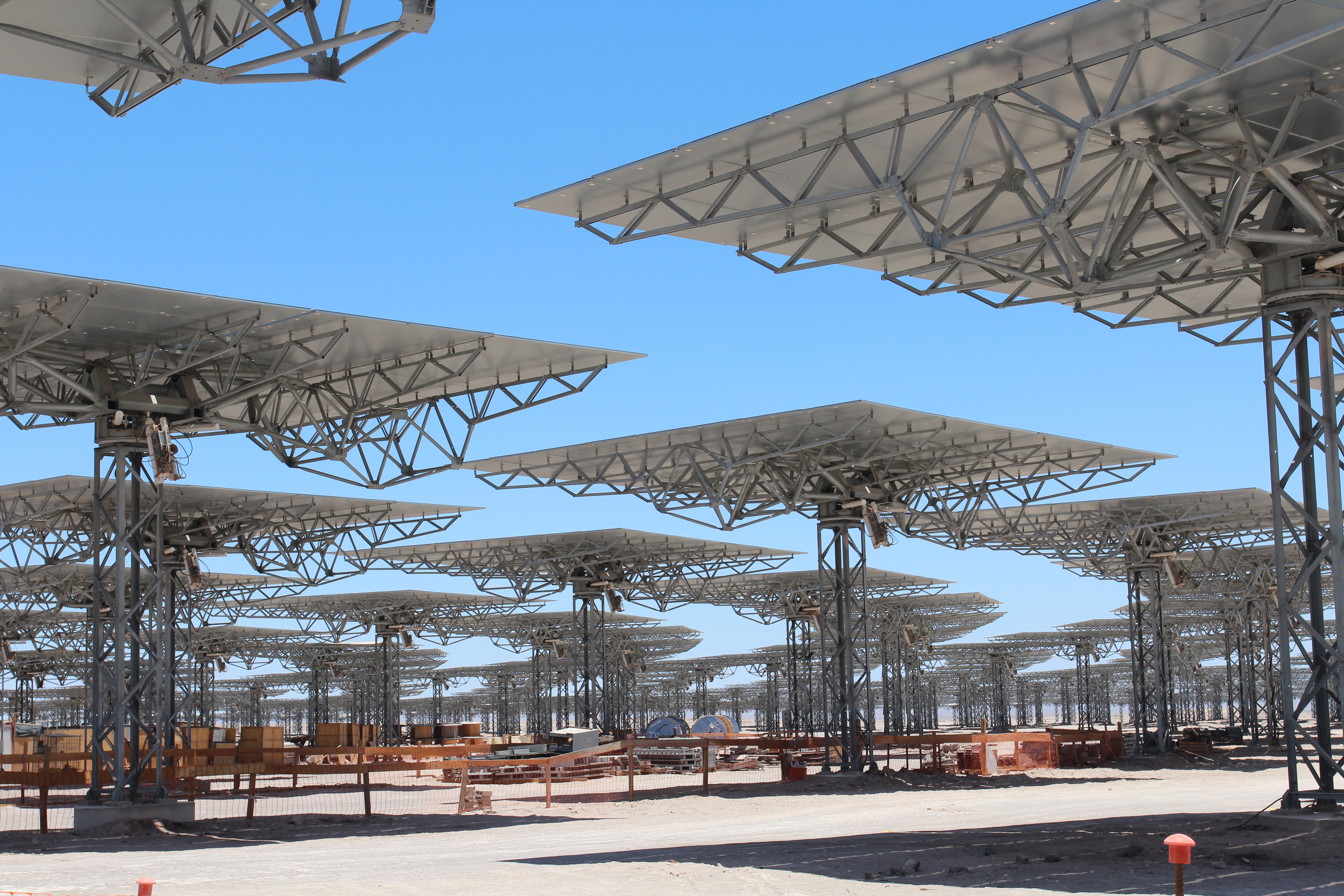
Cerro Dominador Solar Thermal Plant
Forty-five thousand tonnes of salt sit in a storage tank in the Atacama Desert, heated to temperatures that would melt aluminum. When darkness falls across one of the driest places on Earth, that molten salt keeps generating electricity for up to 17.5 hours — long after the sun that heated it has dropped below the horizon. This is Cerro Dominador, Latin America's first concentrated solar power plant, a facility that took nearly a decade, a billion dollars, and the near-collapse of its original builder to bring to life. Inaugurated on June 8, 2021, it represents both a technological achievement and a statement about what Chile's Atacama Desert — cursed with drought but blessed with some of the highest solar radiation on the planet — can become.
Ten Thousand Mirrors, One Tower
The physics of Cerro Dominador are elegant in concept and brutal in scale. Thousands of heliostats — mirrors mounted on two-axis trackers — follow the sun across the sky, reflecting and concentrating its radiation onto a receiver perched atop a central tower. That receiver, weighing 2,300 tonnes, was hoisted to 220 meters in February 2020, bringing the tower's total height to 252 meters — the second-tallest structure in Chile, surpassed only by Santiago's Gran Torre Costanera. At the receiver, concentrated sunlight heats molten salts to extreme temperatures. The salts then flow through heat exchangers, boiling water into superheated steam that drives a turbine through the Rankine cycle, producing 110 megawatts of power. A separate 100-megawatt photovoltaic array brings the combined plant output to 210 megawatts, securing up to 950 gigawatt-hours of annual energy sales.
A Project That Nearly Died
Construction began in May 2014 under Abengoa Solar Chile, a subsidiary of the Spanish multinational Abengoa. The project was more than half complete when Abengoa's broader financial crisis forced a halt in January 2016. Some 1,500 workers were abruptly dismissed, leaving only maintenance staff to guard the partially built facility in the desert. For months, the unfinished tower stood among its mirror field like an abandoned monument. Rescue came in October 2016, when EIG Global Energy Partners acquired full ownership, retaining Abengoa as a technological partner and builder. Financing was restructured at an estimated total cost of US$1 billion, backed by the Chilean government through CORFO, the Inter-American Development Bank, the Clean Technology Fund, and Germany's KfW development bank. By April 2021, the plant was connected to Chile's northern electrical grid.
Daylight Stored in Salt
What sets Cerro Dominador apart from conventional solar farms is storage. Photovoltaic panels generate electricity only while the sun shines. Cerro Dominador's molten salt system banks the desert's heat, enabling the plant to dispatch power on demand for up to 17.5 hours without direct sunlight. The salt mixture, produced by SQM (Sociedad Quimica y Minera), one of Chile's largest chemical and mining companies, was melted in a process that began in February 2020. This thermal battery transforms a solar plant from an intermittent generator into something closer to a baseload power station — reliable enough that Empresas Copec signed a five-year power purchase agreement in December 2019. The technology addresses the fundamental challenge of renewable energy: matching supply to demand when the resource itself is cyclical.
Chile's Renewable Bet
Cerro Dominador is part of Chile's national renewable energy program, which set a target of producing 20 percent of the country's electricity from clean sources by 2025. The plant prevents the emission of approximately 643,000 tonnes of carbon dioxide per year, displacing fossil fuels that once dominated Chile's energy mix. A follow-up project called Likana Solar bid just $33.99 per megawatt-hour in an August 2021 auction, demonstrating how rapidly concentrated solar power costs have fallen. The Atacama's advantages are difficult to overstate: clear skies nearly year-round, solar irradiance among the highest measured anywhere on Earth, and vast tracts of uninhabited land. The plant has also generated significant employment in a region where mining has long been the only major industry, creating direct and indirect jobs in construction, operation, and the support services that sustain a workforce in the desert.
A Beacon in the Desert
From the air, Cerro Dominador looks like nothing else in the Atacama. The circular array of heliostats radiates outward from the central tower in concentric rings, their reflective surfaces catching and redirecting sunlight in a pattern that is geometric and almost hypnotic. At certain angles, the tower's receiver glows visibly where concentrated light strikes it. The facility sits in the commune of Maria Elena, about 24 kilometers west-northwest of Sierra Gorda, surrounded by the tan emptiness of the desert floor. With an estimated lifespan of 30 to 50 years, the plant will be reflecting sunlight into the twenty-first century's second half — a manmade landmark in a landscape that otherwise has not changed appreciably since long before humans arrived.
From the Air
Cerro Dominador is located at 22.77°S, 69.48°W in the Atacama Desert, approximately 24 km west-northwest of Sierra Gorda in Chile's Antofagasta Region. From altitude, the circular heliostat field surrounding the 252-meter central tower is distinctive and unmistakable against the desert floor. The nearest major airport is Cerro Moreno (SCFA) at Antofagasta, about 150 km to the west-southwest on the coast. The Atacama's extreme aridity provides exceptional visibility in most conditions. The 100 MW photovoltaic array is also visible adjacent to the tower facility.