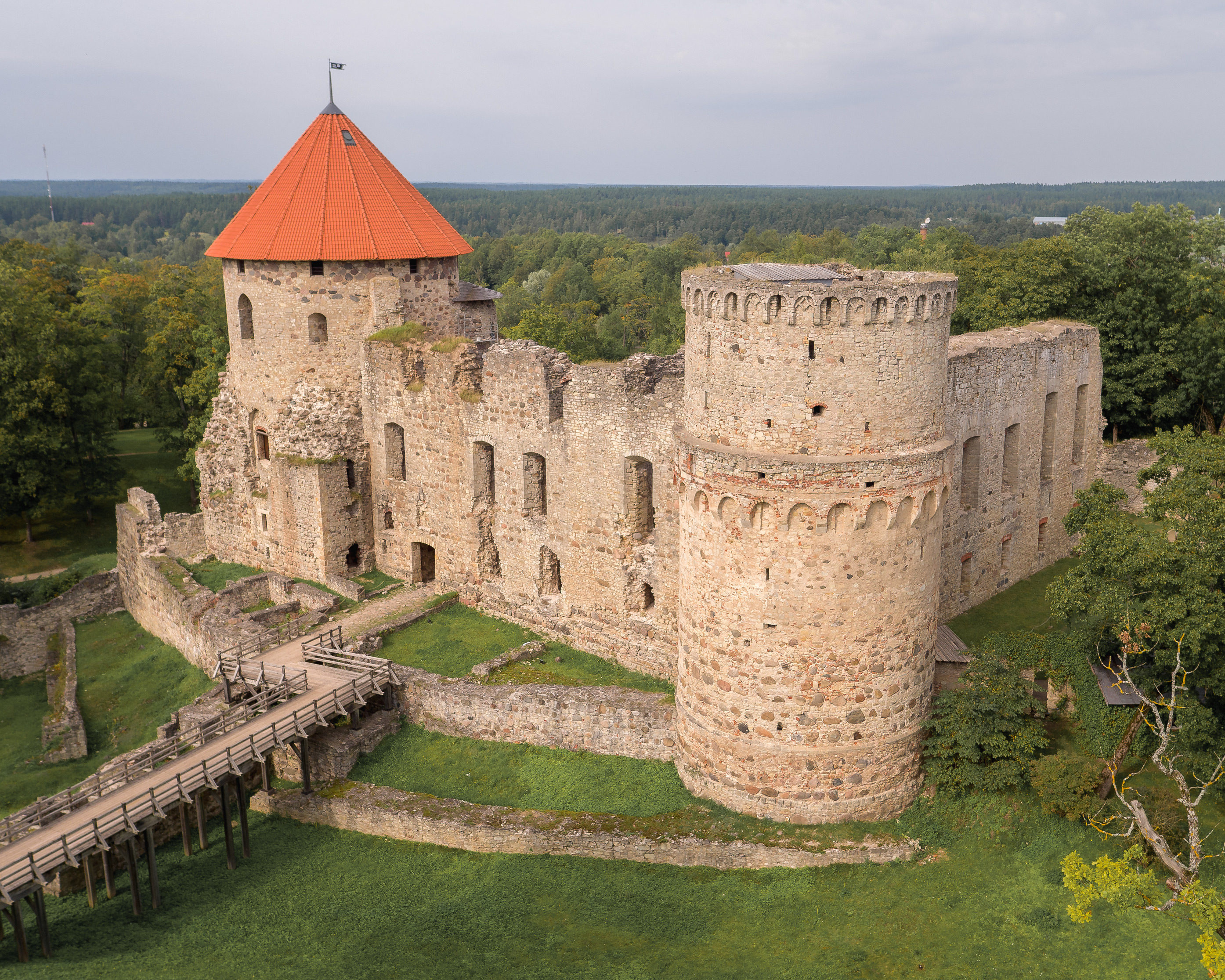
Cēsis Castle
On a September day in 1577, the western range of Cēsis Castle disintegrated in a single blast. Four barrels of gunpowder, lit by the people inside, brought down the walls and the ceilings and most of the people themselves. They had been bombarded for five days by the army of Ivan the Terrible, and they had calculated that whatever the tsar planned for them was worse than what they could do for themselves. Almost four centuries later, in 1974, archaeologists found two basement rooms beneath the rubble. Under collapsed beams they found bones, adults and children together, all dated by the coins beside them to that exact year. The chronicler Salomon Henning wrote that all in the castle were blown up except those who tried to hide elsewhere. The bones were probably the hiders.
How a Crusade Built a Castle
In the autumn of 1206 a small Baltic tribe called the Wends accepted Christianity and threw in with the German crusaders pushing east into Livonia. Two years later the Brothers of the Militia of Christ, also called the Livonian Brothers of the Sword, moved into the Wend hillfort and replaced its timber palisade with stone walls. The Chronicle of Henry of Livonia called the place the smallest fort in Livonia, but it kept beating off Estonian and Russian sieges. Around 1213 the Brothers began building a proper stone castle next door. Then in 1237, after the Brothers were nearly annihilated at the Battle of Saule, what remained of them was absorbed into the Teutonic Order. The Teutonic Knights tore down most of what was there and put up a square convent castle in the Prussian style, four ranges grouped around a courtyard. Cēsis grew into one of the largest fortresses the Order would ever own.
Capital of the Order
By the late fifteenth century the Livonian Master, the Order's supreme commander in the region, had moved his permanent seat from Riga Castle to Cēsis. From these walls envoys were received, wars were planned, and troops mustered. The archives, the library, and the chancery with its scriptorium all lived inside the convent. The peak years stretched from 1494 to 1535, the long reign of Wolter von Plettenberg, soldier and politician, possibly the greatest figure the Order ever produced in Livonia. He reinforced the fortifications with three artillery towers, remade the Chapter Hall and the Master's Chamber, and commissioned the brick vaulting in the Master's Chamber that has survived in place for more than five centuries. When you stand inside that chamber today, holding the candle lantern that has been the castle's tradition since 1996, the ribs of that vault are above your head, exactly where Plettenberg's masons placed them.
1577
The Livonian branch of the Teutonic Order was dissolved in 1561. The territory broke into competing pieces and Russia, Sweden, and Poland-Lithuania began a long contest for the spoils. By the time Ivan the Terrible's army arrived at Cēsis in 1577 the castle had already been damaged by earlier sieges. Five days of bombardment broke the will of the defenders. They were not all soldiers. The remains found in 1974 included children. The decision they made was not heroism in any clean sense; it was a desperate calculation by people who knew that Ivan's army had a documented practice of mass execution and torture, and who chose to end things on their own terms. They lit the gunpowder. The western range collapsed. The castle was still standing the next morning, just smaller. Ivan's troops walked in and did what they had come to do.
Slow Erasure
Cēsis kept being a castle for another century, though never again a great one. After the Polish-Swedish War it became Swedish property and was handed to Lord High Chancellor Axel Oxenstierna. By 1681 it belonged directly to the king of Sweden, and a mounted unit moved in. The soldiers stripped the castle for parts. Doors, cupboards, window lead for musket balls, hinges and locks, anything that could be pried off was pried off. In the early years of the Great Northern War, Russian troops continued the work. Then weather did what soldiers had not finished: rain saturated the ceilings, frost cracked the mortar, and the castle began to bury itself in its own rubble. In the 1830s Count Karl Gustav von Sievers turned the ruin into the centerpiece of a romantic landscape park, with a pond reflecting the broken silhouette. He opened a water-cure clinic on the grounds in 1841 and the broken castle became a place to walk after taking the cure.
What the Stones Remember
When Latvia became independent in 1918 the castle came under the protection of the new state. The Ulmanis regime in the 1930s called for tearing down medieval German monuments, but Cēsis was saved by the local mayor Rudolfs Kaucis, who said in public: we cannot escape our own history; those who once lived in this castle are long gone, but the Latvians whose ancestors built it are now a free nation. The Soviets, who blew up Konigsberg Castle in 1968 to erase the symbol of Prussian militarism, somehow let Cēsis stand. In the 1950s the outer bailey became a sports ground for the local trade school, with running tracks and a long jump pit laid out on top of medieval foundations. Archaeology started seriously in 1974, kicked off by the discovery of the explosion bones, and has so far covered ten thousand square meters and recovered thirteen thousand artifacts. About a hundred thousand visitors come every year. Five species of bats hibernate in the basement walls each winter. In summer, blacksmiths and woodturners work the courtyard using methods five hundred years old.
From the Air
Cēsis Castle sits at 57.313°N, 25.270°E in the Vidzeme region of central Latvia, about 90 km northeast of Riga. The Western Tower is the tallest visible element and the medieval ruins stand inside a green park beside the modern town. Nearest major airport is Riga (EVRA), about 75 km southwest by road. From the air, look for the Gauja River valley to the north and the church spires of central Cēsis adjacent to the castle. Recommended viewing altitude 2,000 to 3,000 ft AGL. The reflecting pond on the south side is most photogenic in calm morning conditions.