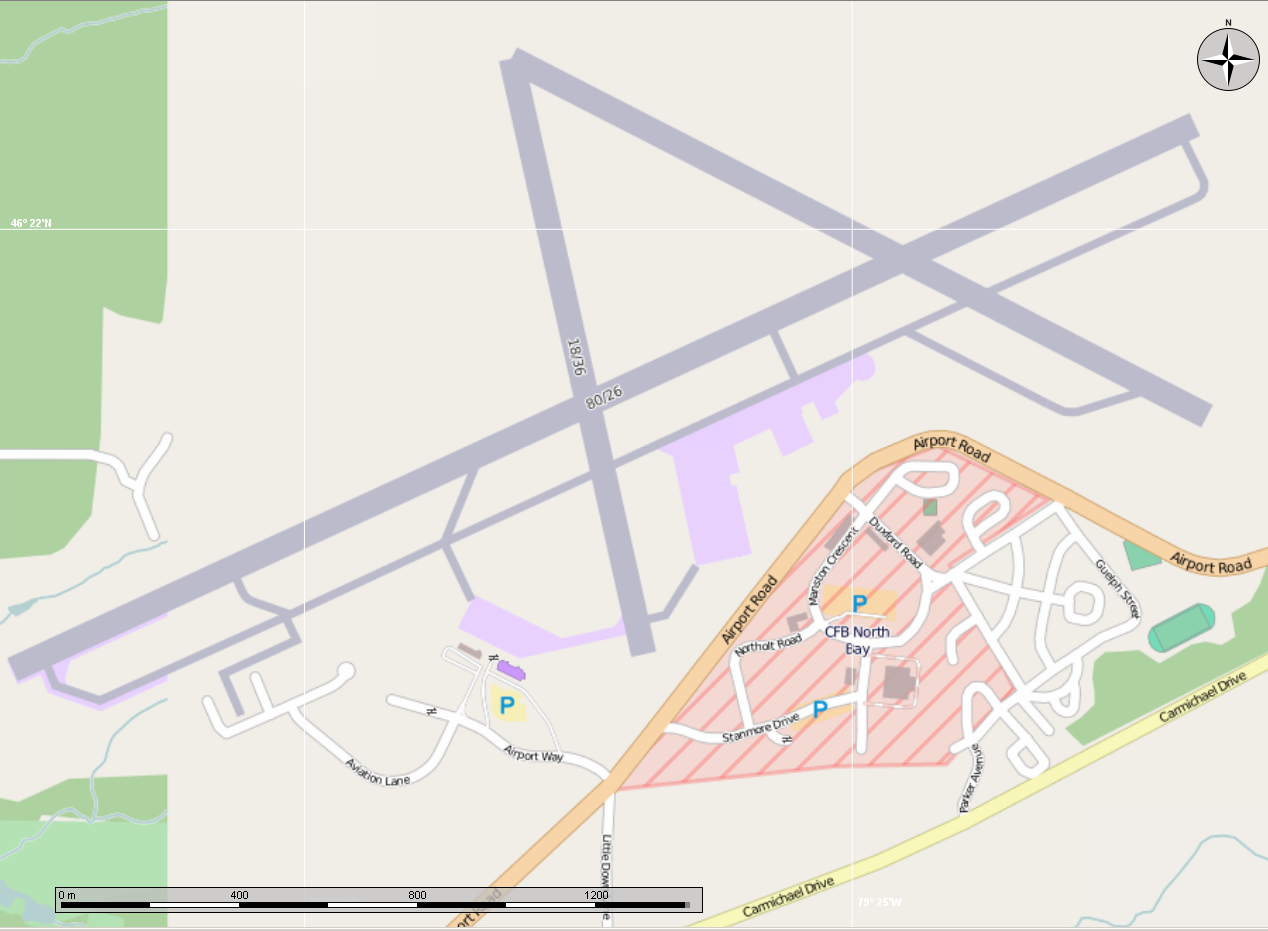
CFB North Bay
Somewhere beneath the granite ridges outside North Bay, Ontario, a cave the size of a five-storey building hums with the glow of radar screens. The NORAD Underground Complex sits more than sixty storeys underground, blasted into the bedrock of the Canadian Shield during the tensest years of the Cold War. From this bunker, Canadian and American operators track every aircraft entering the country's airspace -- from overseas flights to smugglers to, each Christmas Eve, Santa Claus himself. CFB North Bay is the only air base in Canada without an airfield, the only one without flying units, and arguably the most important military installation in the country. Its story stretches from a flying boat that electrified onlookers in 1920 to a satellite launched from India in 2013, and nearly every chapter involves something improbable.
A Flying Boat Over Main Street
On October 9, 1920, a Government of Canada Felixstowe F.3 flying boat appeared without warning over the small town of North Bay. Few residents had ever seen an aircraft. Lieutenant-Colonel Robert Leckie and Major Basil Deacon Hobbs were attempting the first crossing of Canada by air, an eleven-day expedition requiring six aircraft. Over the Canadian Pacific Railway station, Leckie dropped a telegraph signal -- 'Making a good 50 miles per hour' -- waved to the lunchtime crowd, and swung the flying boat out over Lake Nipissing toward Sault Ste. Marie. That fleeting overflight planted a seed. Local politicians began campaigning for an air station. Through the 1920s, Curtiss HS-2L flying boats landed on Lake Nipissing for aerial surveying, and Squadron Leader John Henry Tudhope -- who would win the McKee Trophy, Canada's premier aviation award, in 1930 -- surveyed Northern Ontario for aerodrome sites. By 1938, the persistence paid off: the federal government approved an airport at North Bay. The first official landing came on September 30, 1938, inspected by Squadron Leader Robert Dodds, a World War I fighter pilot. Regular passenger service began in May 1939, just months before the world would need every runway it could get.
Ferrying Bombers Across the Atlantic
In November 1940, seven twin-engine Lockheed Hudson bombers lifted off from Gander, Newfoundland, bound for Britain. German U-boats were sinking cargo ships carrying desperately needed aircraft, so the Royal Air Force proposed an audacious alternative: fly them across the ocean. In 1940, transoceanic flight was raw and new. There were no navigation aids beyond sun, moon, and stars. Search and rescue over open water was nonexistent. Only four of the seven bombers were expected to arrive. All seven made it to Northern Ireland. Inspired, the RAF scaled up the operation, and by 1942, North Bay's uncluttered skies made it the perfect training site for ferry crews. On June 1, 1942, tents went up around the tiny airport for No. 313 Ferry Training Unit. Five Hudsons arrived, eventually joined by nine more, plus B-25 Mitchells, Lancaster heavy bombers, Mosquitos, and Dakota transports. For three years, hundreds of aircrew learned the techniques of transatlantic flying in three-to-four-week courses. The RAF expanded the airport with a double hangar still in use today, plus a hospital, fire station, and recreation building. When the war ended in 1945, the unit disbanded and the airport returned to its sleepy pre-war state -- but not for long.
Into the Mountain
The Cold War changed everything. Canada lay directly between the Soviet Union and the United States, meaning Soviet nuclear bombers would cross Canadian territory to strike American targets. RCAF Station North Bay was founded on September 1, 1951, and a massive building campaign began: a 10,000-foot runway -- one of Canada's longest, later designated a Space Shuttle emergency landing site -- hangars, weapons facilities, and an entire support infrastructure across Airport Road. Five fighter interceptor squadrons rotated through the base between 1951 and 1964, including 445 Squadron, the first unit in the world armed with the Avro CF-100 Canuck, Canada's only homegrown combat aircraft to enter service. But the base's most extraordinary feature was being carved out of solid rock. The NORAD Underground Complex, built over sixty storeys below the surface, occupies a cave almost one and a half times longer than a football field and nearly five storeys tall. From here, operators controlled two BOMARC surface-to-air missile squadrons, each armed with 28 missiles tipped with 10-kiloton W-40 nuclear warheads. Launching a BOMARC required Canadian and American officers to simultaneously turn keys at the missile site and in the bunker, then press buttons together -- a failsafe reflecting the international stakes of the Cold War standoff.
The Squadron That Stole Radars
414 Electronic Warfare Squadron returned to North Bay in August 1972, and its specialty was chaos. The unit trained air defence personnel to fight when an enemy had jammed their radar and radio communications. Their signature trick was electronically locking onto a fighter jet's or ground station's radar and taking control of it. During one massive exercise at Cold Lake, Alberta, an American AWACS jet was providing radar coverage for one team across the entire battlefield. Unable to crack the AWACS air defence frequencies, a 414 Squadron crew found the pilot's personal radio, contacted him, and convinced him that his AWACS aircraft had to return immediately to Tinker Air Force Base in Oklahoma. Off flew the AWACS, leaving its entire team blind. The squadron's abilities earned it considerable renown -- even notoriety -- and its services were frequently requested by the Canadian Navy and American armed forces. When 414 Squadron split and departed in July 1992, it was the last military flying unit at North Bay. The airfield's hangars, once packed with jet interceptors, had already been repurposed; one served as a hockey rink for years. CFB North Bay became the only air base in Canada without an airfield, its control tower, fuel depot, and hangars demolished or sold.
Eyes on the Sky -- and Beyond
Today, 22 Wing/CFB North Bay monitors all aircraft entering Canadian airspace and coordinates with NORAD headquarters in Colorado Springs. Its responsibilities range from escorting aircraft experiencing emergencies to assisting law enforcement against smugglers to tracking Santa's Christmas Eve journey for children around the world. From the mid-1970s to the mid-1990s, the base collected UFO reports from across Canada on behalf of the National Research Council, and resumed that duty in 2000. In 2010, the operations centre began transitioning from air to aerospace defence, preparing for Sapphire, Canada's first military satellite. Launched from India on February 25, 2013, Sapphire tracks objects orbiting between 6,000 and 40,000 kilometres altitude, feeding data to the Space Surveillance Operations Centre in North Bay's bunker, which coordinates with the Joint Space Operations Center in Vandenberg, California. By the end of 2014, it had delivered 1.2 million observations of space objects. The quiet city on Lake Nipissing, where a flying boat once startled lunchtime crowds, now keeps watch over the skies from deep inside the Canadian Shield.
From the Air
Located at 46.36°N, 79.42°W, adjacent to North Bay/Jack Garland Airport (CYYB). The base shares infrastructure with the civilian airport. The NORAD Underground Complex entrance is located in the hills northwest of the airfield -- look for the access road cut into forested granite ridges. The original 10,000-foot runway is visible on approach. North Bay sits on the northeastern shore of Lake Nipissing, a prominent visual landmark. Best viewed at 3,000-5,000 feet AGL to appreciate the base layout and surrounding Canadian Shield terrain. The city of North Bay (population ~52,000) is approximately 330 km northwest of Ottawa.