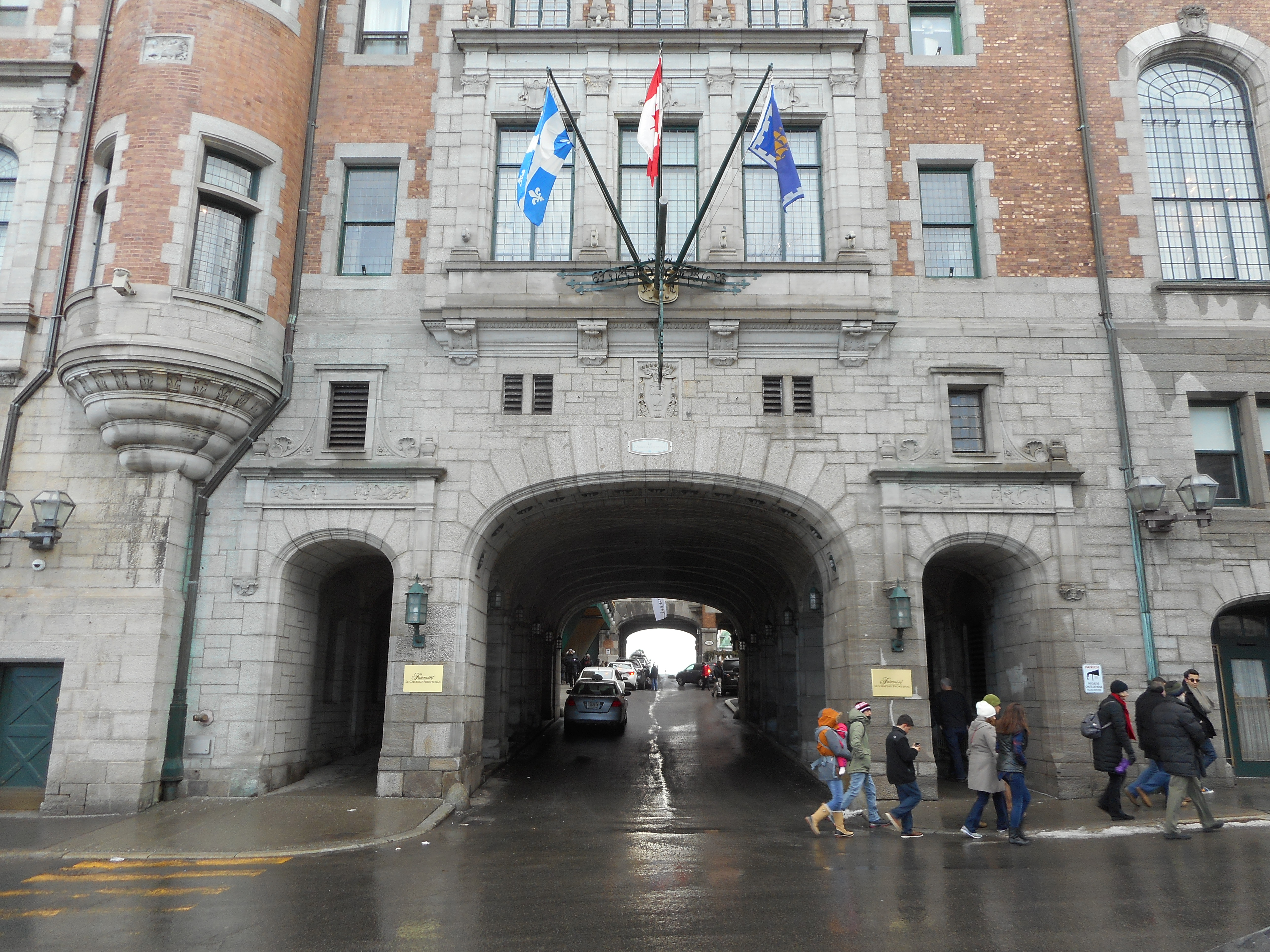
Chateau Frontenac
There is a hotel on a cliff in Quebec City that Winston Churchill and Franklin Roosevelt chose as the place to plan the final stages of World War II. It was not selected for its strategic position -- though the Chateau Frontenac does command a dramatic perch atop the Promontory of Quebec, overlooking the narrowing of the St. Lawrence River that gives the city its name (kebec, an Algonquin word meaning "where the river narrows"). Churchill and Roosevelt came because the hotel, even in wartime, was the kind of place that made serious business feel like an occasion. Designed by New York architect Bruce Price for the Canadian Pacific Railway and completed in 1893, the Chateau Frontenac is widely considered the most photographed hotel in the world, a copper-roofed fairy tale of towers and dormers that became the template for Canada's grand railway hotels and was designated a National Historic Site in 1981.
A Governor's Ghost on the Cape
The Chateau Frontenac stands on ground that has held power since the earliest days of European settlement. The cape beneath the hotel was the site of the Chateau Saint-Louis, home to the French governors of New France from 1620 until the building was destroyed by fire in 1834. The hotel takes its name from one of those governors, Louis de Buade, Comte de Frontenac, who governed the colony twice and became one of its most forceful leaders. In the 1870s, the British governor general Lord Dufferin launched an ambitious project to restore Quebec's 17th-century character, rebuilding the old city walls and planning to reconstruct the Chateau Saint-Louis. That plan evolved when the Quebec City Council and Board of Trade decided a grand hotel would better serve the area. After local financing fell through, businessmen connected to the Canadian Pacific Railway took over the project. Bruce Price designed a horseshoe-shaped building of four wings at obtuse angles, its Chateauesque style drawing on the Loire Valley castles of France -- a deliberate architectural nod to Quebec's French heritage.
Where World Leaders Gathered
The Chateau Frontenac's most consequential chapter came during World War II, when it hosted both Quebec Conferences. In August 1943, British Prime Minister Winston Churchill and American President Franklin D. Roosevelt met here to coordinate Allied strategy, including planning for the D-Day invasion of Normandy. They returned in September 1944, after D-Day had succeeded, to plan the final stages of the war. The hotel's suites still bear the names of its most famous guests: the Churchill Suite, the Roosevelt Suite, and the Trudeau-Trudeau Suite, named for two Canadian prime ministers -- Pierre Elliott Trudeau and Justin Trudeau -- who stayed in later decades. The themed rooms serve as a registry of power, linking a railway hotel in Quebec to the highest levels of 20th-century statecraft.
The Tower and the Skyline
The hotel as it stands today is the work of several architects across more than a century. Price's original 1893 design was expanded by William Sutherland Maxwell in 1908-1909 and again in 1920-1924, when Maxwell and his brother Edward added the central tower that gave the Chateau Frontenac its iconic silhouette. That tower made it the tallest building in Quebec City, a distinction it held until the Edifice Price was completed just northwest in 1930. The building rises 18 floors from its clifftop perch, its main entrance marked by porte-cocheres with large dormers and a cupola. Two public roads -- rue du Tresor and rue des Carrieres -- actually pass through the hotel grounds. Terrasse Dufferin, a boardwalk terrace, wraps around the hotel from northeast to southeast, offering visitors sweeping views of the St. Lawrence, the Lower Town, and the distant Laurentian hills. Further renovations in the 1990s, led by the Montreal firm Arcop, and a major $75 million overhaul after Ivanhoe Cambridge acquired the property in 2011, kept the building current while preserving its historic character.
Copper, Bees, and 70,000 Workers
The Chateau Frontenac's 610 rooms and suites contain unexpected details. On the rooftop, as part of Fairmont Hotels and Resorts' Bee Sustainable program, four queen honeybees preside over hives housing nearly 70,000 bees. The honey is harvested three times a year and used in the hotel's restaurants, which include the 1608 Wine and Cheese Bar, Bistro Le Sam, and the fine-dining Champlain. The rooftop apiary also operates a pollinator hotel for wild insects. When Ivanhoe Cambridge replaced the building's aging copper roofs in 2011, workers hung an image of the original roof on polypropylene safety netting around the scaffolding -- a trompe l'oeil curtain that hid the construction from tourists and photographers. The renovation gutted and rebuilt three-fifths of the hotel's rooms, expanded conference facilities, and modernized the lobby. In 2022, the Chateau Frontenac received the Global Hotel of the Year Award.
The Castle on the River
From the water, from the air, from the bridges and ferries that cross the St. Lawrence, the Chateau Frontenac is Quebec City. Its green copper roof and clustered towers rise from the cliff edge like a castle transplanted from the banks of the Loire to the banks of the St. Lawrence, which is exactly what Bruce Price intended. The Chateauesque style he pioneered here -- steep rooflines, round turrets, decorative dormers -- became the architectural language of Canadian grandeur, replicated in railway hotels from coast to coast. The building sits within the UNESCO World Heritage Site of Old Quebec, bounded by the city walls that Lord Dufferin rebuilt, above the cape where French governors ruled for two centuries. It has survived ownership changes, world wars, and multiple reinventions. Through it all, the Chateau Frontenac has remained what it was built to be: a monument to the idea that a hotel can be as memorable as the city it inhabits.
From the Air
The Chateau Frontenac sits at 46.812N, 71.205W on the Promontory of Quebec, the dramatic clifftop at the eastern edge of Old Quebec's Upper Town. From any altitude, its distinctive green copper roof and clustered towers are the most recognizable landmark in Quebec City. Terrasse Dufferin extends along the cliff edge to the southeast. The St. Lawrence River narrows dramatically below. Quebec City Jean Lesage International Airport (CYQB) is approximately 10 nm west. The hotel anchors the UNESCO World Heritage district of Old Quebec, with the Citadelle visible to the south and the Lower Town (Petit-Champlain) directly below the cliff.