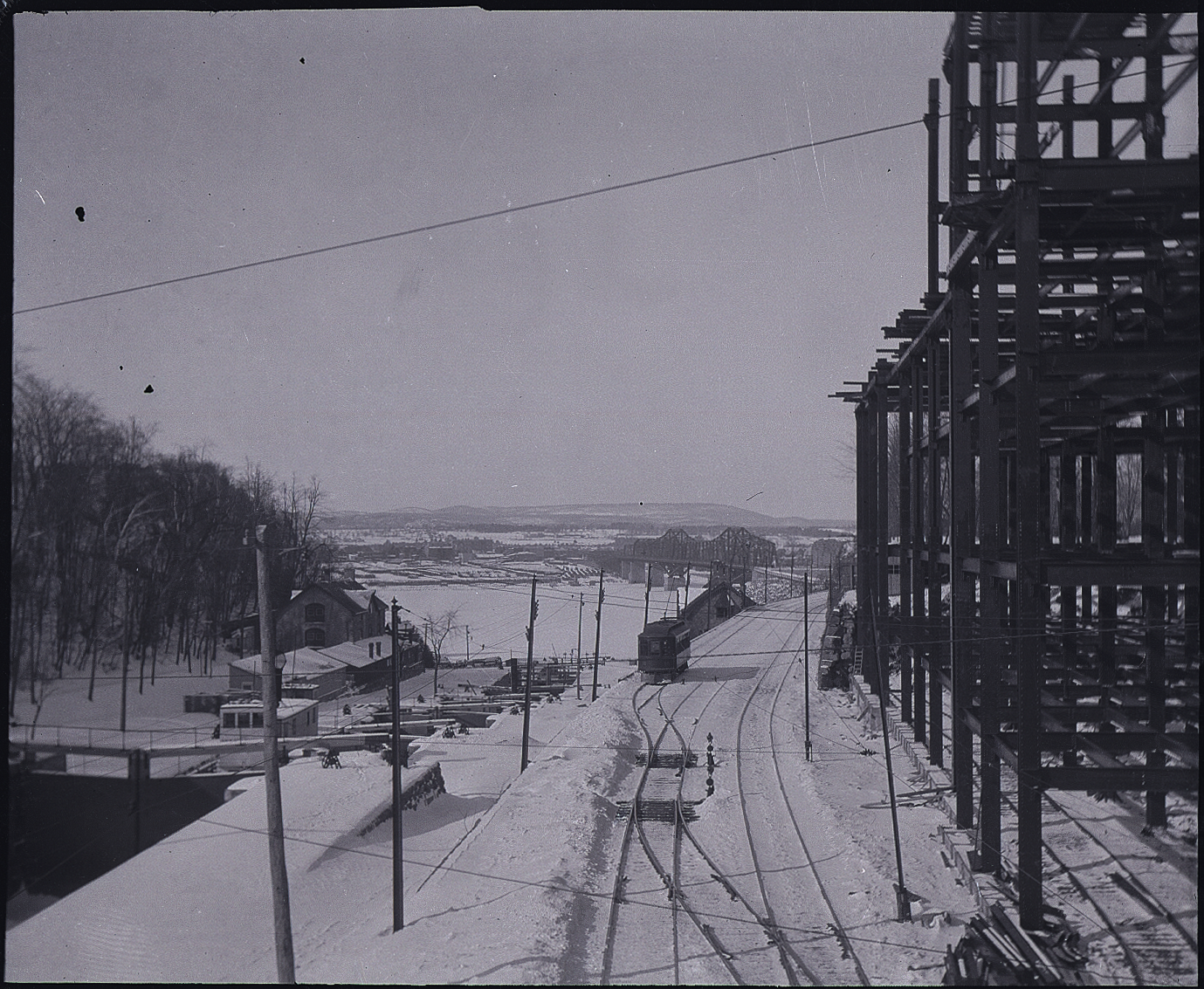
Chateau Laurier
Charles Melville Hays had a vision for a hotel that would rival anything in Europe. As president of the Grand Trunk Railway, he commissioned a French Gothic Revival chateau to stand across Rideau Street from Ottawa's Union Station, connected by an underground tunnel. Construction began in 1909. A grand opening was scheduled for April 1912. Hays boarded the Titanic to return from a European business trip in time for the celebration. He did not survive the sinking. Grand Trunk officials held a subdued opening ceremony on June 12, 1912, with Sir Wilfrid Laurier - the former prime minister for whom the hotel was named - in attendance. The Chateau Laurier has stood on its perch above the Rideau Canal locks ever since, designated a National Historic Site in 1980, its turrets and copper roof as much a part of Ottawa's skyline as the Parliament Buildings themselves.
A Castle for the Railways
The Chateau Laurier was built to serve Canada's railway age. The Grand Trunk Railway erected it alongside the new downtown Union Station (now the Senate of Canada Building) as a statement of corporate ambition and national purpose. The Chateauesque style - French Gothic Revival with steep copper roofs, turrets, and limestone walls - was chosen to complement the Parliament Buildings across the way. The original architect, Bradford Gilbert of New York, was dismissed after disagreements with Grand Trunk executives. The Montreal firm of Ross and Macfarlane completed the design. When the hotel opened, its 350 bedrooms included 155 with private baths, while others offered washstands with hot and cold water. Dormitories and communal bathrooms were available for budget travelers. Rooms for travelling salespeople came with sample tables for displaying goods. A private room cost two dollars per night. The sub-basement held the laundry, repair shops, and engineering departments that kept this small city within a city running.
Famous Residents and Hidden Studios
The Chateau Laurier has never been merely a place to sleep. From 1924 to 2004, the Canadian Broadcasting Corporation operated English and French radio stations from the seventh and eighth floors. Yousuf Karsh, the portrait photographer whose image of a scowling Winston Churchill became one of the most reproduced photographs of the twentieth century, maintained his studio and residence at the Chateau from 1972 to 1992. In the early 1960s, a young Alex Trebek - years before he became the host of Jeopardy! - lived and worked in the building. The hotel's reception rooms read like a catalog of design styles: the Wedgwood-blue Adam Room, the Laurier Room with its Roman columns, the Empire-style ballroom, and the Drawing Room decorated with cream and gold plaster ornament. The main dining room overlooks Major's Hill Park, while the grand corridor known as Peacock Alley was once Ottawa's place to see and be seen.
Decline, Revival, and the Cock and Lion
The 1960s and 1970s were not kind to the Chateau. The closure of Union Station removed a steady stream of railway guests, and new competing hotels opened across the capital. In 1965, the Jasper Lounge was redecorated as an English tavern called the Cock and Lion, featuring oak and old brick walls. Management replaced the male waiters with young women in low-cut tops - a decision the waiters' union contested in court and lost. The Westin Hotel opened directly across the street in 1983. Facing real decline, the owners undertook a major renovation in the 1980s that stripped away decades of accumulated kitsch: the dark wood lobby was lightened, the animal trophies and barbershop were removed, and the Cock and Lion was replaced by a skylit boutique mall. In 1985, Zoe's Lounge opened in a new glassed-in area overlooking Rideau Street, named for Zoe Laurier, the former prime minister's wife. Peacock Alley gave way to Wilfrid's, an elegant restaurant with views of Parliament, the Rideau Canal locks, and the Ottawa River.
The Battle for the Chateau's Future
In 2013, Capital Hotel Limited Partnership, an affiliate of Vancouver's Larco Investments, purchased the Chateau Laurier but retained Fairmont to manage it. Larco proposed an addition to the building that drew immediate public outrage. The modern design clashed sharply with the original Chateauesque architecture. Ottawa council voted to delegate approval to city staff in June 2018, but the backlash was unprecedented. A motion to revoke Larco's heritage permit until they submitted a design more sympathetic to the original structure was defeated by city council 13-10 on July 11, 2019. UNESCO weighed in, requesting that the extension be reassessed due to concerns about the integrity of views along the surrounding Rideau Canal, itself a World Heritage Site. The controversy highlighted a tension that defines heritage cities everywhere: how to accommodate growth without erasing the character that makes a place worth preserving.
Overlooking the Locks
The Chateau Laurier sits at one of Ottawa's most storied intersections - Rideau Street and Sussex Drive, above the Colonel By Valley where the Ottawa Locks of the Rideau Canal step down to the Ottawa River. The hotel is one of the first landmarks visible from the air when approaching Ottawa from the east, its copper-green roofline and limestone turrets rising beside Parliament Hill. The tunnel that once connected it to Union Station still runs beneath Rideau Street. The hotel's 429 rooms look out over the canal, the river, and Major's Hill Park. In winter, the Rideau Canal Skateway passes directly below. In the century since a railway president's ambition and a transatlantic tragedy shaped its opening, the Chateau Laurier has remained Ottawa's defining hotel - a building where prime ministers, photographers, and game show hosts have all called home.
From the Air
Located at 45.43°N, 75.70°W at the intersection of Rideau Street and Sussex Drive in downtown Ottawa. The Chateau Laurier's distinctive Chateauesque turrets and green copper roof are visible from altitude adjacent to Parliament Hill and the Rideau Canal locks. The hotel sits above the Colonel By Valley where the Ottawa Locks connect the Rideau Canal to the Ottawa River. Major's Hill Park is to the north, and the Senate of Canada Building (former Union Station) is directly across Rideau Street. Ottawa Macdonald-Cartier International Airport (CYOW) is approximately 10 km south. Best viewed at 2,000-3,000 feet AGL for architectural detail.