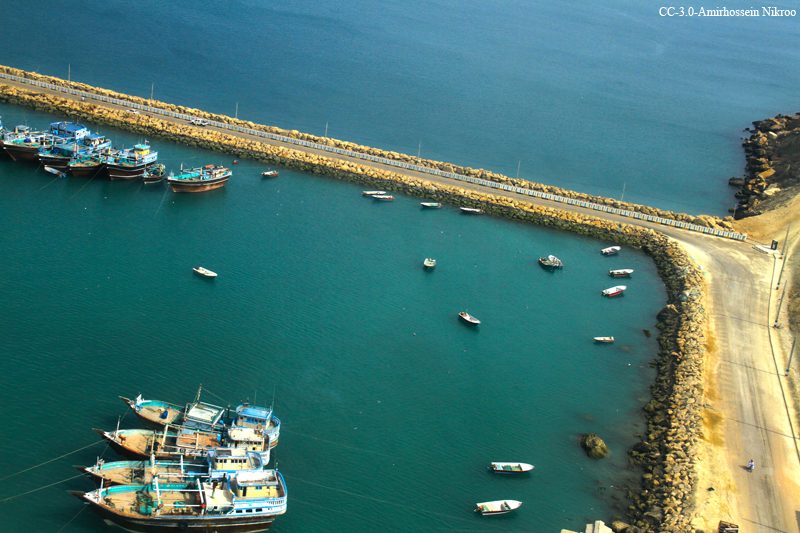
Chabahar Port
A port city known to Ptolemy as 'Tesa' is now the most contested piece of maritime infrastructure between the Persian Gulf and the Indian subcontinent. Chabahar Port, on Iran's southeastern Makran coast, is the country's only deep-water facility with direct access to the Indian Ocean. It sits 170 kilometers west of Pakistan's Gwadar port, 353 nautical miles from Dubai, and 843 nautical miles from Mumbai. For India, it represents a way to reach Afghanistan without crossing Pakistani territory. For Iran, it is the key to developing its neglected eastern provinces. For everyone else, it is a case study in how geography, sanctions, and ambition collide.
The Golden Gate
Chabahar's appeal is geometric. It is closer to Afghanistan's border than Karachi by 800 kilometers. It offers landlocked Central Asian nations -- Turkmenistan, Uzbekistan, Tajikistan -- their nearest warm-water port access. The ancient port of Tis, in Chabahar's neighborhood, dates to Sasanian times. The medieval scholar Alberuni wrote that the sea coast of India commenced with Tis. Portuguese forces under Afonso de Albuquerque controlled the area until 1621. The strategic logic has remained constant for two thousand years: whoever holds this stretch of coastline controls a gateway between oceans and continents.
Revolution, War, and a Port Reborn
The last Shah of Iran first proposed developing Chabahar in 1973. The Iranian Revolution delayed everything. When the first phase opened in 1983, it was driven by necessity: the Iran-Iraq War made Persian Gulf ports vulnerable to Iraqi air attacks, forcing Iran to shift seaborne trade eastward. Between 1982 and 1983, Iran constructed berths at two facilities -- Shahid Kalantari and Shahid Beheshti. Larger berths followed in 1997 and 2004. But Chabahar remained underutilized. Ninety percent of Iran's population lives in the western half of the country, and Bandar Abbas, which handles eighty-five percent of Iran's seaborne trade, absorbed the attention and investment.
India's Gambit
India and Iran first agreed to develop Shahid Beheshti port in 2003, but international sanctions froze the plan. The thaw came in 2016, when India signed an $8 billion investment deal encompassing the port, a free trade zone, an aluminum smelter, and rail links. In October 2017, India sent its first shipment of wheat to Afghanistan through Chabahar. By December 2018, India had taken over port operations. The vision was ambitious: a multimodal corridor connecting Indian ports to Afghanistan's ring road and onward to Central Asia via the 7,200-kilometer North-South Transport Corridor. In February 2019, Afghan trucks carrying dried fruits, textiles, and carpets were dispatched from Zaranj to Chabahar for shipment to Mumbai.
Sanctions and the Unraveling
The re-imposition of American sanctions against Iran after 2018 chilled the project. Foreign companies withdrew. Only ten percent of the port's 8.5-million-ton capacity was utilized in 2019. The $1.6 billion Chabahar-Zahedan railway stalled; in 2020, Iran proceeded with construction independently after India could not deliver promised funding. The United States exempted the port project from sanctions in November 2018 due to its economic importance to Afghanistan, but the exemption provided limited reassurance to investors. By 2026, reports surfaced that India was considering exiting the port entirely, though the Indian government denied this while acknowledging it was negotiating with Washington for an extension of the waiver.
Two Ports, One Coastline
The comparison with Gwadar is unavoidable. Pakistan's Chinese-funded deep-sea port sits just 76 nautical miles east on the same Makran coast. Both ports claim to offer Central Asia a gateway to the sea. Both are embedded in larger geopolitical frameworks -- Chabahar in India's strategic calculus, Gwadar in China's Belt and Road Initiative. The competition is less about tonnage than about which vision of connectivity prevails in a region where ancient trade routes are being redrawn by modern rivalries. For now, Chabahar operates well below capacity, its cranes and terminals waiting for a geopolitical alignment that keeps shifting out of reach.
From the Air
Coordinates: 25.30N, 60.60E, on Iran's southeastern Makran coast in Sistan and Baluchistan Province. The port facilities are visible from 8,000-12,000 ft with the two separate port areas (Shahid Kalantari and Shahid Beheshti) identifiable. Chabahar Airport (OIZC) is nearby. Pakistan's Gwadar is 170 km east. Hazy conditions common along the coast.