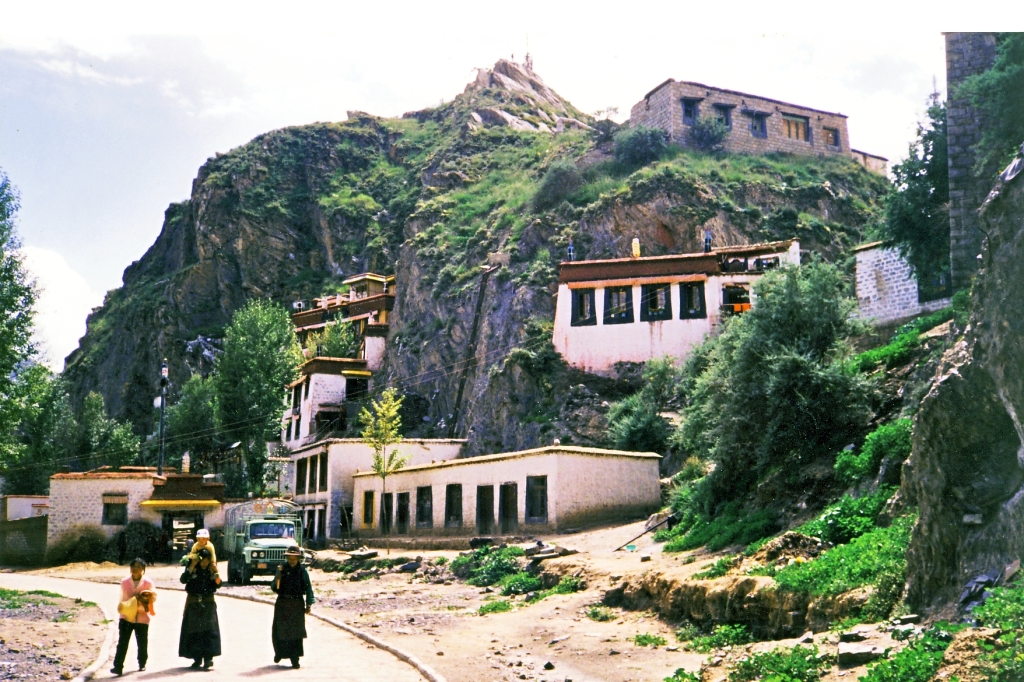
Chagpori
Its name means "Iron Mountain," but Chagpori has always been more fragile than iron. This rocky hill in the heart of Lhasa, rising just south of the Potala Palace, carried on its summit one of the most important medical institutions in Asian history. For 263 years the Chagpori College of Medicine trained physicians in the art of Tibetan healing, drawing students from across Central Asia. Then, in March 1959, People's Liberation Army artillery shells tore it apart. Today a communications antenna stands where monks once studied the Four Tantras.
The Soul-Mountain of Vajrapani
Tibetan tradition holds that the three main hills of Lhasa represent the "Three Protectors of Tibet." Marpori, the Red Hill where the Potala Palace stands, embodies Chenresig, the bodhisattva of compassion. Pongwari represents Manjushri, bodhisattva of wisdom. And Chagpori belongs to Vajrapani, the bodhisattva of power. As one of the four holy mountains of central Tibet, Chagpori anchored the spiritual geography of the city long before any building crowned its summit. Rock carvings at the base of the hill may date to the reign of King Songtsen Gampo in the 7th century, some of them painted by Nepalese artists. A spur of rock once connected Chagpori to Marpori, and at this junction stood the Pargo Kaling, a spired reliquary with an arch that served as Lhasa's western gate. The British expedition of 1904 photographed the gateway framing the road between the two sacred hills, the Potala towering on the left and Chagpori's temple on the right.
A College Built on Monk Tax
In 1696, Sangye Gyatso, the powerful regent serving the 5th Dalai Lama, founded the Chagpori College of Medicine on the hilltop. The college incorporated a recently restored temple built by the legendary Thang Tong Gyalpo and was funded through an ingenious system: revenue-generating lands supported the institution, while a "monk tax" ensured a constant supply of students. The curriculum drew from the Four Tantras, a comprehensive medical treatise compiled at Samye Monastery in the 8th century and re-edited in the 12th century. Chagpori taught not only medicine but also astrology, and its graduates carried their knowledge across Tibet and Central Asia. By 1916, the 13th Dalai Lama expanded the institution by establishing the Men-Tsee-Khang, the Medical and Astrological Institute, on the same hill. In 1947, Austrian mountaineer Peter Aufschnaiter stood on the college roof with a theodolite, surveying Lhasa's layout while Heinrich Harrer photographed him, two European refugees finding purpose in a city that would soon face its own upheaval.
Twelve Minutes of Artillery
In March 1959, as the Lhasa uprising erupted, Tibetan defenders positioned a cannon atop Chagpori. The response was devastating. PLA artillery targeted the hilltop, destroying the medical college, the Men-Tsee-Khang, and a temple that had housed statues of Tsepame in coral, Tujechempo in mother of pearl, and Green Tara in turquoise. Jampa Phuntsok, a monk of Namgyal Monastery, later recalled the destruction. The Pargo Kaling gateway was demolished in 1967 during the Cultural Revolution, though it was rebuilt in 1995. A road was cut through the spur that once connected Chagpori and Marpori, severing the physical link between the two holy hills. The medical tradition, however, proved harder to kill than the buildings that housed it. In 1992, the Chagpori College of Medicine was reestablished in Darjeeling, India, continuing the lineage that Sangye Gyatso had started nearly three centuries earlier.
What the Carvings Remember
Some rebuilding has taken place on Chagpori since 1959, and remarkably, a number of ancient rock carvings at the base of the hill survived both the artillery bombardment and the Cultural Revolution. Scholars believe some were carved during the reign of Songtsen Gampo, who ruled from approximately 605 to 649 CE, making them among the oldest artistic works in Lhasa. The painted stones endure as quiet witnesses to a continuity that politics and artillery could not entirely erase. From the Potala's rooftop, Chagpori is visible as a bare hill with an antenna where a medical college once stood. The contrast tells Lhasa's modern story as clearly as any monument could. Below the antenna, the rock carvings persist, their colors fading under the high-altitude sun but their forms still legible after fourteen centuries.
From the Air
Chagpori sits at 29.652N, 91.109E at approximately 3,700m elevation, immediately south of the Potala Palace in Lhasa. The antenna on its summit is a useful visual reference. Lhasa Gonggar Airport (ZULS) is approximately 60km to the southwest. At this altitude, expect thin air and variable mountain weather. The hill is best identified by its proximity to the Potala and the contrast between its bare summit and the palace complex.